
World’s only professor of joik shares experience composing for Frozen
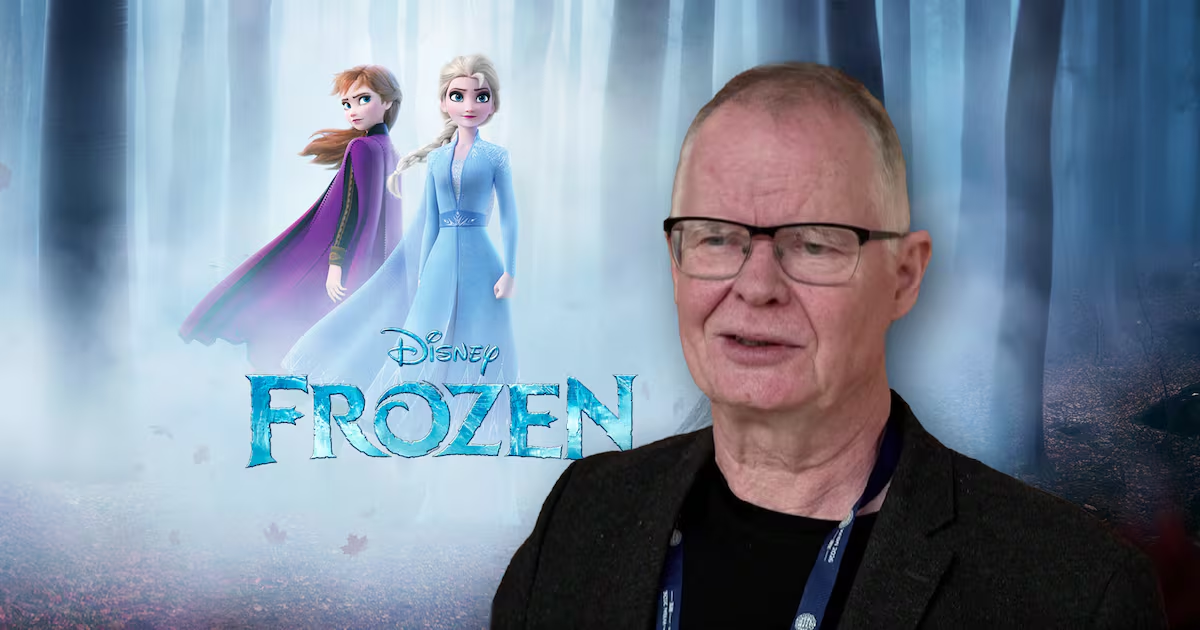
Frode Fjellheim is known around the world as the powerful voice behind the opening music of Disney’s global hit Frozen. Beyond the screen, the South Sámi musician and professor is helping to ensure the sound of joik is preserved for generations to come.
His composition, Eatnemen Vuelie (Song of the Earth), was adapted for the opening song for Frozen, bringing the sound of Sámi joik to audiences around the world.
Fjellheim was a guest speaker at the World Indigenous Broadcasters Conference held in Kautokeino, Sápmi, Norway, earlier this month where he shared his experience working with Disney to Te Ao Māori News.
“Disney came to Trondheim, where I live. They wanted to research for some material for doing this film,” says Fjellheim.
There, the Disney team listened to some of Fjellheim’s music and asked if they could use it in the film.
“I recomposed a new composition that was suitable for this film but used joik as an element that would also contribute to tell a story that would fit into the Frozen movie theme. It’s a simple joik that is the place where we live with various structures.”
The name of the song is Vuelie, also co-composed by Christophe Beck, sung by the Norwegian women’s choir Cantus.
Fjellheim describes joik as a Sámi vocal tradition.
“You use your voice in a special way to communicate with other Sámi people, but it can have a lot of functions.”
He says an example would be creating a joik about a mountain to preserve knowledge about the landmark, including how it is shaped, how it can be used and whether it has interesting plants that are edible.
“A joik can be something from the past and you can joik something that is not easy to describe using Western languages.”
Fjellheim is the world’s only professor of joik. For the last 15 years, he has run a course at Nord University, Lavanger, teaching joik.
“I teach people how to joik, explain what joik is and how knowledge could be transferred in the joik.”
For Fjellheim, preserving Sámi culture is important because it is intrinsically connected to protecting and caring for the land.
“In the world today, we haven’t been clever taking care of the land, the nature in the way that it should be done. So, I think indigenous knowledge is as important as ever, he says.
“We could listen to Indigenous people from all over the world who have a knowledge that is important today because we mustn’t abuse the nature because nature is all we have.”
Fjellheim says that, through his work as a musician and professor, it has been a pleasure conveying knowledge about the Sámi culture.
“Knowledge is the key word today. If we have a lot of knowledge about each other’s cultures, I think the world will be easier.”
Related Stories
 World
World
Trump rejects Iran’s proposal to reopen the Strait of Hormuz
23 minutes ago
 World
World
Japan duo prevail in Pair Go tournament | NHK WORLD
1 hour ago
 World
World
2026 MLB playoff predictions: Expert picks for entire postseason bracket, including World Series champion
2 hours ago
 World
World
Kevin Pietersen promises to challenge Brendon McCullum as England white
3 hours ago
 World
World
Tkʼemlúps te Secwépemc chief says ‘white nationalist’ group protested on reserve
3 hours ago
 World
World
Commentary: Dystopia, Inc
4 hours ago
 World
World
News media must stay relevant or 'society will struggle', says World News Day boss
5 hours ago
 World
World
FIM Board of Directors holds third meeting of 2026 in Agadir
6 hours ago