
Winnipeg
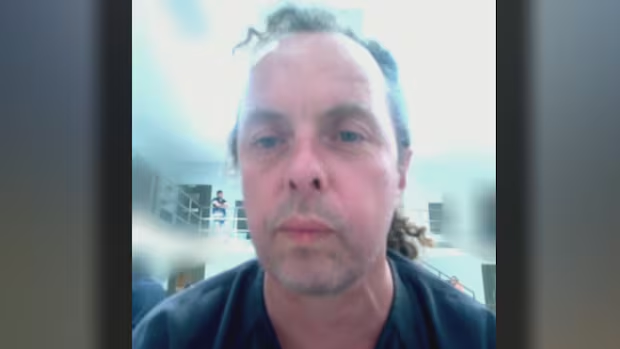
Winnipeg-born man deported back to Canada after 9 months in ICE detention
Clayton Herman was taken into ICE custody in October 2025, released in June, taken back into custody in July
A Winnipeg-born Canadian citizen has been deported back to Canada after a harrowing nine and a half months behind bars in a California ICE detention centre, where he says he endured poor food, mouldy walls and lack of proper medical care.
Clayton Herman landed in Vancouver on Aug. 26 with little more than the clothing on his back and a cellphone, after being escorted to the plane by detention officers who stood guard until the hatch was sealed and the plane rolled onto the tarmac.
Herman says he's ambivalent about leaving the life he built in Ojai, Calif., where he had become part of the community.
"One relief is that I'll never have to be held in chains again, in a concrete blockhouse behind razor wire," Herman said in an interview from the home of a friend of a friend who put him up for a few weeks.
Herman had been taken into custody in the U.S. in October 2025, after he was accused of violating his supervision conditions based on readings from what he called a "glitchy" location monitoring device.
He had entered the U.S. legally through a port of entry 20 years earlier, but had long overstayed his visa. He had reported regularly in person to U.S. Immigration and Customs Enforcement since 2022, as he waited for his visa overstay case to be heard in court.
Canadian who was held in ICE facility for months back in detention despite judge's ruling rights were violated
After being held for eight months, he was released in mid-June, but was taken back into custody at an ICE office on July 21, when he went for a routine check-in as his case moved through the U.S. immigration system.
Lack of ID can trap people in cycle: SEED Winnipeg
Though he's now back in Canada, Herman still faces challenges.
He knows when he leaves his current accommodations, he could be unhoused for a while, since he has no job and no identification.
Herman had to surrender a temporary emergency travel document issued by Global Affairs Canada as he passed through customs in the Vancouver airport.
"If I have to rough it for a while, I have no fear of that. I've done that before," Herman said. "And it's better than being in that inhumane conditions of that filthy, concrete, razor-wired blockhouse down south."
People who lose ID documents face barriers to getting housing, jobs, health-care and government benefits, said Jennifer Bogoch, a manager at SEED (Supporting Employment and Economic Development) Winnipeg. The non-profit runs a program that helps people get ID documents for free.
"It's really a fundamental piece of being included in society," Bogoch said.
Losing identification can make it hard to access the stability and other documentation a person needs to get ID, trapping them in a vicious cycle, she said.
"It takes time, it takes money to replace it. Those barriers can really be compounded for people who are living on a low income, who are experiencing trauma, who are without stable housing, who don't have a safe place to keep it."
Herman says he needs to find a place to live before he can be reunited with his beloved cats, Poquito and Butters, who he had to leave behind in California.
Other detainees face worse fate: prof
Sharry Aiken, a law professor at Queen's University in Toronto, says there are thousands of people locked up in ICE detention centres who are suffering a worse fate than Herman.
Some detainees have been deported to countries where they have no connection.
Others, many from Latin America and other nations in the global South, face "a prospect not of departure to Canada, but potentially removal to countries where their very lives are at risk," Aiken said in a July interview with CBC News.
Among them are Haitian detainees, who no longer have the temporary protected status granted after a 2010 earthquake that killed more than 300,000, could be sent back to a country the U.S. State Department has told citizens to avoid due to the risk of "crime, kidnapping, terrorism, unrest and limited health care."
And Aiken notes many migrants in the U.S. who try to flee to Canada are turned away because of the Safe Third Country Agreement, under which refugees who first arrive in the U.S. are barred from seeking asylum in Canada, barring certain exceptions.
Federal Court challenge says Canada failing to protect refugees turned back to U.S.
That agreement needs to end because of the "brazen cruelty" of ICE enforcement and detention, said Aiken.
"Canada is continuing to remove people to the United States and subject them to detention and deportation," as a result of that agreement, she said.
"We shouldn't have it. It should be suspended in light of what's going on."
Immigration, Refugees and Citizenship Canada did not respond to a request for comment prior to publication.
Winnipeg-born man back in Canada after months in ICE detention
While Herman is working to put his life together in Canada, he's also dedicating himself to protesting the conditions in ICE facilities.
He's started by writing a 12-page document that details the facility in Adelanto, Calif., where he was held — a for-profit ICE detention centre run by the Geo Group that Herman describes as a "hellhole."
Winnipeg-born Canadian released from U.S. immigration detention after 8 months in 'hellhole'
He wants to let the world know what is going on behind its gates, he said.
"I feel sorry for what people are going through down there."
Joanne Levasseur is a producer for the CBC News I-Team based in Winnipeg. She has worked at CBC for more than two decades.
Related Stories
 Canada
'This is not going to stop us,' Belleville, Ont., synagogue president vows after shooting incident
5 minutes ago
 Canada
Winemakers group pushes spotted lanternfly public awareness after 1st Canadian detection
5 minutes ago
 Canada
Canadian artists grapple with U.S. tariffs, find new buyers amid trade war
1 hour ago
 Canada
MPs are heading back to Parliament Hill. Here's what to watch this sitting
1 hour ago
 Canada
Decades later, family renews search for 17-year
1 hour ago
 Canada
Trump seeks ‘massive’ Belarus fertiliser deal amid Canada trade war
2 hours ago
 Canada
Families of first
2 hours ago
 Canada
Forever Canadian kicks off official campaign for 'remain' side in Alberta referendum
3 hours ago