
Will the Alberta
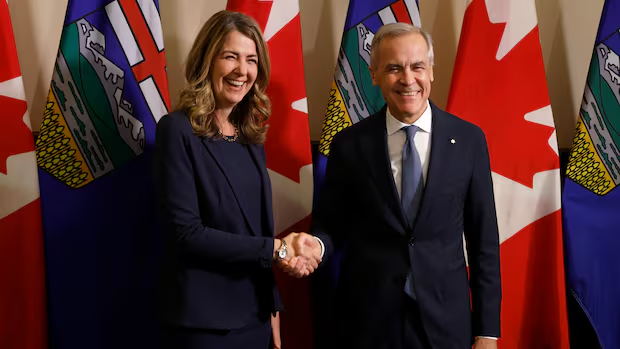
Will the Alberta-Canada carbon pricing deal work? A new analysis is skeptical
Canadian Climate Institute says reductions are 'not really significant'
A new analysis shows the Carney government's pipeline deal could lead Canada further from its climate targets, even with an agreement on carbon pricing.
The independent Canadian Climate Institute modelled the impact of the new deal between Alberta and Ottawa on carbon pollution. Compared with the emissions trajectory before the deal was signed, the institute's analysis found Canada's emissions would remain largely unchanged and might even grow.
"The emissions reductions we are getting out of the deal are not really significant," said Dave Sawyer, the institute's principal economist.
In May both levels of government signed an implementation agreement to build a potential pipeline to the West Coast. The federal government promised it would "reduce emissions, and build a stronger economy" and establish a "stronger" carbon pricing system.
Neither Ottawa nor Alberta has released any of their own emissions modelling to back those claims.
Canada and Alberta agreed to an effective carbon price of $130 per tonne by 2040, which will apply across the country. The new deal weakens and delays the price increase, which was supposed to rise to $170 per tonne by 2030.
In a report accompanying the analysis, the Canadian Climate Institute found carbon pollution levels would be left unchanged "in the best case" or increase in the "worst" case.
Any reductions achieved may not be large enough to offset a new pipeline, which would add an output of 1.4 million barrels of oil per day and "ultimately" keep emissions on a "high trajectory through the middle of the century," the report states.
Alberta accounts for nearly 40 per cent of Canada's total greenhouse gas pollution due to its high-emitting oil and gas sector.
The province for years has levied a price on the carbon emissions for large emitters through its own industrial carbon pricing system. The system, formally called the Technology Innovation and Emissions Reduction Regulation or TIER, created a carbon market.
Alberta considering 3 pipeline routes through northern B.C.
Facilities that reduced their emissions earned carbon credits and could sell them to competitors that needed to buy them. But changes to TIER led to an oversupply of low-priced credits that traded at one point at $20 per tonne instead of where the target price currently sits at $95.
The agreement on carbon pricing commits to implementing a price floor for those credits, but Sawyer said the institute is not convinced that the price mechanism will actually work.
"The assumption that emissions will be lower really hinges on the successful implementation of this price floor, which looks to be really complex and fundamentally a challenge to implement given what they have done to the market," Sawyer said.
Two weeks after signing the new deal, Alberta's carbon market seems to be heading in the wrong direction. Prices for TIER carbon credits in Alberta have fallen by 25 per cent, from around $42.25 per tonne to $31.50, according to Quantum Commodity Intelligence, a price reporting agency.
Uncertainty about how effective that price floor will function, plus weaker benchmark tightening and continued problems with an oversupply of credits, led the institute to conclude that Canada's emissions would be left worse off after the Alberta-Canada pipeline deal.
Senior reporter, Parliamentary Correspondent
David Thurton is a senior reporter in CBC's Parliamentary Bureau. He covers daily politics in the nation’s capital and specializes in environment and energy policy. Born in Canada but raised in Trinidad and Tobago, he’s moved around more times than he can count. He’s worked for CBC in several provinces and territories, including Alberta and the Northwest Territories. He can be reached at david.thurton@cbc.ca
Related Stories
 Canada
Conservatives want the Liberals to release the rejected U.S. trade deal. Should they?
44 minutes ago
 Canada
California governor ’absolutely’ believes Trump will restart trade talks with Canada in ’a matter of days’
45 minutes ago
 Canada
U.S. ‘withdrawing’ demands on Canadian content, bilingual labelling: LeBlanc
45 minutes ago
 Canada
Federal government removes seafood and fish products from counter
1 hour ago
 Canada
‘Lake Ontario, that’s gone,’ Trump says; U.S. takes Canadian culture off table. Follow for live updates.
1 hour ago
 Canada
'So relieved': 91-year
1 hour ago
 Canada
'Visual symbol of climate change': Mount Robson's Berg Glacier no longer reaches lake
1 hour ago
 Canada
Ottawa removes counter
2 hours ago