
Conservatives want the Liberals to release the rejected U.S. trade deal. Should they?
Conservatives want the Liberals to release the rejected U.S. trade deal. Should they?
Poilievre argues American negotiators have seen deal, says Canadians deserve to know what was on offer
Conservatives are calling on the Liberals to release the text of the U.S. tariff agreement that the federal government ultimately rejected last week. While one expert argues there is some merit to showing that level of transparency for the sake of national unity, others suggest it would ultimately hurt Canada's negotiation position.
U.S. President Donald Trump slapped 50 per cent tariffs on hundreds of Canadian imports over the weekend after negotiators failed to secure some form of trade agreement — even though there were indications that progress was being made.
Prime Minister Mark Carney said the Americans "asked too much and offered too little" for the government to settle on a final agreement.
Conservative MPs have been calling on Carney to be fully transparent about the details in the agreement that the government turned down.
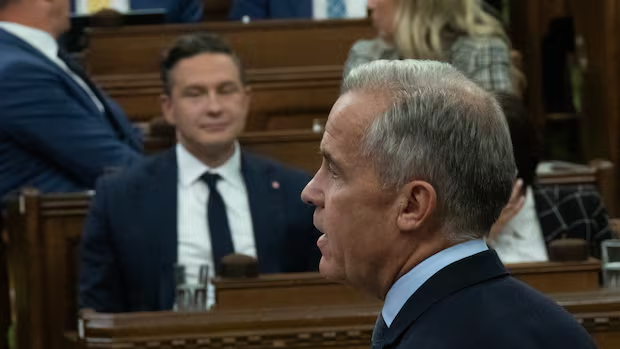
"Canadians deserve to know what is the deal that the prime minister at first planned to accept and later decided to reject. Release the proposed text," Conservative Leader Pierre Poilievre said in a news conference on Tuesday.
"Canadians deserve to know what was on the table so all of us can know what we are fighting for and what we are fighting against."
‘Canadians deserve to see’ dead U.S. trade deal: Poilievre
For his part, Bloc Québécois Leader Yves-François Blanchet said in a French-language interview with Radio-Canada's Midi info that he's not against the government releasing those details.
"I'm open to it, but it's not an imperative for me as it would have been the case if a deal would have been reached," Blanchet told host Alec Castonguay on Wednesday.
Lawrence Herman, a trade lawyer and senior fellow with the C.D. Howe Institute, told CBC News that it would "be a total mistake" for any government to release that level of detail around trade talks.
"Trade negotiations are highly delicate matters that have to be dealt with behind closed doors. It's just the way the world works when we're dealing with trade talks," he said.
Herman suggested that putting out full details of what was on offer would tip the government's hand in future talks.
"We may be sitting down with the Americans, I think, at some point in the future and talking to them again. You don't want to have all kinds of political gamesmanship surrounding papers that Canada might have put on the table during the suspended negotiations."
U.S. trade rep disputes why talks fell apart | Canadian exclusive
But Carlo Dade, the international policy director and head of the New North America Initiative at the University of Calgary, said there is merit to being fully transparent given that much of what the U.S. is asking from Canada had been put on the table with other countries.
"The Americans aren't constructing a whole new set of negotiations and demands for us. They're resetting the global trade agenda," Dade told CBC news.
"This is not just about Canada. This is a larger global process and as we continue to think about this only as Canada, we miss the forest for the tree that we're looking at right now."
Feds announce 'dollar-for-dollar' counter-tariffs on billions in U.S. imports
Asked about Poilievre's call to release a draft of the deal, Finance Minister François-Philippe Champagne argued that key details had been publicly reported in the media.
"This is probably the most publicly advertised negotiation of a trade agreement I can recall," he told reporters in Ottawa on Tuesday.
"In terms of transparency I think Canadians have been able to follow that on a daily basis."
'No national secrets,' Poilievre says
On Tuesday, Poilievre argued that if the two sides were close to an agreement, American negotiators would have seen much of what Canada was offering at this point.
"There are no national secrets in that text. It's already been shown to the United States' administration." Poilievre said.
But Jason Kenney, a former Conservative cabinet minister and Alberta premier, told CBC Radio's The Current that it might not be that simple.
"There wouldn't be a final text that was subject to negotiations," Kenney told guest host Susan Ormiston.
"In contexts like this, there are lots of different texts flying back and forth, different versions, a lot of it is happening verbally."
California governor says Carney is ‘playing this well’ in Trump trade fight
Kenney also suggested that negotiations should remain confidential, although he agreed with Poilievre's suggestion that Parliament be recalled to discuss the ongoing trade dispute.
Even though Herman argued that trade talks need to remain largely confidential, he said the government does need to have some level of transparency. He specifically said the government needs to lay out its broad goals for trade talks, but added that he thinks the current government has done that.
While Dade thinks the government should release the details of the talks, he did agree that Canada is in a unique circumstance compared to other countries because the Canada-U.S.-Mexico Agreement is still subject to review.
But Dade suggested the CUSMA review might be a "minor point" given that Canada is also the only country subject to tariffs under Section 338 of the U.S. Tariff Act, or the Smoot-Hawley Act.
Section 338 is what Trump used to impose the latest round of tariffs and Dade suggested they can be used as a "divide and conquer" tactic.
A CBC News analysis of the goods that now have a 50 per cent tariff suggests the levies are hitting provinces to various degrees. But Dade said that Section 338 can also be used to level tariffs against a specific good from one province while leaving it off another province.
"The administration [could] decide it has the authority under Section 338 to say liquor from B.C. and Ontario, no [tariffs]. Wine from Nova Scotia, yes [tariffs]. So that creates a further potential for the Americans to divide and conquer," he said.
"Under that scenario, national unity is more important than it is with your normal trade negotiation."
Dade argued that, according to his own research, the government needs to be transparent about what each province would need to give up in a successful negotiation or suffer through if a deal isn't reached to ensure the U.S. can't set jurisdictions against one another.
"By not providing details, we create the fuel for division. We create the fuel for uncertainty in Canada and it's uncertainty that leads to division between the provinces" if the government isn't transparent, Dade said.
Darren Major is a senior writer for CBC's parliamentary bureau in Ottawa. He previously worked as a digital reporter for CBC Ottawa and a producer for CBC's Power & Politics. He holds a master's degree in journalism and a bachelor's degree in public affairs and policy management, both from Carleton University. He also holds a master's degree in arts from Queen's University. He can be reached at darren.major@cbc.ca.
Related Stories
 Canada
Ratko Mladic, ex
6 minutes ago
 Canada
2 Air Canada employees arrested by RCMP in connection with alleged drug trafficking
7 minutes ago
 Canada
U.S. confirms language, culture protections won’t be subject to trade actions: LeBlanc
7 minutes ago
 Canada
Blockbuster Sale: Save big on select digital games!
7 minutes ago
 Canada
Chapman’s Ice Cream pledges no price increase as Ontario company shifts away from U.S. suppliers
7 minutes ago
 Canada
30 Canadians missing after flash floods in Nepal and China, officials say
7 minutes ago
 Canada
California governor ’absolutely’ believes Trump will restart trade talks with Canada in ’a matter of days’
1 hour ago
 Canada
U.S. ‘withdrawing’ demands on Canadian content, bilingual labelling: LeBlanc
1 hour ago