
Why the Politics of Permanent Enemies Can No Longer Govern India
Every political ideology eventually encounters the limits of its own imagination. That moment arrives not when it loses an election, nor when its leaders become unpopular, but when the explanations it offers for society’s condition cease to correspond with the lived experience of the people. Political power can survive many crises, but it cannot indefinitely survive intellectual exhaustion. Governments may continue to command parliamentary majorities, dominate institutions, shape media narratives and project an image of invincibility, yet still discover that they have gradually forfeited something more fundamental than electoral advantage: they have lost the capacity to persuade society that they understand the nation they claim to govern. It is this deeper crisis, rather than the fortunes of any political party, that increasingly defines contemporary India.
The recent assertion by RSS leader Indresh Kumar that “internal and external powers do not want India to become a developed nation” deserves serious attention, not because it offers an explanation of India’s present condition, but because it reveals an enduring characteristic of the ideological universe inhabited by the Sangh Parivar. For decades, its political vocabulary has rested upon the assumption that India is perpetually endangered by hostile forces operating from within and without, and that every national difficulty is ultimately attributable to the machinations of those who oppose its civilisational vision. Such a worldview possesses an undeniable emotional appeal because it relieves those who wield power of the burden of self-examination. If every failure can be explained by conspiracies, then governance itself is never required to account for its own shortcomings. The search for enemies becomes a substitute for the search for truth.
This is neither an accidental nor an isolated rhetorical habit. It is, rather, the organising principle of an ideology that has always understood politics less as the art of democratic negotiation than as the perpetual mobilisation of society against imagined threats. Every ideological project that seeks to define the nation through cultural homogeneity inevitably develops a corresponding need to identify forces responsible for obstructing that imagined unity. The existence of the enemy becomes indispensable to the coherence of the ideology itself. Remove the enemy, and the narrative begins to unravel because it must then confront a more uncomfortable possibility: that the nation’s deepest problems arise not from hidden conspiracies but from visible failures of governance.
The irony could scarcely be greater. The Bharatiya Janata Party has governed India for more than a decade with an authority unmatched in recent political history. It commands overwhelming institutional resources, possesses formidable organisational machinery, exercises unprecedented influence over the national political discourse, and has enjoyed the advantages that accompany sustained incumbency. If, after twelve years of such extraordinary concentration of power, its leading ideologues continue to insist that unnamed domestic and international forces are preventing India from achieving development, then they have unwittingly offered the most devastating indictment of their own record. Governments cannot plausibly claim unrivalled authority while simultaneously portraying themselves as helpless victims of invisible adversaries. Either they possess the capacity to govern or they do not. Political maturity demands that those entrusted with power accept responsibility for outcomes rather than perpetually transferring responsibility to anonymous enemies.
The deeper issue, however, extends far beyond questions of administrative competence. What confronts India today is not merely the failure of particular policies but the gradual exhaustion of a governing philosophy. Every society produces contradictions. Democratic governments respond by investigating those contradictions, engaging dissent, revising policies and strengthening institutions capable of self-correction. Authoritarian tendencies respond differently. They transform contradictions into acts of disloyalty, convert criticism into sedition, redefine disagreement as hostility to the nation, and elevate conformity into the highest expression of patriotism. The consequence is that governments progressively lose the ability to learn from the societies they govern. They become prisoners of their own certainties.
Antonio Gramsci observed that ruling classes maintain authority not simply through the instruments of the state but through what he described as moral and intellectual leadership. Power becomes durable when people consent to the explanations offered by those who govern. Conversely, crises emerge when governments continue to exercise authority while losing the capacity to command belief. It is precisely this distinction that illuminates India’s present moment. The apparatus of governance remains formidable, yet increasing numbers of citizens evaluate official claims not against ideological declarations but against the evidence of their own lives. Employment cannot be manufactured through speeches. Agrarian distress cannot be wished away by slogans. Inflation cannot be defeated through televised optimism. Constitutional anxieties cannot be dismissed by invoking nationalism. The cumulative weight of lived experience gradually acquires greater authority than the narratives disseminated by power.
The Sangh Parivar’s response to this widening gap has not been introspection but intensification. The language of national insecurity has become more frequent precisely as public confidence has become more fragile. Invisible enemies are invoked with greater urgency because visible realities have become increasingly difficult to reconcile with triumphalist claims about national transformation. This represents not confidence but anxiety. Ideologies secure in their historical purpose rarely require permanent conspiracies to explain why promised futures remain perpetually deferred. They acknowledge complexity, adapt to changing circumstances and revise their assumptions. By contrast, ideologies that have exhausted their explanatory power cling ever more tightly to narratives of betrayal because those narratives postpone the necessity of confronting their own limitations.
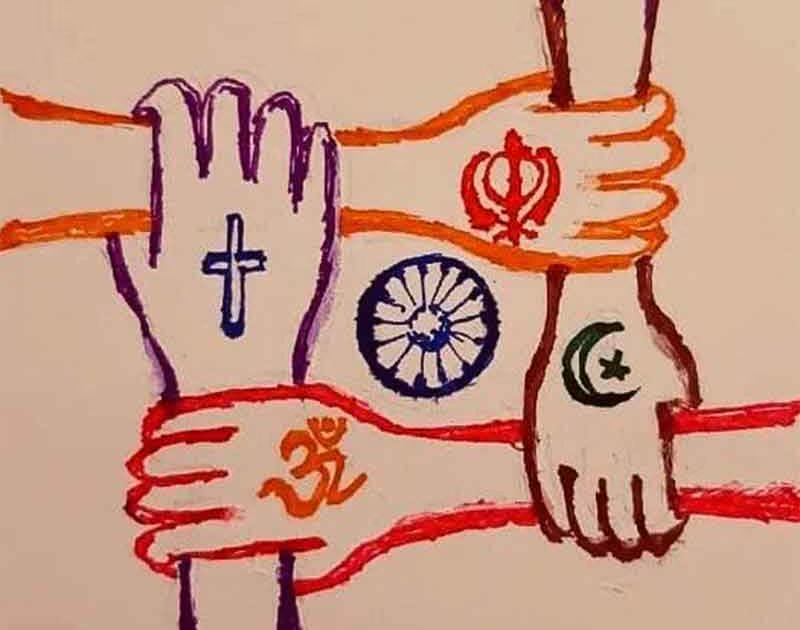
It is here that the historical memory of the Republic assumes profound significance. The freedom struggle was not won by teaching Indians to fear one another. It was won by persuading them that despite immense differences of language, religion, caste and region, they constituted a political community capable of imagining a common democratic future. That achievement did not emerge from ideological uniformity but from extraordinary diversity. The Republic inherited that plural imagination. The Constitution institutionalised it. The moral legitimacy of independent India rested not upon cultural homogeneity but upon the recognition that citizenship transcended inherited identities. It is therefore historically ironic that those who today claim exclusive guardianship over nationalism frequently invoke a conception of the nation narrower than the one bequeathed by the architects of India’s democratic freedom.
Governments do not earn democratic legitimacy by identifying enemies. They earn legitimacy by solving problems, strengthening institutions, deepening public trust and demonstrating the humility to acknowledge when policies have failed. Democracies judge governments not by the number of conspiracies they expose but by the quality of the lives they improve.
This historical irony also invites a more searching examination of the Sangh’s own political inheritance. Organisations derive legitimacy not only from present electoral success but also from their relationship to the struggles that created the Republic. India’s freedom movement was a vast democratic mobilisation encompassing peasants, workers, students, women, trade unionists, social reformers, constitutionalists, revolutionaries and religious communities of every description. It was through those struggles that democratic citizenship acquired moral substance. Historians have long debated the extent to which the RSS participated in that collective endeavour. What remains beyond dispute is that independent India’s constitutional identity was shaped far more decisively by pluralist and anti-colonial traditions than by the cultural nationalism that later became the ideological foundation of the Sangh Parivar. This history cannot simply be rewritten because political power has changed hands. Nations are not created retrospectively by governments; they are shaped through the sacrifices, aspirations and democratic struggles of generations.
For this reason, Indresh Kumar’s remark unintentionally reveals something larger than perhaps he intended. It discloses an ideology increasingly unable to distinguish between criticism of a government and hostility towards the nation. That confusion lies at the heart of the present political crisis. Democracies survive because governments remain answerable to citizens, not because citizens are required to demonstrate unquestioning fidelity to governments. Patriotism that demands silence ceases to be patriotism; it becomes obedience. Constitutional democracy, by contrast, rests upon the opposite principle: that love of country often requires the courage to confront those who govern it with uncomfortable truths.
It is precisely within this widening space between obedience and democratic responsibility that a new political reality is beginning to emerge. Across India, and in Goa with particular clarity, citizens who once organised around specific environmental, social, labour, constitutional or local concerns are discovering that their struggles are connected by a common experience. They increasingly recognise that what is at stake is not merely a series of isolated policy failures but the character of the Republic itself. This is the threshold at which civil society ceases to function merely as a collection of voluntary organisations. It begins, instead, to recover its deeper constitutional vocation as the organised conscience of the nation. That transformation is perhaps the most significant political development of our time, for when citizens cease asking what governments will permit and begin asking what democracy requires, history quietly changes direction.
If the present crisis were merely one of governance, it could be corrected through administrative reform, ministerial reshuffles or a more efficient bureaucracy. If it were merely an electoral crisis, it could be addressed through better political strategy or more persuasive communication. The evidence before us, however, suggests a deeper historical phenomenon. India is witnessing the gradual erosion of a governing philosophy that has come to believe that the centralisation of power is itself a substitute for democratic legitimacy. Political authority has become increasingly concentrated in the executive; institutions that were intended to function as autonomous pillars of constitutional democracy are widely perceived as operating under unprecedented pressure; Parliament has progressively ceased to be the nation’s principal forum for deliberation and has too often become an arena where legislation is accelerated rather than scrutinised; the federal compact has been strained by an impulse to subordinate diversity to uniformity; and civil society has frequently been regarded not as an indispensable partner in democratic governance but as an adversary whose independence must be curtailed. None of these developments can be understood in isolation. They are manifestations of a governing imagination that confuses command with leadership and obedience with consent.
This confusion has produced consequences extending far beyond constitutional theory. The economic aspirations that accompanied the promise of a “New India” remain stubbornly at odds with the lived experience of millions. India has indeed witnessed impressive achievements in infrastructure, digital public services and several sectors of economic growth, yet these achievements coexist with persistent concerns about employment, widening inequality, agrarian insecurity, pressures on small enterprises, rising costs of living for many households, and the uneven distribution of opportunity. The contradiction is not that development has failed to occur; it is that development has increasingly been presented as spectacle rather than as a measurable enhancement of human dignity. A highway cannot compensate for the absence of secure employment. A digital platform cannot substitute for accessible public healthcare. Grand announcements cannot erase the anxieties of young graduates who find that educational attainment no longer guarantees meaningful work. Governments committed to democratic accountability would regard these contradictions as invitations to reflection. Governments captive to ideological certainty are tempted instead to redefine the contradiction itself as an expression of insufficient patriotism or misplaced pessimism.
The same pattern is visible in the relationship between the state and the natural environment. Across India, communities resisting environmentally destructive projects are too often described as obstacles to development rather than as citizens defending resources that sustain future generations. Forests, rivers, coastlines and agricultural lands are increasingly viewed through the narrow lens of commercial utility, while those who seek ecological accountability are compelled to justify their patriotism. Goa has become one of the clearest illustrations of this tension. Citizens who organise to protect forests, rivers, biodiversity, traditional livelihoods and public spaces are not rejecting development. They are asking a profoundly democratic question: development for whom, at what ecological cost, and under whose authority? When governments answer such questions with suspicion rather than dialogue, they reveal an impoverished conception of democracy. They assume that electoral victory authorises every subsequent decision. Constitutional democracy has never rested upon such an assumption. Elections confer governments with authority to govern; they do not exempt governments from the continuing obligation to persuade, consult and remain answerable to the people.
It is here that the significance of organisations such as the CJP extends far beyond the immediate issues around which they mobilise. Their historical importance lies not simply in their campaigns but in the political culture they represent. They embody a conception of citizenship that refuses to confine democratic participation to the periodic act of voting. They insist that democracy is a continuous public conversation in which organised citizens retain both the right and the responsibility to scrutinise power. This marks an important transition. Classical civil society occupied the intermediate space between the state and the individual citizen. What is emerging today is qualitatively different. Environmental campaigns discover common cause with labour movements; constitutional rights groups find themselves standing alongside farmers, students, women’s organisations, neighbourhood associations and professionals alarmed by the weakening of public institutions. Their immediate concerns differ, yet they increasingly recognise that the underlying struggle is shared. They are defending not isolated causes but the constitutional architecture that enables all causes to be pursued peacefully and democratically. At that historical threshold, civil society acquires a new political character. It becomes the organised expression of popular sovereignty itself.
The government appears unable to comprehend this transformation because its ideological framework permits only two categories of political actors: those who support the nation and those who oppose it. Such binary thinking may be effective in sustaining electoral polarisation, but it is singularly inadequate for understanding democratic societies. Democracies are not strengthened by unanimity. They are strengthened by institutionalised disagreement. Every major democratic advance in India’s history—the struggle against colonialism, the movement against untouchability, the assertion of workers’ rights, the expansion of women’s participation, the defence of civil liberties during the Emergency, the campaigns for transparency and the Right to Information—emerged because citizens challenged prevailing orthodoxies. Had dissent been equated with disloyalty, many of the Republic’s proudest achievements would never have occurred. The attempt to reduce criticism to anti-nationalism therefore represents not merely a political tactic but an impoverishment of democratic imagination itself.
This inability to distinguish between the government and the nation also explains why the Sangh Parivar repeatedly invokes hidden enemies whenever confronted with growing public dissatisfaction. It is easier to attribute social unrest to conspiracies than to recognise that democratic societies possess their own moral intelligence. Citizens do not require foreign instigation to perceive unemployment, inflation, corruption, environmental degradation, institutional decline or the shrinking space for public dialogue. They encounter these realities in their daily lives. To insist that popular discontent must originate elsewhere is to deny the political maturity of the Indian people themselves. Such a claim is not only analytically weak; it is profoundly patronising. It suggests that ordinary Indians are incapable of independent judgement and become politically conscious only when manipulated by unnamed forces. Nothing could be further from the truth. The history of India demonstrates precisely the opposite. From the freedom movement to struggles for land reform, linguistic rights, social justice, environmental protection and democratic accountability, transformative political change has repeatedly emerged from the independent moral agency of ordinary citizens.
The greatest weakness of the present government, therefore, is not that it has made mistakes. Every government does. Its deeper weakness lies in its diminishing capacity for self-correction. Democratic governments survive because they retain the humility to learn from criticism, to revise policies, to admit errors and to engage opponents as legitimate participants in the national conversation. Political systems that gradually lose these capacities begin to confuse permanence with strength. Yet history is unambiguous on this point. No government enjoys an indefinite mandate. Political authority remains legitimate only so long as citizens continue to believe that those who govern are capable of responding honestly to changing realities. When governments cease listening, society eventually begins speaking in a different voice.
That voice is becoming audible across India. It is not yet unified. It does not march under a single flag or submit to a single leadership. Nor should it. Democratic renewal rarely begins through centralised command. It begins through countless local acts of civic courage that gradually discover one another and recognise that they are participants in the same constitutional journey. Goa’s citizens defending their environment, farmers protecting their livelihoods, workers demanding economic justice, students insisting upon intellectual freedom, women challenging discrimination, communities resisting arbitrary decisions, lawyers defending constitutional rights, journalists preserving independent inquiry and countless ordinary citizens refusing to surrender their democratic agency are together composing a political language that the existing order struggles to understand. Their strength lies precisely in the fact that they do not seek to replace one orthodoxy with another. They seek to recover the Republic’s foundational promise that governments derive legitimacy from the people and remain answerable to them.
One need not rely solely upon political theory to recognise this transformation. It is visible in the everyday conversations of India. It is heard in tea stalls where rising prices eclipse triumphant slogans; in villages where farmers worry less about ideological battles than about water, debt and uncertain futures; in universities where, young people seek employment rather than manufactured cultural wars; in fishing communities defending fragile coastlines; in neighbourhoods resisting ecological destruction; and among countless ordinary citizens who increasingly ask whether democracy still listens before it commands. These are not voices orchestrated by invisible conspirators. They are the accumulated experiences of a society that has begun to trust its own lived reality more than official narratives. When such voices begin to recognise one another, they cease to be isolated grievances. They become the moral foundations of a people’s movement.
The tragedy of the Sangh Parivar is thus not that it sees enemies where they exist. Every state must remain vigilant against real dangers. Its tragedy is that after decades of ideological work and more than a decade of extraordinary political authority, it still struggles to recognise the difference between opposition to a government and fidelity to the Republic. It continues to search for conspirators while citizens search for constitutional renewal. It mistakes the organised conscience of the people for an organised campaign against the nation. In doing so, it reveals that the narrative of permanent enemies belongs less to India than to the Sangh itself. The Indian people have historically demonstrated a greater confidence in democracy than those who claim to speak in its name. They have repeatedly shown that they do not fear debate, dissent or diversity. They fear only the concentration of power beyond democratic accountability.
The Republic was never the creation of one party, one ideology or one organisation. It emerged from the moral imagination of millions who believed that freedom required institutions capable not merely of exercising power but of restraining it. That democratic inheritance has survived governments before, and it will survive governments again. What is stirring across India today is therefore not simply political opposition but the reawakening of constitutional citizenship itself. Governments may dismiss it, caricature it or attempt to silence it, yet they cannot erase the historical truth from which it derives its authority: sovereignty has never belonged permanently to those who govern. It belongs to the people, who periodically remind governments that the Republic is larger than any ruling party, deeper than any ideology and stronger than the politics of fear. When citizens recover the conviction that the Republic belongs to them and not merely to those who temporarily administer it, history does not simply change direction. It changes hands.
Get the latest CounterCurrents updates delivered straight to your inbox.
Ranjan Solomon has worked in social justice movements since he was 19 years of age. After an accumulated period of 58 years working with oppressed and marginalized groups locally, nationally, and internationally, he has now turned author-researcher and freelance writer focussed on questions of global and local justice struggles. Ranjan Solomon is particularly tied in close solidarity with the Palestinian struggle for freedom from Israeli occupation, and the cruel apartheid system since 1987. Ranjan Solomon can be contacted at [email protected]
Related Stories
 India
India
Panthic politics finds new vehicle as Amritpal’s ADWPD gears up for 2027 polls
2 hours ago
 India
India
Bangladesh
2 hours ago
 India
India
'Nothing to do with politics': Nitin Gadkari clarifies amid retirement buzz over 'can't work much now' remark | India News
3 hours ago
 India
India
The whitewashing of the Green India Mission forest expansion initiative
4 hours ago
 India
India
The return of profanation as a new political language
6 hours ago
 India
India
How has the Cockroach Janta Party changed India’s politics?
6 hours ago
 India
India
‘Honest leaders are the first step to a better future’: Cockroach hunger striker targets India’s political class
12 hours ago
 India
India
"Dimagi Goondaism": How Political Power Produces Street Violence
16 hours ago