
The return of profanation as a new political language

In his work Profanations, Italian philosopher Giorgio Agamben observes how the act of profanation applies to the game of chess and children playing with household items as toys. For Agamben, profanation refers to removal or transfer of objects, places, animals, personalities or languages from the realm of sacred or restricted use to the common or ordinary use of people. Religion, state, political ideology, and marketplace are identified by him as the agents that make things sacred, removing them from common use and transferring them to a separate sphere. What chess does is profanation, converting wars or ancient divinatory rituals into a game, a playful activity.
The same thing happens when a child plays with a household object; they free or liberate it from its restricted use and open it up for a new purpose. These two textbook examples of desecration are best understood within the context of the recent student protest at Jantar Mantar.
The protest led by the Cockroach Janta Party (CJP) has sparked a national debate over what is “sacred” and “profane”, and what is “formal” and “informal” in Indian politics. It shows how students can desecrate a “sacred” and “invincible” political force through a measured act of profanation. Interestingly, labelling the movement “profane”, “informal”, or “violent” also serves as the ruling party’s best defence.
Admittedly, a fraction of the students used profanity, slurs and abusive slogans which were directed at the administration out of anger. No one can justify this. However, one must not ignore the instances of profanation in the protest expressed through informality, casualness, and fearlessness, which mainstream media labelled as “anarchism” and the “collapse of political civility”.
Profanation as a mode of serious political intervention is not something new to Indian politics. The Indian national movement has, at various times, resorted to such acts as a part of its core political strategy. Instead of violent means, the movement strategically employed non-cooperation, economic boycotts, and public burning of clothes made in England to strip away the authority, prestige and institutional power of the British Raj. In an act tantamount to profanation, some of its leaders publicly renounced awards and honorific titles conferred on them to show that no honours superseded their national sentiments.
Mahatma Gandhi sometimes used satiric language to ridicule the authority. To the question by a reporter about his unimpressive dressing while meeting King George V at Buckingham Palace in 1931, Gandhiji is reported to have remarked, “The king had enough on for both of us.” This was not at all a personal insult or an act of belittlement, but a powerful political statement highlighting the vast disparity in power and wealth between the British colonisers and the Indians, the colonised.
Universally, when conventional means of expression are restricted or suppressed by force, humour, satire, comedy, and trolling fill the vacuum, challenging hegemonic structures in a subtle but more powerful manner. Charlie Chaplin explored this possibility in his 1940 satirical masterpiece, The Great Dictator, satirising Hitler’s mannerisms through a character who closely resembled him. More recent examples come from Palestine, where humour serves as a political tool, transforming the daily suffering of Palestinians into a collective form of resistance.
In a novel shift, the students function as the agents of profanation in India; they deal with the excessive power of the state by weaponising humour, satire, memes and trolls in ways unheard of. India’s political orthodoxy may refuse to acknowledge that Indian democracy is equally built through such acts of profanation, not solely through the interventions of formal political institutions. This orthodoxy clearly resonates in media debates, which often write off any form of unconventional politics as either liberal denunciation or left adventurism, completely missing the hopeful cues of a new mode of politics to emerge.
Further, the demand for greater accountability and transparency in governance from the students, a “non-party” political entity, has elicited sceptical responses from across the political spectrum. Much of the concern stems from the movement’s “informal” and “non-institutional” character and its “single-issue” oriented politics. Critics argue that such “street politics” alone does not have the power to bring about radical political transformation.
More optimistically, those on the other side argue that it should remain one of the tactics at our disposal when formal opposition struggles to deliver the desired results. The Congress Party, for instance, does not dismiss the potential of the CJP’s mode of politics, even as it detects and warns of an Aam Aadmi element within it. Congress leader Rahul Gandhi himself occasionally adopts an informal style, engaging directly with people through street-level interventions.
The Jantar Mantar protest has definitely offered a radical component for a rethinking of the ways in which informal politics works in India’s democracy. Expressions of dissent in informal forms are often downplayed as subordinate to “popular consensus”, which is measured chiefly through electoral victory. The question of where to place this protest or what basket suits it — whether as an impromptu student mobilisation driven by anger, a street protest with intensive political content, or a sign of an unconventional style of politics — is therefore a significant one.
M.H. Ilias is Professor at the School of Gandhian Thought and Development Studies, Mahatma Gandhi University, Keralam
Related Stories
 India
India
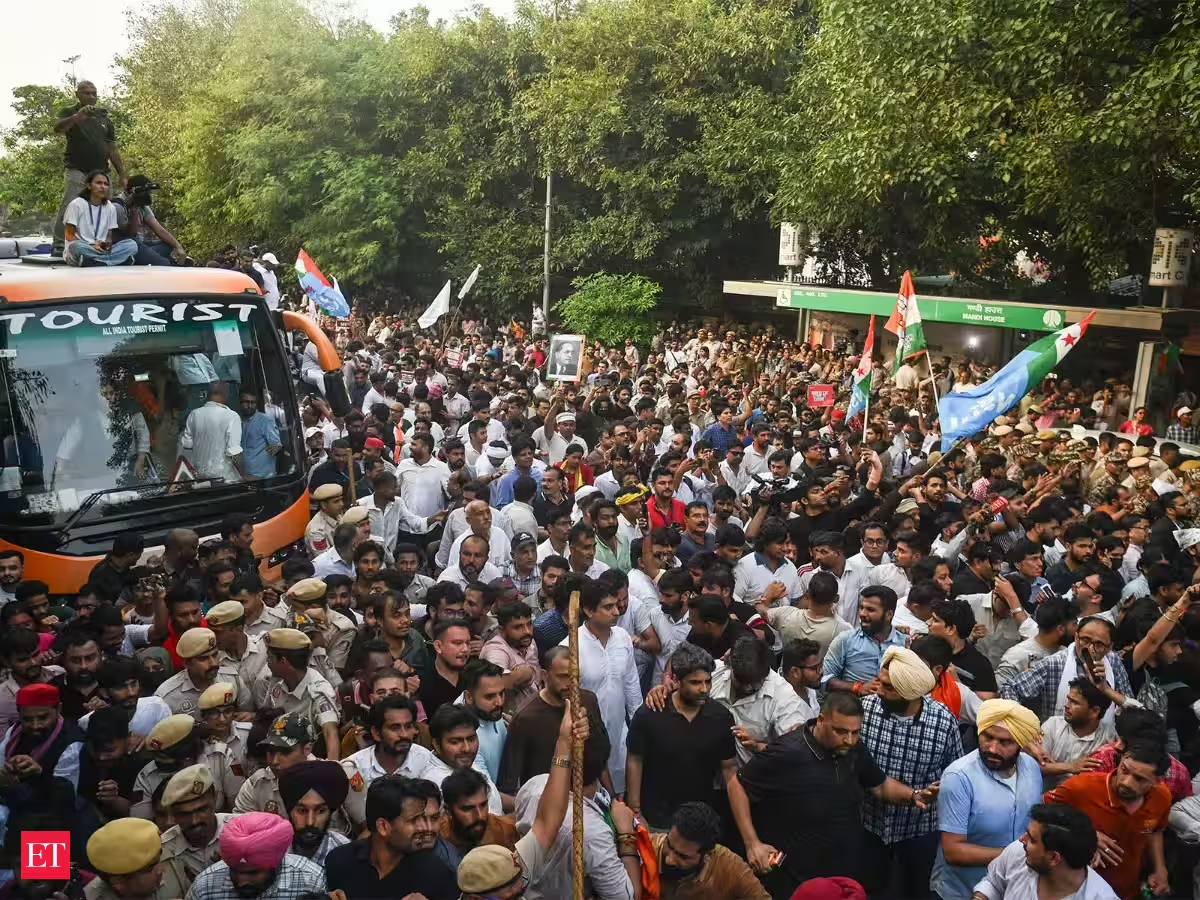
‘Power comes from people’s mandate, not chaos’: CM Yogi Adityanath warns against ‘Bangladesh
19 minutes ago
 India
India
Delhi traders urge PM Modi, Rahul Gandhi, Kejriwal to postpone protests till January 31
2 hours ago
 India
India
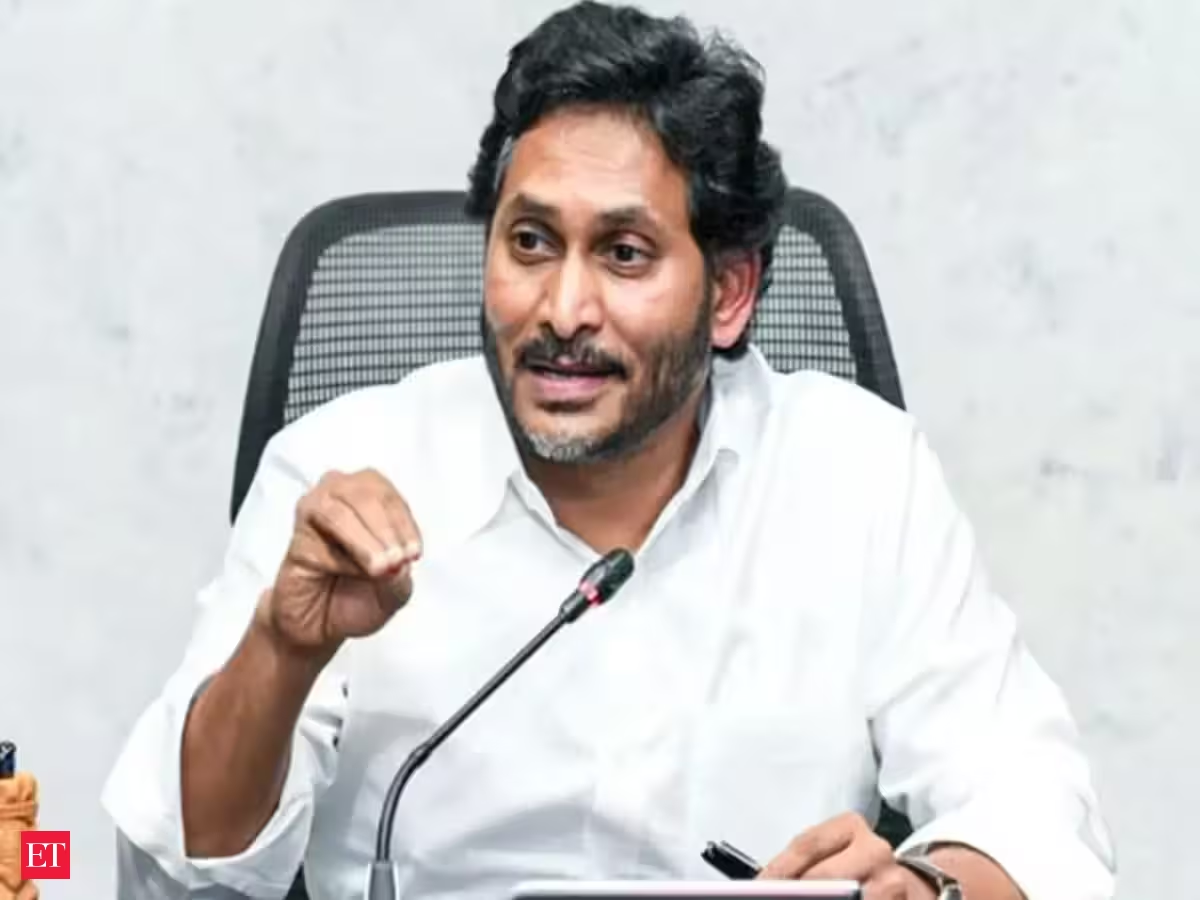
Jagan Mohan Reddy recalibrates stance, demands CEC's resignation, signals opening to INDIA Bloc
2 hours ago
 India
India
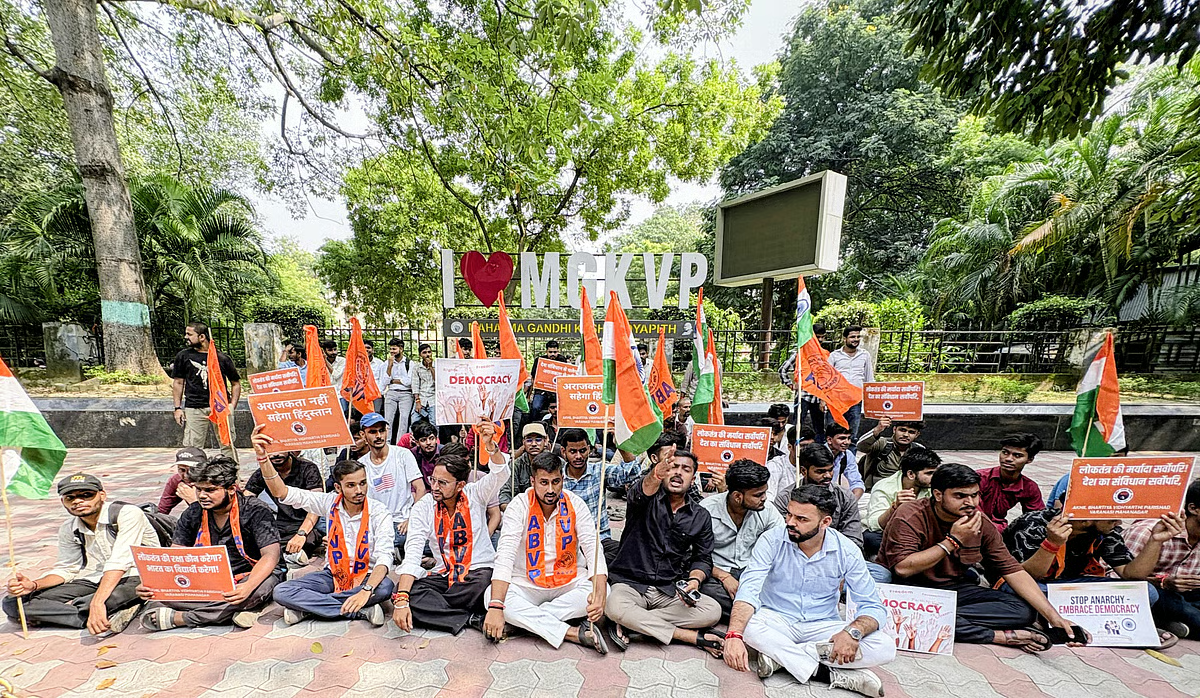
ABVP stages nationwide protests against ‘politics of anarchy’, backs constitutional institutions
2 hours ago
 India
India
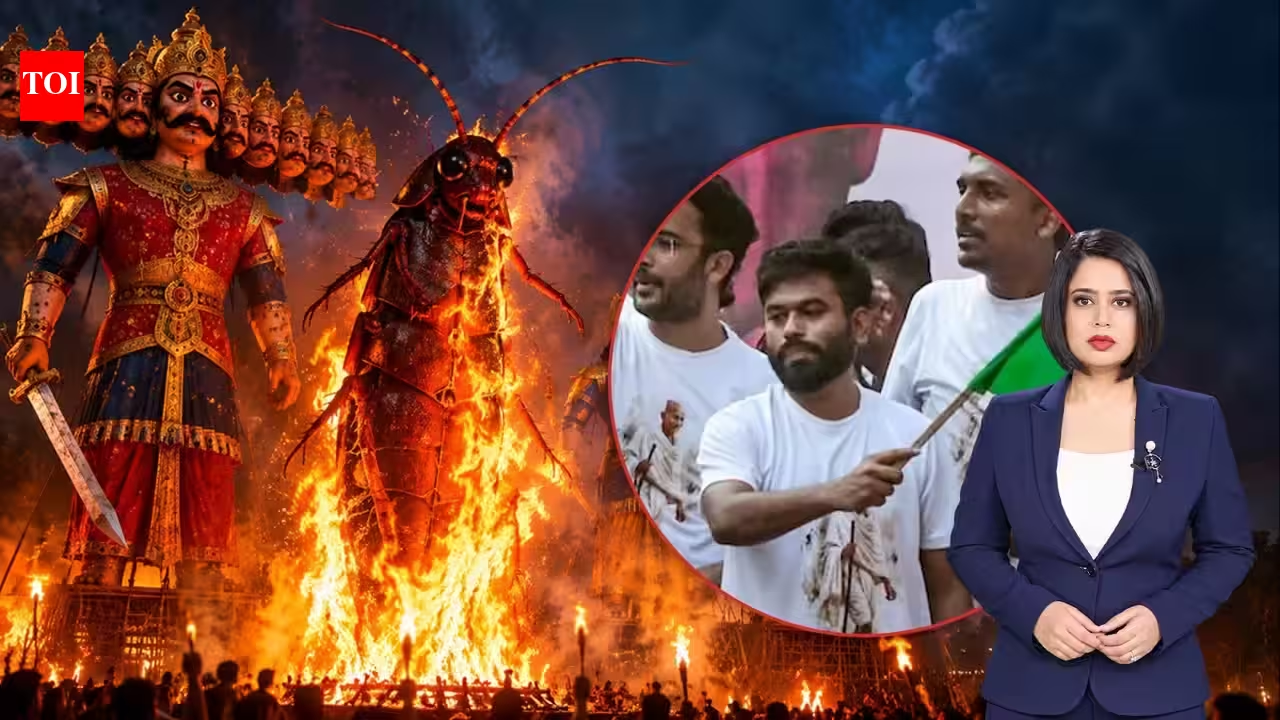
The 'Cockroach' Context: Lessons From Nepal, Spain, Kejriwal On Protest
3 hours ago
 India
India
UPI politics, SIR protests and India’s inflation squeeze | Delhi Police | CEC | Macro Matters Ep 10
6 hours ago
 India
India
India's Missing Voters And The Politics Of Protest At Jantar Mantar
7 hours ago
 India
India
Navi Pillay’s Nobel Honour: Praise, Politics, Diplomatic Calculations
8 hours ago