
Why Does the Khilafat Movement Still Matter to Indian Politics?
Imperial powers combine against a West Asian state in the righteous language of security. The state is weakened and humiliated, unable to answer in proportion to the injury it feels. Elsewhere, its sympathisers watch with rage. Some ask why Indians should care at all. Why import another region’s pain into our politics? Why treat an extra-territorial symbol as if it belonged to us?
This could be about Iran today, where American and Israeli strikes have inflicted severe damage, including the death of its senior leadership. It could be about Gaza, reduced to rubble after October 2023. It could just as easily be about Gamal Nasser’s Egypt, bombed for daring to nationalise the Suez Canal in 1956. More pertinently, it could be about the Ottoman state after the First World War, when defeat was followed by ruthless dismemberment.
A century ago, some Indian Muslims found in the Caliph’s fall a potent vessel through which a wide range of anxieties about the British Raj could be expressed. What followed in late 1919 was one of the most consequential experiments in anti-colonial mass politics.
In her work on the Khilafat movement, historian Gail Minault argues that its central purpose was to create a pan-Indian Muslim political constituency. The movement sought to mobilise Indian Muslims around a shared sense of religious grievance: that British aggression threatened the sanctity of Islam’s holiest sites.
Unlike the Swadeshi movement of the early 1900s, Khilafat was not anchored in arguments about material drain or trade—words largely urban in reach. It spoke instead in the language of dignity and self-respect, acquiring a sweeping rural resonance that economic rhetoric alone rarely commanded.
Of course, the movement had deep contradictions and is remembered as a failure, not least because Turkey itself abolished the Caliphate. Naturally, one wonders whether Indian energies were misdirected into an overtly religious movement, away from what we might comfortably recognise as emancipatory struggle.
The groundwork for Khilafat was laid well before 1919. The Ali brothers—Shaukat Ali and Muhammad Ali—had long sought to cultivate political consciousness among Indian Muslims, particularly through alumni networks of Aligarh University. They were dissatisfied with the Muslim League, which remained cautiously loyal to the Raj. In parallel, the Deobandi ulama were attempting a revival of a different kind, rekindling religious discipline within Muslim communities.
In their quest for wider appeal across India, they found an unlikely ally in Mahatma Gandhi, whose politics of religion caught their attention after he returned to India in 1915. For them, Gandhi was someone who could translate their sense of injustice into a shared moral vocabulary intelligible to the Hindu masses.
Constitutional deputations to London failed to garner any support for the Caliphate. The Rowlatt Act, followed by the Jallianwala Bagh massacre, only worsened the mood. Gandhi sensed an inflection point. He persuaded the Indian National Congress that the struggle for Muslim dignity and the struggle for freedom from the Raj were deeply intertwined, lending crucial support to the All India Khilafat Day hartals on October 17, 1919.
The Hindu-Muslim unity visible in subsequent hartals was more apparent than real, but there was a remarkable synergy between Congress and Khilafat leadership. If Khilafat emerged as a symbol of self-determination, Gandhi in turn became a symbol of restraint, assuaging the insecurities of factions across the political spectrum.
The Historic Trial of Ali Brothers, Dr. Kitchlew, Shri Shankeracharya, Maulana Hussain Ahmed, Pir Ghulam Mujaddid and Maulana Nisar Ahmed, 1921. | Photo Credit: By Special Arrangement
Soon, a flurry of organisations such as the Pradesh Congress Committees (PCCs) and the Provincial Khilafat Committees (PKCs) spread the message of satyagraha in towns and villages. The ulama formed their own local units under the Jamiat Ulama-i-Hind led by Maulana Abdul Bari.
Known for his fiery speeches, Abdul Bari was among the first to push for complete non-cooperation with the Raj. Gandhi resisted, partly because the masses had yet to fully internalise the rigour satyagraha demanded. But he eventually called for Khilafat Non-Cooperation on August 1, 1920. That he did so, much to the unease of the prudent Congress Working Committee (CWC), established his unyielding grip over the organisation.
The courtyard of Firangi Mahal, Lucknow, where Maulana Abdul Bari shaped the Khilafat Non-Cooperation campaign and hosted Gandhi among other national leaders. | Photo Credit: Surya Bulusu
The Muslim community provided fresh impetus to this new phase of the movement, relinquishing privilege and office under the Raj. In an astonishing act of solidarity, several students and teachers walked out of Aligarh Muslim University to form the autonomous Jamia Millia Islamia, with Muhammad Ali at its helm.
In time, fissures developed across communities. Muslims felt they were sacrificing far more than their Hindu counterparts for the cause, a perception only sharpened by the British selectively arresting Muslim leaders.
The larger concern, however, was organisational. As Jawaharlal Nehru later observed in his autobiography, many interpreted Khilafat simply as khilaf—“against” in Urdu. All anti-British anger was latched onto the movement, whether against the Oudh Rent Act or exploitative Assam plantations. Local committees lacked the foresight to channel this diffuse rage non-violently.
Perhaps the gravest eruption came in the Malabar region in 1921, where a volatile mix of agrarian resentment, anti-colonial fury, and communal animosity exploded in the Mapilla rebellion. The colonial state brutally crushed the short-lived “Khilafat Raj”: over 2,300 rebels were killed and tens of thousands imprisoned. Neither Congress nor Khilafat leadership took meaningful accountability, chiefly blaming British restrictions for cutting off access to the region.
Disorder was not just confined to the streets. The Khilafat House in Bombay became embroiled in a scandal over misused donation funds, forcing Seth Mian Mohammad Chotani to resign as president. Though the sums themselves were modest, the betrayal stung ordinary people who had donated believing freedom was a year away.
Khilafat House, now an educational institution, in Byculla, Mumbai | Photo Credit: Surya Bulusu
Ultimately, the Khilafat leadership proved too myopic. Fixated on holy sites and Islamic brotherhood, it opportunistically neglected both local outrages and Arab political realities, where there was little appetite for subordination to the Caliphate. The conservative ulama, for their part, could not reconcile democratic ideals within a rigid religious framework.
The movement lost momentum after the Chauri Chaura incident in 1922. Disillusioned by both Gandhi’s withdrawal of non-cooperation and Mustafa Kemal Atatürk’s abolition of the Caliphate, the Khilafatists found themselves adrift. Meanwhile, troubling revivalist currents such as the Shuddhi Sangathan campaign and, later, the RSS took shape in response to often-exaggerated fears of Muslim mobilisation.
Such is the recurring dilemma of religious mass politics. It can summon deep emotional energies and galvanise masses with startling speed. But therein lies the danger: it leaves little room for conciliatory retreat. A modest political backstep comes to feel like an apostasy. And once unleashed without sufficient discipline, those energies are easily captured by demagogues, or provoke a hardening reaction in other communities.
None of this means abandoning religious symbols altogether. Religion, with its ethic of sacrifice and courage, is one of the most formidable idioms humans possess. Even an extra-territorial symbol, whether Iran or Gaza, need not be a misstep. Chosen sensibly, through honourable means, it can stir conscience and bind communities rather than divide them.
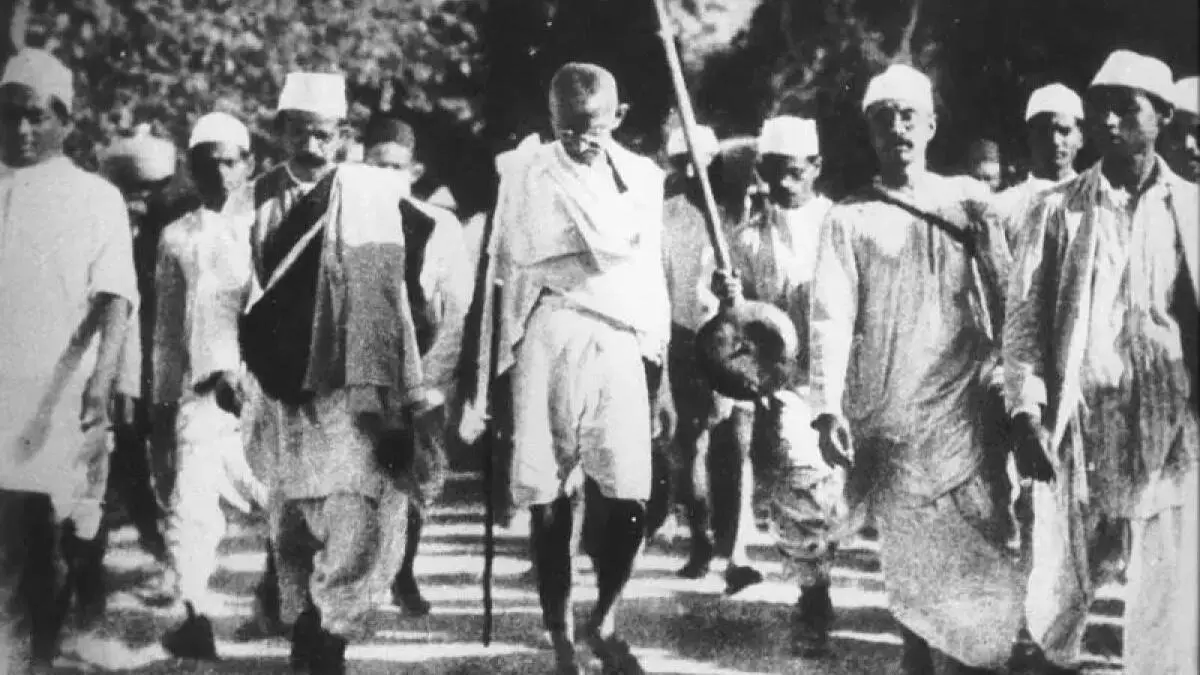
For all its disarray, Khilafat did set the machinery of satyagraha in motion in the countryside, laying ground for Gandhi’s next great campaign. He found a symbol that mattered intensely to households of all religions and castes—material yet no less sacred, capable of wounding the British exchequer—and perhaps his most inspired moral invention: salt.
The challenge, then, is to not purge faith from politics but to fight with the whole self, suppressing no part of it for another. Muhammad Ali put it best. At the First Round Table Conference in London, near the end of his life, he declared: “Where God commands, I am a Muslim first, a Muslim second, and a Muslim last, and nothing but a Muslim. But where India is concerned, where India’s freedom is concerned, I am an Indian first, an Indian second, an Indian last, and nothing but an Indian.” Two circles of equal size—and he would leave neither.
Surya Bulusu is a researcher and software engineer at Avanti Fellows, a non-profit building open-source technology for public schools. He writes on books, cities, and history.
Also Read | Mahatma Gandhi, in his own words
Also Read | Mahatma Gandhi opposed the Jewish state. But after his death, India’s socialist leaders embraced Israel
Related Stories
 India
India
New York to ban Central Park’s horse
3 hours ago
 India
India
One
3 hours ago
 India
India
Rahul Gandhi, his 'ecosystem' trying to create anarchy in India for 'regime change', says BJP
4 hours ago
 India
India
‘Mary Millben can back BJP, Imran Khan can’t criticise it’: CJP's Abhijit Dipke flags contrast
4 hours ago
 India
India
CJP's Saurav Das, Ashutosh Ranka: India's 'cockroach' leaders jailed after holding protest
5 hours ago
 India
India
India’s IDBI Bank falls 7% as government announces $5.5 billion stake sale to Canada's Fairfax
5 hours ago
 India
India
Backlash in Kashmir over proposal for uniform Friday sermons across mosques
5 hours ago
 India
India
Will wipe out the broom: Jhotas father rules out entering politics, but warns AAP of electoral rout
7 hours ago