
Algorithms, Artificial Intelligence and Milei’s ethics
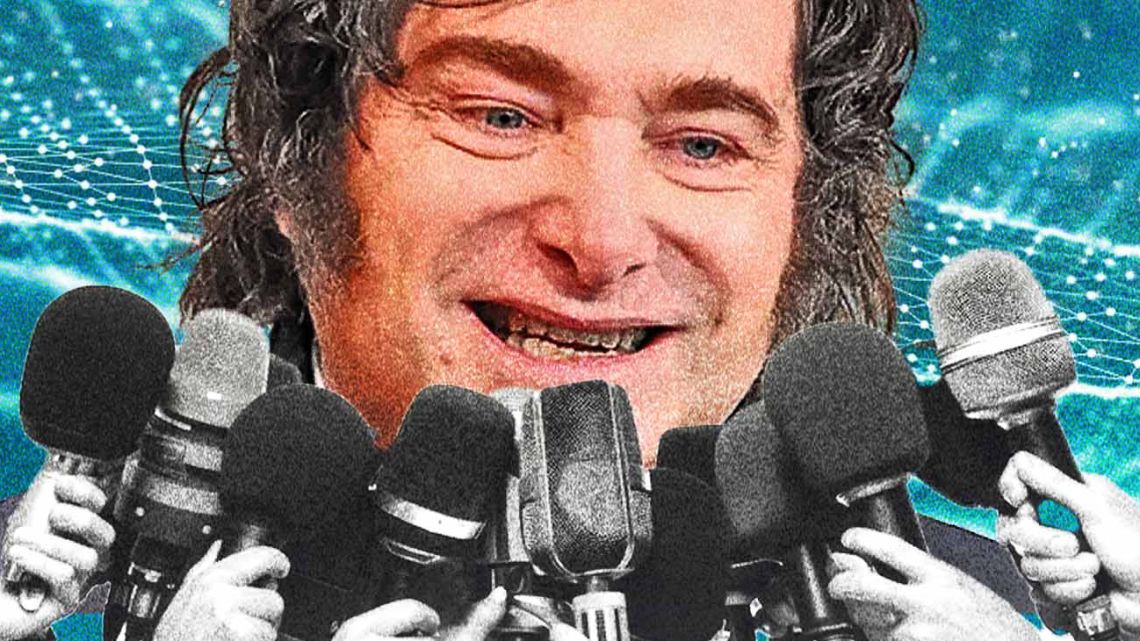
Javier Milei has been pushing the narrative that Argentina will become a haven for Artificial Intelligence, suggesting that a wave of investment and prosperity could be unleashed by fully opening the doors to any and all related projects and businesses. His former lead advisor on the subject, Demian Reidel – who has now fallen into disgrace over accusations of malfeasance during his time as a public servant – even tied Argentina’s relatively outstanding status as one of the few middle-income nations with a peaceful nuclear programme as a competitive advantage, together with the favourable weather in the Patagonian region, suggesting that the country should become fertile ground for the building of AI super data centres. Last year, Milei and Reidel revealed an agreement with one of the world’s leading AI companies, OpenAI, where billionaire Sam Altman and local partners Sur Energía announced they would invest some US$25-billion in a major data centre and related AI infrastructure in Patagonia. As of today, the project hasn’t moved forward an inch.
Milei, together with his Deregulation & State Transformation Minister Federico Sturzenegger, has publicly clashed with historian Yuval Noah Harari over the idea of making non-human corporations legal entities, allowing AI agents to fully own and control limited liability companies. There is clearly a major affinity between Milei’s self-professed “anarcho-capitalist” libertarianism and the vision of many of the Silicon Valley elite, where total deregulation, a rejection of the idea of paying taxes and therefore of having a centralised state at all have converged. Milei had actively pursued the “friendship” of Elon Musk, the billionaire who owns social media platform X (formerly Twitter), Tesla, and SpaceX. He recently received Peter Thiel, the venture capitalist behind Palantir and one of the early investors in Mark Zuckerberg’s Facebook, at the Casa Rosada. And he’s preached anti-wokeism, deregulation, and the culture wars against “socialism” at the global stage.
A similar kind of logic underlies the Argentine President's total rejection of journalism, a profession he believes should be eradicated after social media allowed disintermediated relationships between leaders and audiences. In his mind, journalists and news outlets acted as a sort of filter between influencers like himself and their potential followers, unjustly becoming arbitrators of what information society should consume, condition the construction of its subjectivity. Whereas editors and reporters actively decided what they thought was relevant or important, algorithms were truly just that in that they rewarded content that was truly in the interest of the people. Journalism, in that it acted as a gatekeeper of the information ecosystem, was part of the same “socialist” virus that had invaded the rest of Western society, picking winners and losers while only suiting its own interests, he claims. It had become a caste – like the political class he hates so much. Instead, people should trust what they see and hear directly from their leaders, or what other followers or detractors say about them on platforms like X, Instagram, or TikTok. Milei can swear by this given his meteoric rise from Austrian economic school book nerd to high-flying TV panellist and professional polemicist, all the way to the top office, forcing to unravel the two major political coalitions that had governed the country for nearly two decades. Milei counted on the support of his sister Karina, and his dogs – four alive, one dead, all present according to him – to get there.
There is a certain naïveté in Milei’s position that were it not dangerous, could be taken as the eccentric consequence of his militant views – much like the idea that the Central Bank should be bombed to oblivion and that children and organs could be bartered for in an open market. There should be no doubts that journalism is undergoing a deep transformation that the industry has been unable to face from a business perspective, leading to a steady decline in the quality of the news. Together with a generalised decline in society’s trust in the institutions of democracy, the deterioration of journalistic quality has contributed to more and more people questioning whether democracy is the best political system. Populism, present since man is man, has found new ways and has become fashionable for certain political sectors. Capitalism, in its most financialised and globalised form, has failed to generate a sensation of growing welfare for a majority of the populations of Western nations, while wealth has concentrated extremely, not in just the one percent but in the 0.1 percent.
The digital ecosystem has created this illusion that everyone can benefit by using technology. Foundational stories such as Zuckerberg’s building of Facebook in his college dorm or the construction of Marcos Galperin’s Mercado Libre from a garage tell society that anyone with a good idea can become a billionaire. Influencers on different social media platforms tell a screen-addicted audience that they should quit their jobs to pursue their dreams, financed via content creation and marketing. Major social media platforms pump this content out to billions daily, setting the stage for a major wealth transfer at the long tail, where many spend their time and money expecting to become rich and famous by posting content. Big Tech rakes it in.
Algorithms and Artificial Intelligence aren’t neutral technologies. They are for profit products designed by a concentrated group of people who run companies and respond to their shareholders. State actors including the United States and China are actively engaged in pursuing their geopolitical interests both through these technologies and by capturing supply chains to guarantee natural resource flow to sustain the AI race. There is nothing inherently bad about technology, capitalistic enterprise and the pursuit of national interests. That doesn’t make them universally good either. Within Milei’s ethical framework, what is morally good is tied to wealth creation that increases the wellbeing of the individual. Even under this conception it is clear that total subjugation to the gods of AI isn’t morally preferable in of itself.
The same exact thing should be said about the media. Journalism and journalists aren’t inherently good and they are not neutral. In general, it and they are also part of for-profit products produced by media companies looking to maximise returns for their shareholders. The media can and is constantly manipulated in favour of particular interest groups, something made exponentially easier in the context of the technological disruption that has detonated the traditional business model and weakened the journalistic ethical guardrails. The rise of an AI-dominated ecosystem will only exacerbate the decadence of the media industry, which in turn will continue to weaken the information ecosystem, which in the long run will feed back into the AI systems.
Journalism and technology must be used intelligently and ethically in order to generate greater good. While Milei, like Néstor Kirchner and Cristina Fernández de Kirchner before him, is right to criticise news outlets and individual journalists for using their position to pursue spurious interests, the solution isn’t eradicating journalism but making it better. In the same line of reasoning, AI will unleash a major productivity revolution that will give humanity powerful tools to tackle some of its most difficult problems and biggest ambitions. The Silicon Valley revolution that is now some three decades old promises to keep accelerating, pushing the boundary of human imagination. The same tools are harming the information ecosystem by pillaging content creators while accelerating the concentration of wealth to the very top.
Suggesting Argentina will be fully deregulated for any and all AI-related projects, failing to protect the competitive advantage generated by geography and nature , appears as a bad strategy. It’s not about rejecting technology or innovation, but about deciding to pursue ways in which to open up the economy and change Argentina’s geopolitical alignment to benefit the country as a whole. Around the world there are many examples of smart industrial policy and foreign policy approaches that can allow middle-income nations like Argentina to integrate into the global economy and community without handing over comparative advantage and opportunity. Ideologically, though, if the mere mention of industrial policy is considered heresy, there will be no alternative to handing over economic sovereignty.
At the end of the day, Milei has a militant and narrow world view that he’s tied to a vision that integrates AI and tech billionaires. Those same players have a global agenda that they will pursue, and Argentina will only be part of that plan for as long as it is useful for them. Putting in place incentives that will attract them is valuable in so much as it spurs wealth and transfers know-how to the country. Trying to kill the media and journalists will only weaken society’s critical capacity, making it more ignorant and less capable of trying to pursue what is best for it. It also helps keep democracy going, which is a much better alternative to authoritarianism. Good technology and journalism are forces for good.
Related Stories
 AI News
Bill Gross bets AI can help mass
3 days ago
 AI News
Nigeria records 93% rise in AI micro
3 days ago
 AI News
The Italian gelato maker using AI to invent new flavours
3 days ago
 AI News
Closing the Gap Between Agentic CX Pilots and Production
3 days ago
 AI News
New Brunswick data centre debate highlights cross
3 days ago
 AI News
How to Structure an AI Agent Referral Fee Agreement Between Startups
3 days ago
 AI News
No, AI didn’t delete a Swedish reality TV series
3 days ago
 AI News
There is no AI in Armageddon. Artificial intelligence is a tool, not an apocalypse
3 days ago