
Why Canoo Collapsed: Strategy Shifts, Financial Struggles, And Bankruptcy

Canoo Inc. (GOEV) was one of the electric-vehicle startups that attracted significant investor attention during the SPAC boom. After agreeing to merge with Hennessy Capital Acquisition Corp. IV in 2020, the company promoted a business model built around three revenue streams: engineering services, a subscription-based vehicle program, and future commercial vehicle sales, presenting them as key drivers of long-term growth.
Canoo presented investors with a business strategy built around three revenue streams: engineering services for third parties, a subscription-based ownership model, and future commercial vehicle sales based on its electric-vehicle platform.
The lawsuit alleges that several of those statements overstated the company’s near-term revenue opportunities, the commercial viability of its subscription model, and the significance of its partnership with Hyundai.
The company later struggled to execute its business plan amid mounting financial pressure. In January 2025, Reuters reported that Canoo had filed for Chapter 7 bankruptcy and would cease operations after failing to secure additional funding, marking the end of the once-promising EV startup.
By then, investor confidence had largely disappeared and Canoo’s stock dropped drastically.
Canoo’s stock reflected the trajectory of many EV startups that entered the public markets through SPAC mergers.
During its early years as a public company, the shares were driven largely by expectations of future growth rather than current financial performance. Investors valued Canoo based on its projected engineering-services business, subscription model, and plans to scale commercial vehicle production before the company had established a sustainable source of revenue.
As the company abandoned key elements of that strategy and struggled to execute its business plan, investor confidence steadily eroded. Large selloffs were followed by weaker recoveries, and the stock continued making lower highs and lower lows instead of establishing a sustained recovery.
TechCrunch later reported that Canoo “underwent numerous pivots after it went public,” highlighting the repeated strategy changes that ultimately failed to stabilize the business. By the time the company filed for Chapter 7 bankruptcy in January 2025, the stock had lost virtually all of its value from its post-SPAC highs.
Canoo’s biggest challenge was turning its ambitious business strategy into a financially sustainable business.
Developing electric vehicles required years of investment in engineering, manufacturing, product development, and production capacity before meaningful revenue could be generated. As the company revised its strategy and delayed commercial execution, operating expenses continued to outpace revenue.
In early 2024, Canoo attempted to strengthen its manufacturing operations by acquiring a substantial portion of Arrival’s manufacturing assets at a discount of more than 80%. The acquisition was presented as a way to reduce costs and improve production capabilities.
The company became increasingly dependent on external financing to fund its operations. However, as its share price declined and investor confidence weakened, raising additional capital grew increasingly difficult. After months of seeking new funding, Canoo announced its bankruptcy following unsuccessful efforts to secure financing, immediately ceasing operations and initiating a court-supervised asset liquidation process.
What the Settlement Means for Investors
The securities class action now provides a potential recovery path for eligible investors.
Although the parties have agreed to resolve the case, the final settlement terms, including any monetary consideration, class eligibility, loss calculations, and the claims process, remain subject to court approval.
Once approved, eligible investors will need to submit a valid claim supported by their trading records and comply with the final filing requirements before receiving any potential payment.
For investors who experienced losses following Canoo’s strategic shift and subsequent stock decline, the settlement may offer an opportunity to recover a portion of those losses.
Market sentiment toward Canoo is no longer centered on the company’s growth prospects. Following its Chapter 7 bankruptcy filing, the original investment thesis has effectively come to an end.
Before bankruptcy, investors could still speculate that Canoo might secure additional financing, ramp up production, or turn its commercial partnerships into meaningful revenue. The liquidation process largely eliminated those possibilities for common shareholders.
Following the bankruptcy filing, Canoo’s remaining assets entered the liquidation process. TechCrunch reported that CEO Tony Aquila offered to purchase substantially all of Canoo’s assets for $4 million through a newly formed entity.
While Canoo’s technology and intellectual property may still hold value, any proceeds from asset sales will be distributed according to bankruptcy priority rules, with creditors paid before shareholders.
Canoo is expected to remain focused on completing its Chapter 7 bankruptcy process, including the liquidation of its assets and the resolution of creditor claims. For common shareholders, receiving any payout through the bankruptcy estate remains unlikely, as creditors hold absolute priority under U.S. bankruptcy law.
Recoveries for creditors will ultimately depend on the total value realized from asset sales, the priority tier of individual claims, and administrative expenses incurred during liquidation.
Meanwhile, for investors covered under the securities class action, the proposed settlement offers a separate potential avenue for recovery. However, the settlement must receive final court approval before claims can be processed and eligible investors can receive distributions.
Benzinga Disclaimer: This article is from an unpaid external contributor. It does not represent Benzinga’s reporting and has not been edited for content or accuracy.
© 2026 Benzinga.com. Benzinga does not provide investment advice. All rights reserved.
To add Benzinga News as your preferred source on Google, click here.
Related Stories
 Business
Robot factories and hypersonic missiles: JPMorgan Chase’s first $5 billion of defense investments
2 days ago
 Business
Police say a car has hit an Australian lawmaker, critically injuring her; the driver was arrested
2 days ago
 Business
Boomi acquires Israeli startup Elementary for $43 million
2 days ago
 Business
Mega chicken farm expansion plan withdrawn
2 days ago
 Business
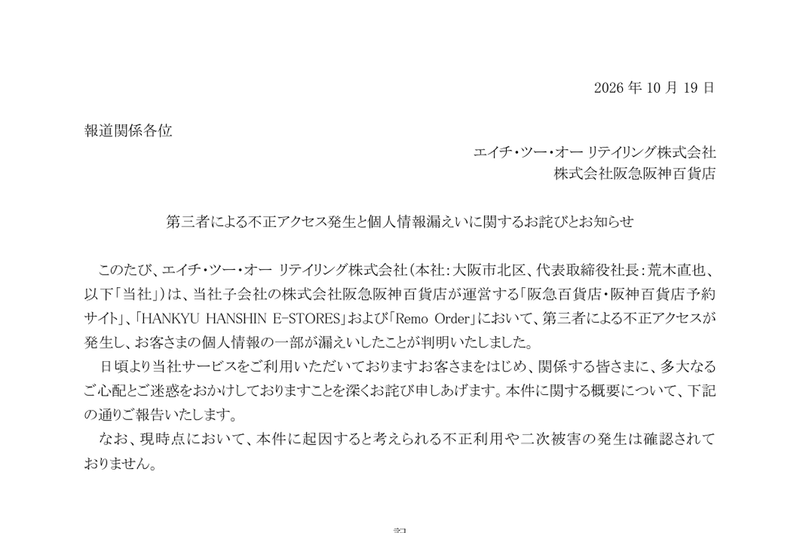
Data Breach at Hankyu Hanshin Department Store Common ID System Affects Nearly All 1.26 Million Members
2 days ago
 Business
Global Startup EXPO and Nippon Startup Awards 2026: METI Showcases Japan's Deep
2 days ago
 Business
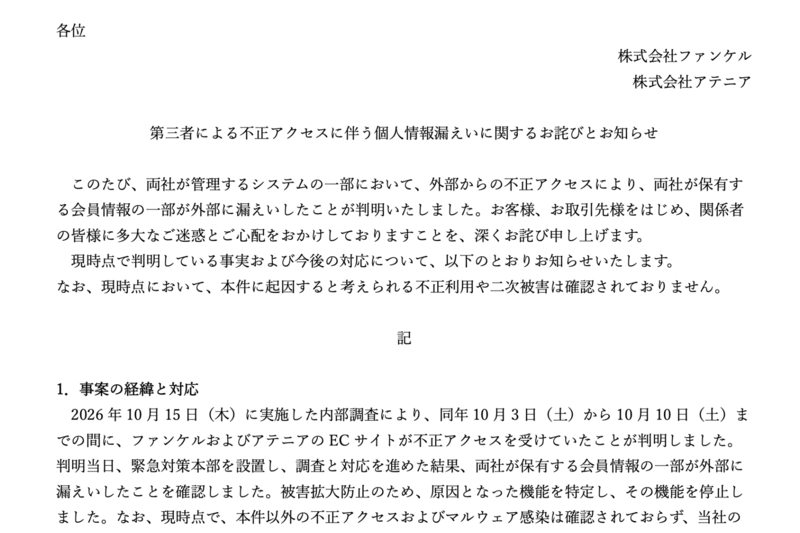
FANCL and Attenir Suffer Data Breach Affecting 780,000 Customers, Exposing Addresses, Names, Phone Numbers
2 days ago
 Business
DeepSeek Quietly Ships V4.1-Flash
2 days ago