
Why AI is driving a record boom in new US startups
Why AI is driving a record boom in new US startups
While it may still spawn a jobs apocalypse, artificial intelligence is set to spark a record number of new entrepreneurs in the US.
Many of these startups could fail quickly, as AI helps dubious business plans move forward - a new wrinkle on the “AI slop” that’s all over social media. But the AI-enabled startup surge is so robust it should yield many lasting companies even after the weaker ones peter out, said Aaron Terrazas, an economist who works with small business services firm Gusto.
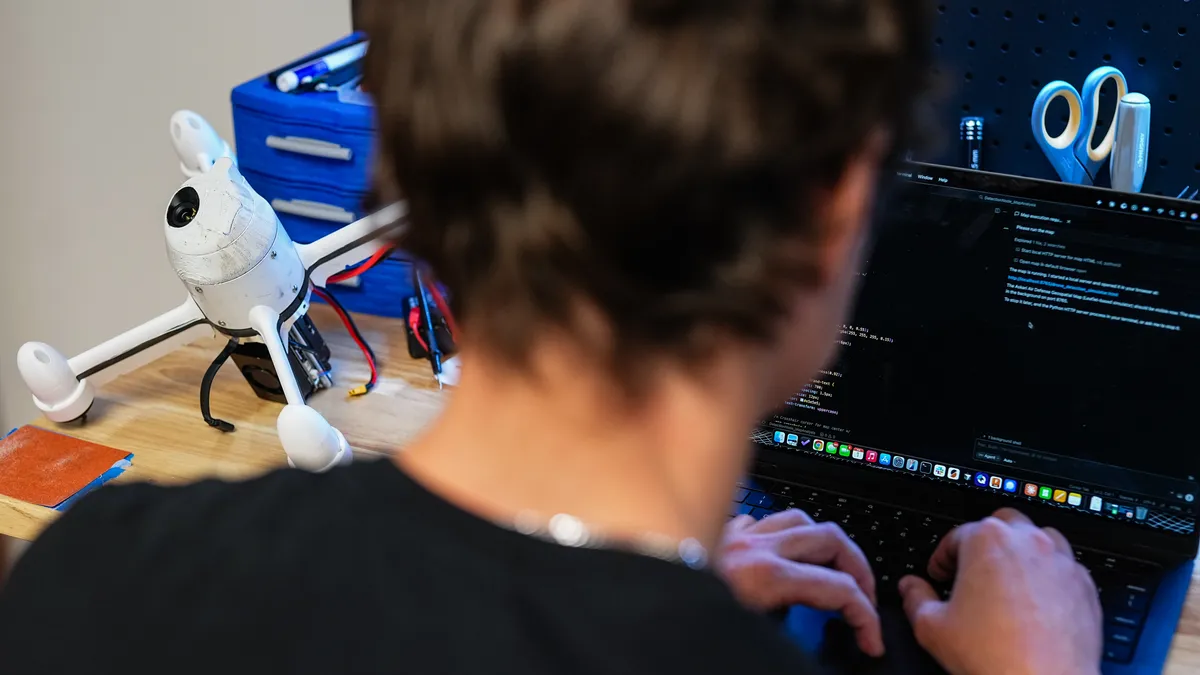
Robbie van Zyl, a 26-year-old South Africa-born entrepreneur, is a believer. AI is now his secretary, scheduler, PowerPoint creator and occasional accountant and legal adviser, he says, freeing himself and his team of six engineers to design drones for the departments of Defense and Homeland Security. AI is the firm’s entire back office.
“AI is like the next-generation force multiplier for small businesses,” said van Zyl, head of Askari Defense Inc. in Atlanta.
Nationwide, economists say we’re seeing a second wave in the business formation boom that started in the Covid-19 lockdowns, when worried and laid-off workers rushed to start their own businesses. Only this wave appears closely correlated with AI’s growth, economists say, with the strongest gains in sectors amenable to AI usage, such as professional services.
Across all industries, the US Census Bureau projects 29,700 new businesses will form monthly within a year, based on initial IRS paperwork filed by entrepreneurs. That’s 17% more than formations projected a year ago, based on June data published Thursday.
The AI-friendly professional services sector (architects, lawyers and advertisers) is expected to see even faster growth, with more than 5,000 companies formed monthly over the coming year, a record in data going back to 2004 and 24% more than a year ago.
“We’ve never created as many businesses,” said Torsten Slok, chief economist at Apollo Global Management Inc. “It does tell you that AI is playing a very big role.”
Census projections include only “employer businesses,” or those with employees. Just how many employees these businesses will generate is unclear, though. It may take a year or two to assess whether the AI startup surge will result in job creation, because there’s a lag between when people file initial business documents and when their businesses actually get off the ground.The boom in one-person startups is even greater in AI-sensitive sectors, as University of Maryland’s John Haltiwanger recently pointed out. But the Census Bureau doesn’t project their growth over time and these “solopreneurs,” at least initially, won’t employ people.
The pace that Americans form businesses hit record levels in the pandemic, eventually plateauing in 2021. Now, the adoption of ChatGPT, which was released in November 2022, and other AI tools seems to have sparked another round of fast growth, said Guillermo Gallacher, a London-based economist and contractor with the Indeed Hiring Lab.
Economists see clues in early-stage business filings with the IRS. Anyone wanting to create a limited liability company or other entity, hire employees or pay employment taxes needs to apply for an Employer Identification Number (EIN) from the taxing agency.
Recently, Gallacher and other economists have watched new employer ID applications soar, especially in industries with functions that can be streamlined or automated with artificial intelligence. Since the launch of ChatGPT, new filings in professional services grew by more than four times the pace they did in construction, which has lower AI exposure, Gallacher said.
Many of the startup founders probably are tech-savvy people “that get their mind blown” and realize what they could be doing with AI, Gallacher said, including people backed by venture capitalists and angel investors.
However, “I think it’s just going to be everyday people more and more, really,” he said.
North of Atlanta, Olivier and Kayli Morris are your everyday married couple that each tapped AI to launch a new business. His company tests commercial buildings’ windows for air and water seepage, while she and her father grow English garden roses on a rural patch in northwest Georgia. At a Christian-oriented AI training session a few months ago, Olivier deployed one AI assistant, Anthropic’s Claude, to direct another AI assistant, Lovable, to design his new window company’s website.
“Having attempted creating a web page before, I spent hours on it and got almost nowhere,” said Olivier, 37. “And using AI I had one within three hours.”
Other entrepreneurs are college students worried that AI will displace them and are launching startups to strike first. Nationwide, undergraduate entrepreneurship programs at colleges report long waiting lists.
Circled around a table, eight Georgia Institute of Technology students and recent graduates shared their startup dreams in early June. All are using AI to cut costs and speed up their work. Several also are worried. One recent graduate envisions an AI family law firm that would, among other things, make divorces easier and cheaper by helping people gather their paperwork without first meeting with a lawyer.
“AI is increasing pressure to get ahead,” said Alberto Flores, who formed his AI law firm in Mexico. “I see that a lot of people feel like, ‘AI is going to come for my job, so I have to do something.’”
Rahul Saxena, a former venture capitalist who leads Georgia Tech’s CREATE-X startup lab, estimates AI can give his startup pupils “80% of what a professional would get you.” Aside from coding, students can research what’s unique about their products and reduce their need for patent lawyers. They’re using it to decide if an LLC or a C-corporation is the right fit. And, it’s dramatically reduced the cost of customer acquisition, he said.
“With AI, I can have the next 10 Facebook posts drafted,” Saxena said. “I can tell it I want to target this type of person, and ask it what’s the best messaging to do.”
In Atlanta, van Zyl is building out a small space in Georgia Tech’s innovation center, his interceptor drones spread out on the boardroom table and a small team of engineers plugging away at Claude in a back room. Askari Defense’s interceptors seek out and ram enemy drones, the collision rendering them inoperable.
Van Zyl said he spends only roughly $2,000 a month on AI tools, a fraction of what startups in the software sector pay, and the technology lets his seven-person company churn out the work of 30.
“The thing that we are worried about is, are we deploying these tools effectively and efficiently? If not, yes, somebody will come and eat our lunch that is doing it,” van Zyl said. “And so, instead of not only hiring the best people, you hire the best people and you make sure that they’re using the AI tools that are available to the max.”
Related Stories
 AI News
UK-based Veridue secures €3.4 million to accelerate investment and project financing for renewable energy and data centres
24 minutes ago
 AI News
Anthropic drops plans to acquire Israeli AI startup Decart
2 hours ago
 AI News
This is how artificial intelligence is already looking after our hearts
2 hours ago
 AI News
AAEC Letter to Baltimore Sun Re: Use Of Artificial Intelligence
2 hours ago
 AI News
Eric Wu's newest company, out of stealth since May, is going after construction's labor crunch
4 hours ago
 AI News
‘No one is prepared’: ChatGPT maker’s top scientist sends an AI warning
4 hours ago
 AI News
AI cancer cures slowed by chip shortage, says UK's biggest tech boss
5 hours ago
 AI News
Artificial intelligence top draw at upcoming digital trade expo
5 hours ago