
Whataboutery: The Slow Poisoning of Indian Politics
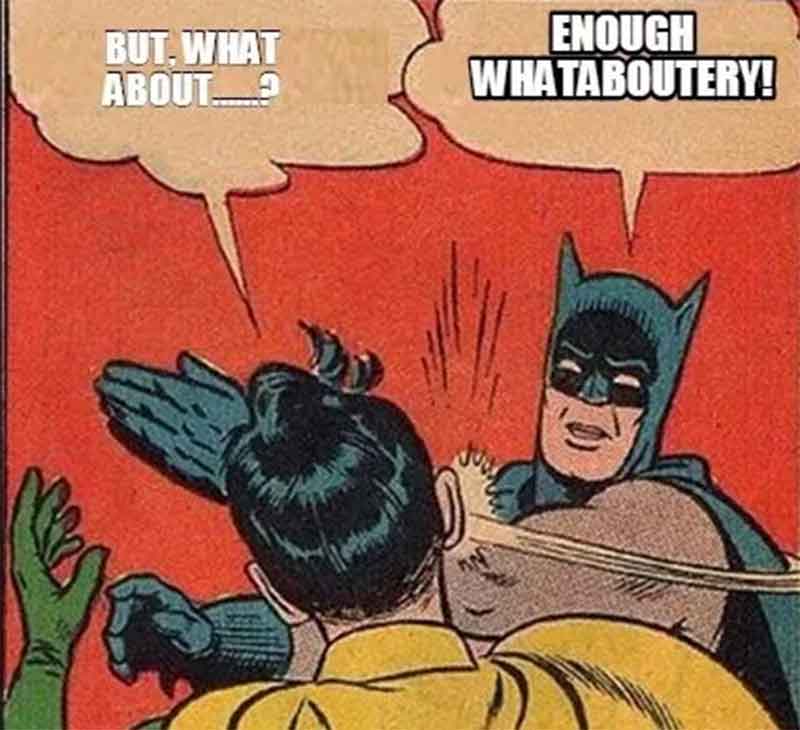
Watch any Indian news debate the evening after a riot, a bank fraud, or a leaked video, and notice what doesn’t happen. Nobody says the act was justified. Nobody says it was wrong, here’s why it happened, here’s what we’re doing about it. The spokesperson does something else. The rationality goes down the drain. They reach backwards, to a different year and a different party, and hand the accusation back unopened. Ask about Manipur, get an answer about 1984. Ask about electoral bonds, get an answer about the 2G scam. The charge is never met. It’s returned.
That reflex has a name. “Whataboutery” was coined in January 1974, when a history teacher named Sean O’Conaill wrote to the Irish Times describing people who answered every condemnation of the Provisional IRA with a claim about the greater sins of “the enemy.” Days later, the columnist John Healy turned the phrase into “whataboutery” in print. The move itself is older still. The Sophists of pre-Socratic Greece taught it as a way to win an argument without disproving the claim in front of you. And by the 1970s and 80s it had become the Soviet Union’s standard answer to Western criticism of the gulags: what about American segregation? What’s changed in India isn’t the existence of the tactic. It’s that whataboutery has stopped being one weapon among several and become nearly the entire arsenal. And Indian politics is dying amidst all this.
Ask a BJP spokesperson about the 2023 Manipur violence, where the death toll eventually reached 258, and Narendra Modi stayed publicly silent for more than two months before finally speaking, only after a video surfaced of two women being paraded naked by a mob, and the conversation routes to the 1984 anti-Sikh pogrom under Congress, in which the government’s own commission counted 2,733 dead in Delhi alone. Ask a Congress spokesperson about that 1984 number. 2002 Gujarat comes back at you, where the state’s own figures put the toll at 1,044, independent estimates running closer to 2,000. Neither number is ever allowed to stand on its own. Each exists only as a rebuttal to the other, which means neither one actually gets investigated in the only forum most Indians ever encounter it: the evening debate.
Corruption follows the same ‘path’. The Bofors scandal, a roughly ₹64 crore kickback on a 1986 howitzer deal that helped cost Rajiv Gandhi’s Congress the 1989 election, gets answered with Rafale. Rafale gets met with the 2018 Punjab National Bank fraud, in which Nirav Modi and his uncle Mehul Choksi allegedly siphoned ₹14,357 crore and left the country in early January, weeks before the fraud became public. That gets met with the 2G spectrum allocation, where the CAG’s 2010 audit under the UPA government put the presumptive loss at ₹1.76 lakh crore, a figure the government of the day called mythical. And when the Supreme Court struck down the BJP’s electoral bonds scheme in February 2024 for letting anonymous money fund political parties, the defence on air wasn’t an account of why the scheme existed. It was a reminder that Congress ran on unaccounted cash for decades before 2017. Every era’s opacity becomes the alibi for the next era’s opacity.
There’s a reason this specific move has taken over, and the reason sits in psychology. Leon Festinger’s 1957 theory of cognitive dissonance describes what happens when a belief a person holds, my party stands for good governance, collides with an inconvenient fact: my party’s government did this. The mind rarely updates the belief. It looks for the cheapest way to discount the fact, and pointing at someone else’s worse fact is cheap precisely because it requires denying nothing, only changing what’s being measured against what.
Add Henri Tajfel and John Turner’s social identity theory from 1979, which holds that people draw part of their self-worth from group membership and will systematically judge the in-group more charitably than the out-group to protect it, and you get exactly what plays out on Indian television most nights. The in-group’s worst moment gets shrunk by inflating the out-group’s worst moment, and the viewer leaves with two grievances confirmed.
Call this the slow poisoning, because that’s what it is functionally. One act of whataboutery doesn’t do much damage on its own. It’s a debate trick, and most people can see through a debate trick. The damage is cumulative. Every scandal that never gets adjudicated on its own facts becomes the floor the next scandal is measured against. And that floor keeps dropping, because nothing above it was ever actually resolved. Once ₹1.76 lakh crore gets called a myth, ₹16,518 crore in electoral bonds looks unremarkable by comparison. The currency of political defence has stopped being facts and become relative ranking against history’s worst entries. Welcome to the era of post-truth and whataboutery.
The complication is that fact-based accountability hasn’t disappeared entirely. In December 2018, thirty-four years after the anti-Sikh riots, the Delhi High Court convicted Congress leader Sajjan Kumar and sentenced him to life. A verdict decided on evidence about that riot.. But it took thirty-four years to produce one high-profile conviction out of thousands of deaths, which tells you how rare that kind of reckoning has become, not how common. If fact-based defences, or convictions, started showing up anywhere near as often as the deflections do, if the standard response to a scandal became “here is what happened and here is the consequence” instead of “what about them”, that would be real evidence the pattern is breaking. Through the Manipur debate of 2023 and the electoral bonds debate of 2024, that isn’t what happened. The charge went out. The charge came back, addressed to somebody else.
Get the latest CounterCurrents updates delivered straight to your inbox.
Rahul Banerjee is a postgraduate student at the Department of English and Cultural Studies, Christ University, Bangalore. He is also doing research in Medical Humanities. You can contact the author at [email protected]
Related Stories
 India
India
After Gen Z, India’s Gen Alpha rises, demanding education reforms
22 minutes ago
 India
India
'Mirzapur: The Movie' box office Day 2: Pankaj Tripathi film crosses Rs 50 crore in India
23 minutes ago
 India
India
Rahul a poster boy of negative politics, inherits ‘comprised mission’ legacy of family: BJP chief
1 hour ago
 India
India
Ali Fazal surprises cinemagoers at Mirzapur: The Movie screening in Delhi, fans call it a 'goosebump moment'
3 hours ago
 India
India
Rescuers in Nepal pull 2 people alive from debris 10 days after devastating floods
5 hours ago
 India
India
Rescuers in Nepal find two more people alive after flash flood disaster
6 hours ago
 India
India
Mirzapur The Movie Box Office Collections: Ali Fazal, Pankaj Tripathi, Divyenndu starrer rakes up a fantastic Rs. 25 Cr opening day in India
8 hours ago
The ‘naraaz fufa’ of politics: PM Modi’s latest dig at habitual critics
12 hours ago