
What we know about the 2030 men's FIFA World Cup
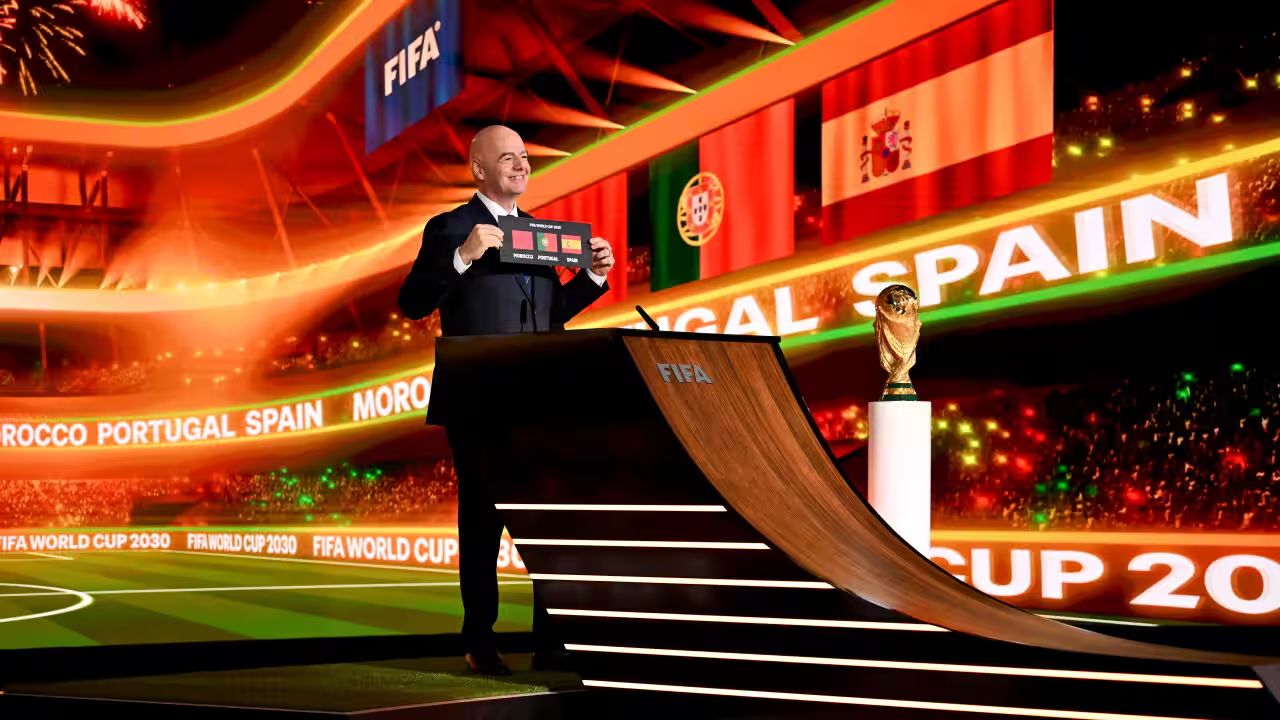
What we know about the 2030 men's FIFA World Cup
The 2026 FIFA World Cup has reached the pointy end, but planning for the next tournament is already well underway.
As the 2026 FIFA World Cup draws to a close, many football fans will already be looking ahead.
The next men's World Cup is still four years away, but many of the major details have already been confirmed for what is shaping up to be one of the most unique tournaments in the competition's history.
Here's what you need to know about the 2030 FIFA World Cup.
Who is hosting the 2030 World Cup?
The 2030 World Cup will be staged across three continents — South America, Europe, and Africa.
Your trusted source for staying up-to-date with the world around you. Get free daily news updates and analysis, straight to your inbox.
Uruguay, Argentina, and Paraguay will each host one match, with Uruguay also staging the centenary celebration to mark 100 years since the inaugural FIFA World Cup.
The tournament will then move to Spain, Portugal, and Morocco for the remainder of the competition.
The decision reflects the tournament's history.
Uruguay hosted and won the first World Cup in 1930, while Argentina was awarded a centenary match after reaching that inaugural final against Uruguay.
Paraguay was also awarded a centenary match because it hosts CONMEBOL, South America's football governing body.
Has anyone qualified for the 2030 World Cup?
As co-hosts, Uruguay, Argentina, Paraguay, Spain, Portugal, and Morocco have automatically qualified.
No other nations have secured a place, with the remaining spots expected to be decided through regional qualifying matches played between 2027 and 2029.
A major detail yet to be confirmed is how many teams will compete.
The 2026 World Cup expanded from 32 to 48 teams, with 12 groups of four. The top two teams from each group, along with the eight best third-placed teams, advanced to the Round of 32.
The new format also replaced goal difference with head-to-head record as the first tiebreaker during the group stage.
CONMEBOL has proposed expanding the tournament even further to 64 teams.
If adopted, the tournament would likely feature 16 groups of four, with the top two teams from each group progressing to the knockout stage, eliminating the need for the best third-placed qualification system.
However, such an expansion would present significant logistical challenges, requiring additional venues and a larger match schedule.
FIFA is yet to release the full match schedule, but has confirmed special arrangements to accommodate the teams beginning the tournament in South America.
The governing body says the six teams playing their opening matches in Uruguay, Argentina, and Paraguay will receive 11 to 12 days before their second group game, while their opponents will have five to six days for travel and recovery before those fixtures.
FIFA is yet to confirm which country will host the final.
For the latest from SBS News, download our app and subscribe to our newsletter.
Related Stories
 AI News
Remote Work May Be a Bigger Threat to New Grads Than AI
4 minutes ago
 AI News
Stocks in news: DMart, HCL Tech, ICICI Pru AMC, Dr Reddy’s, NTPC, IndiGo
7 minutes ago
 AI News
India to augment AI compute capacity
8 minutes ago
 AI News
Google Cloud expands partnership with Samsung to accelerate agentic AI
9 minutes ago
 AI News
Alfred Dreyfus statue to finally receive permanent home in central Paris
56 minutes ago
 AI News
‘Spermageddon’: is the world facing a male reproductive crisis?
56 minutes ago
 AI News
World Cup power rankings: France, Spain, Argentina and England were the top 4 all along
57 minutes ago
 AI News
US launches new attacks on Iran, killing one person, state media reports
57 minutes ago