
What made this World Cup different?
This wasn’t like any other World Cup.
At least to many North Americans, this one felt different. It was real and intense, like it meant something.
It made history as the first FIFA World Cup hosted by three different countries, but none of those countries managed to secure a quarterfinal bid.
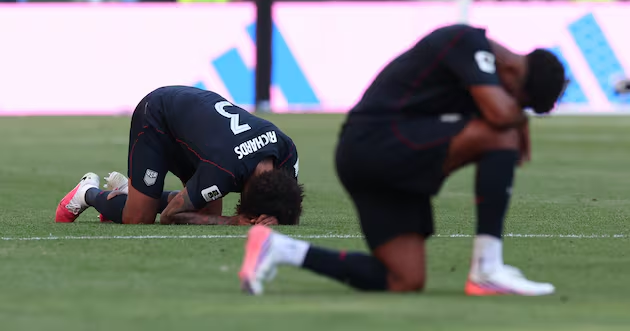
The U.S. squad repeated a familiar story: make it to the round of 16, face a European powerhouse, then go home early. The 4-1 loss to Belgium on Monday was another one of those stingers. The only goal for the U.S. came as Malik Tillman evened the match at one apiece in the 31st minute.
But the night proved to not belong to the U.S., as Belgium dominated with three more goals before the match’s end.
“I think we were not good enough. It wasn’t our day. We didn’t perform in the way that we’re supposed to perform or show our quality,” head coach Mauricio Pochettino said. “All that was happening around was around, but I think it wasn’t a situation that affects us in the group.”
Highlighted by off-field decisions regarding Folarin Balogun’s one-game suspension being lifted, a plethora of mistakes and an injury to star player Christian Pulisic, Pochettino was right when he said it wasn’t their day.
Despite the lackluster finish, the support raised throughout the country shows how far the sport has come, and brings hope for further improvement.
Canada finished deeper than it had at any other World Cup. Having never advanced to the knockout stage until it expanded to 32 teams, a late-game goal from Stephen Eustaquio secured the country’s first-ever round of 16 spot in a 1-0 victory over South Africa.
Morocco ended the dream, defeating the northern host in demanding fashion, 3-0.
Still, it was still a great showing for the host country. A barrier was broken for Canada.
“What a privilege our fans have had to root a team on like this, that goes after the game, that doesn’t play defensive, that shows that they can be better,” Canada head coach Jesse Marsch said when asked about what the future might look like for Canadian soccer. “Right, of course, we have to be in these situations more and more, and we have to find ways to succeed, and we have to build from that. But what a great team.”
The coach doubled down on his vision for the future.
“I’d rather be us than them, as good as Morocco is, I’d rather be us.”
Having a World Cup hosted in your country can bring about massive change, as the U.S. can attest. After a historic showing like this, Canada looks to be in good position to up its presence in the soccer community.
The whole country backed the southern host as the fans packed massive Azteca Stadium and filled it with excitement and hope. Then the team won all three games during group play.
The hot start instilled belief in the team to make a deep run, as it did when it reached the quarterfinals both times the country hosted before. The hope was drained after Mexico’s match with England.
Going down 2-0, Mexico clawed back, cutting the deficit to 3-2 after a goal from Raul Jimenez in the 69th minute. But England was able to withstand Mexico’s pressure and held tight defensively to escape the legendary Azteca with a win.
“It’s going to be a tough night. Honestly, for a while now, I’ve felt so proud to be Mexican — proud to wear this jersey and proud to belong to this national team, to this family — because I think we played with great honor,” Erik Lira said after the loss. “To be honest, I’m not satisfied, but I am happy with what we achieved.”
Looking ahead, Lira believes the team holds a bright future.
“Today, we planted a seed that we’ll look back on in the future, and I’m certain that great things lie ahead for us.”
From tourists raving about the U.S. to the massive fanfare supporting their countries, the U.S. turned out to be a great fit for co-hosting the massive tournament. With massive stadiums already prepared and plenty of different places and cultures to discover across the 3,000-mile stretch between stadiums, it seemed everyone won.
However, amid all of the fun stories surrounding the World Cup, much of the credit for its unique feel lies with how far the U.S. has come in its appreciation for soccer. When it was hosted in the states 32 years ago, the sport was hardly on any radars, but 1994 left a lasting impact.
“Having the World Cup here in ’94 is what really planted the seeds for Major League Soccer,” Real Salt Lake vice president of communications Trey Fitz-Gerald said.
Founded to help secure a host bid, Major League Soccer wanted to ensure the sport continued to grow after the World Cup left the U.S. Now, the original 10-team league is made up of 30 squads, not to mention the eventual birth of the National Women’s Soccer League in 2012, bringing soccer closer than ever to American homes.
The new league allows kids to find athletes and role models within the sport of soccer close to home. Now they can attend matches and become inspired to chase after the sport.
Fitz-Gerald said the league has only been around for about a generation and a half, while “other countries around the world have a 100-year head start on us” at the professional level.
Just like other sports in the U.S., it takes time to build a following, but he says the U.S. is currently in a good spot.
Trying to follow global storylines in a country where soccer was simply not popular was “difficult” to do in 1994.
“There wasn’t mainstream media coverage. Unless you traveled to another country, you probably didn’t experience it,” Fitz-Gerald said. However, “the rise of the internet shrank the world.”
Now more and more people are following soccer storylines across the world thanks to increased coverage by media outlets and social media. In 1994, players like Roberto Baggio, Diego Maradona and Romario were not well known leading up to the United States’ first World Cup, but this time, everyone already knew Lionel Messi, Cristiano Ronaldo and Kylian Mbappé before it began this year.
The hype existed well in advance.
Mexico soccer fan David Brindis said he is excited for what the World Cup did in his home country. Originally from Puebla, Mexico, three hours south of Mexico City, he said it was a sight to see everyone together watching the World Cup on home soil. He now lives in Utah County.
“Most of the time we grew up watching the national team just going to different countries and celebrating there, watching the games on TV,” he said. “But having it especially three hours from my house, it’s one of those opportunities that are not going to come back too often.”
Having lived in the U.S. for six years now, he believes there is more education surrounding the sport than when he first moved here and says it is cool to see how it is uniting people in the U.S. just like it has always done in his home country.
“That’s what soccer means, you know, connecting people. It doesn’t matter where you are,” he said. “If you come from Mexico and watch a game in Canada, you can celebrate with those people, right? You come to the U.S., it’s the same. They feel that connection between them.”
“They like the same sport and they just want to celebrate no matter what.”
And the World Cup is evidence of that connection and unique feel.
Related Stories
 World
World
Raising children amid air alerts and explosions
27 minutes ago
 World
World
School roof collapse kills at least 29, injures more than 3 dozen in Pakistan
27 minutes ago
 World
World
Couple drive 66,000 miles around world in campervan
28 minutes ago
 World
World
Heavy rain shuts down Istanbul, causing flooding and 2 deaths
1 hour ago
 World
World
Clock ticking for leap second: Why timekeeping could change forever
1 hour ago
 World
World
Fuel crisis hits Bali
2 hours ago
 World
World
The problem with living in a rich man’s world | Letters
2 hours ago
 World
World
North Korea holds first underwater
2 hours ago