
World Cup 2026 crowds take celebrations to the next level
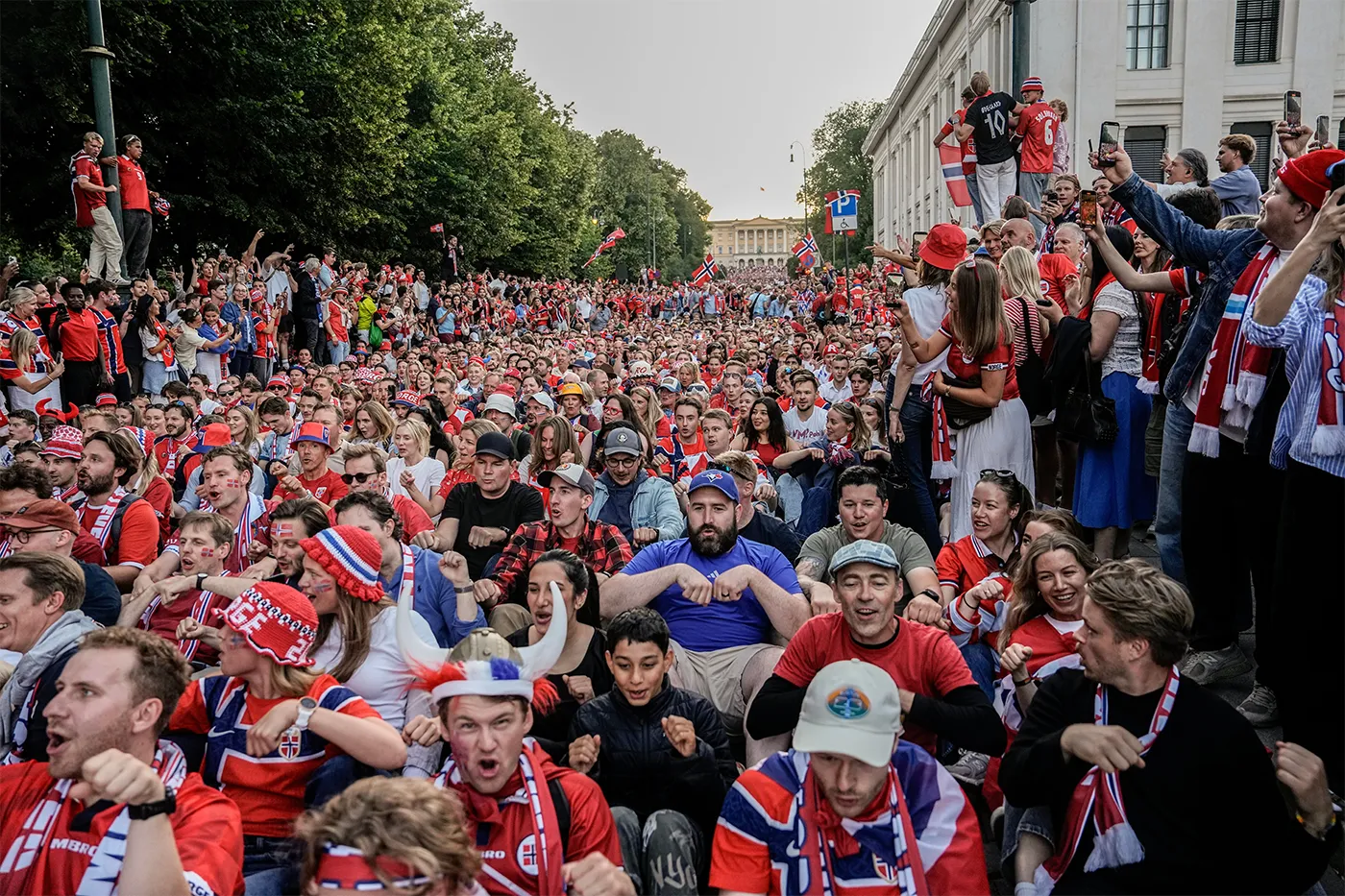
“Row! Row! Row!” a crowd of Norway football fans chants in unison as they steer a fleet of invisible longships up a Boston escalator, where they were recently spotted by Northeastern University communication studies professor Stephen Warren on his way home after a Norway-Iraq watch party.
Created by superfan Ole Frøystad in 2025, the “Viking row” has swept the globe during the 2026 World Cup, erupting everywhere from New York’s Times Square to the Norwegian Parliament, where politicians joined in the viral trend.
Norway football fans are not the only ones breaking into what looks like spontaneous street theater these days. The Dutch Oranje Bus Parade in Monterrey, Mexico, had arm-linked fans hopping in unison as they performed the iconic left-right jumping dance. The Scottish “Tartan Army” swept through Boston around Scotland’s June 13th opening match, with thousands of kilted fans marching through Fenway Park to the sound of bagpipes and “putting traffic cones on top of things,” Warren says. The makeover dates back to 1980s Glasgow, where the Duke of Wellington statue at the Gallery of Modern Art was first spotted sporting the humorous headpiece.
Ray Butler, owner of Boston’s “The Banshee” pub that has been airing games throughout the tournament, said that out of all the crowds, “definitely the Scottish have had the greatest impact” in terms of how strongly their presence was felt in the city.
At first glance, these performances seem to erupt out of nowhere. But is that really the case?
Professor Brennan Klein, who studies dynamics of complex systems at the Northeastern Network Science Institute, thinks there’s a method to the joyful madness. He sees crowd performances as examples of the “collective behavior synchronization phenomenon” often seen in nature. It allows birds to perform virtuosic maneuvers, a paper he co-authored explains. The Dutch dance might have fewer mid-air somersaults, but it looks just as complex.
According to Klein’s paper, a school of fish is also endowed with a collective sensory system that picks up cues and allows information to spread quickly. It snaps into action as a single unit thanks to a reaction from a few members.
Northeastern Global News, in your inbox.
Sign up for NGN’s daily newsletter for news, discovery and analysis from around the world.
When it comes to the Dutch left-right dance, Klein explains that the “seasoned fans” have to be tuned in to the crowd to sense how “ripe” it is to get going. As for the Viking Row, it takes a few committed members to kick things off at a key moment — and before you know it, the whole stadium (or escalator) has set sail.
It’s a “kind of planned spontaneity,”said Klein.
Northeastern communication studies professor Steve Granelli thinks the group action is all about a sense of belonging. Identifying as a fan calls for active engagement in certain behaviors, he said.
“Instead of just all wearing the same jersey or rooting for the same team, we all now are speaking the same language of fandom,” Granelli explained. “We all know how to do this row and what this means for us.”
Why this year in particular? Klein said he thinks social media has a lot to do with it. Well before the World Cup, montages of football team footage set to “a silly song” or “catchy” chant started to make their way through TikTok and Instagram. Soon after, images started to appear of people in Kansas “going left to right down the street,” he said.
Granelli added that there’s an element of competition at play. While most supporters won’t reach the level of “superfans” inventing the chants, there are more realistic targets, such as having a video go viral, he said. And seeing longer ground-level clips of fans fumbling through the steps makes it feel achievable.
Fan crowds have also been remarkably peaceful. Granelli talks about seeing a tearful Japanese fan being consoled by Brazilian counterparts after a close match between the two teams ended in a winning goal by Brazil.
Similarly, when a lone Dominical Republic fan broke out in a national anthem solo, the sea of yellow-jerseyed Colombia supporters respectfully gave him the floor and even applauded at the end.
Granelli thinks the global scale of the World Cup makes local rivalries between teams fall by the wayside. All of a sudden, I get to root for who I perceive to be the best of the best,” he said.
Warren pointed out the positive mood of the celebrations.
“These international stages … only happen once every few years, and people are just so excited to see their country represented,” he said, explaining that with only so much time in the spotlight, it makes sense to use the time wisely.
That doesn’t mean that mob mentality is harmless. Fun celebrations can turn on a dime. Take the 2026 Paris Saint-Germain riots that ended in hundreds of arrests and injuries after clashes erupted between football fans and police across France following the team’s victory in the Champions League final against Arsenal.
There have also been isolated cases of football festivities gone wrong during the World Cup. After Mexico’s June 30 knockout victory against Ecuador, four people died in a crowd surge after a celebration, while a San Jose watch party led to two stabbings and multiple arrests. Morocco’s recent victory also led to unrest in the Netherlands.
The experts warn that any unexpected wins or losses in the final stretch of the tournament could ignite tempers, and it’s always best to be prepared.
Northeastern engineering professor Michael Silevitch, who serves as director of Soft Target Engineering to Neutralize the Threat Reality (SENTRY), has been helping design ways to keep 2026 World Cup Stadiums secure. While he agreed that large crowds are vulnerable to internal discord, he said that the threat of an outside attack outweighs that of the crowd itself going off the rails.
SENTRY has been trying to get ahead of the possible danger by building “digital twins” of venues to simulate possible attacks, Silevitch explains. Running through a gaming scenario allows possible outcomes to be tested before they happen, he said.
As for tips on staying safe in the crowd, Silevitch suggested the classic guidance of, “see something, say something!”
Related Stories
 World
World
Manchester United weigh up stunning move for Real Betis and ex-Tottenham forward Troy Parrott
1 day ago
 World
World
Israeli police arrest 10 following weekend attacks by settlers on journalist and diplomats
1 day ago
 World
World
Trump says suspension of Russia sanctions is to keep peace negotiations going
1 day ago
 World
World
Ukrainian drones strike St. Petersburg oil facilities | NHK WORLD
2 days ago
 World
World
Victoria Falls stadium in Zimbabwe nears completion for CWC27
2 days ago
 World
World
‘The world will be amazed:’ Iran’s commanders prepare for further war
2 days ago
 World
World
Festival opens with musket salute in Sakai, Osaka
2 days ago
 World
World
Trump's new pitch for Republican candidates — they're really good
2 days ago