
Was this the week Mark Zuckerberg lost control of AI?
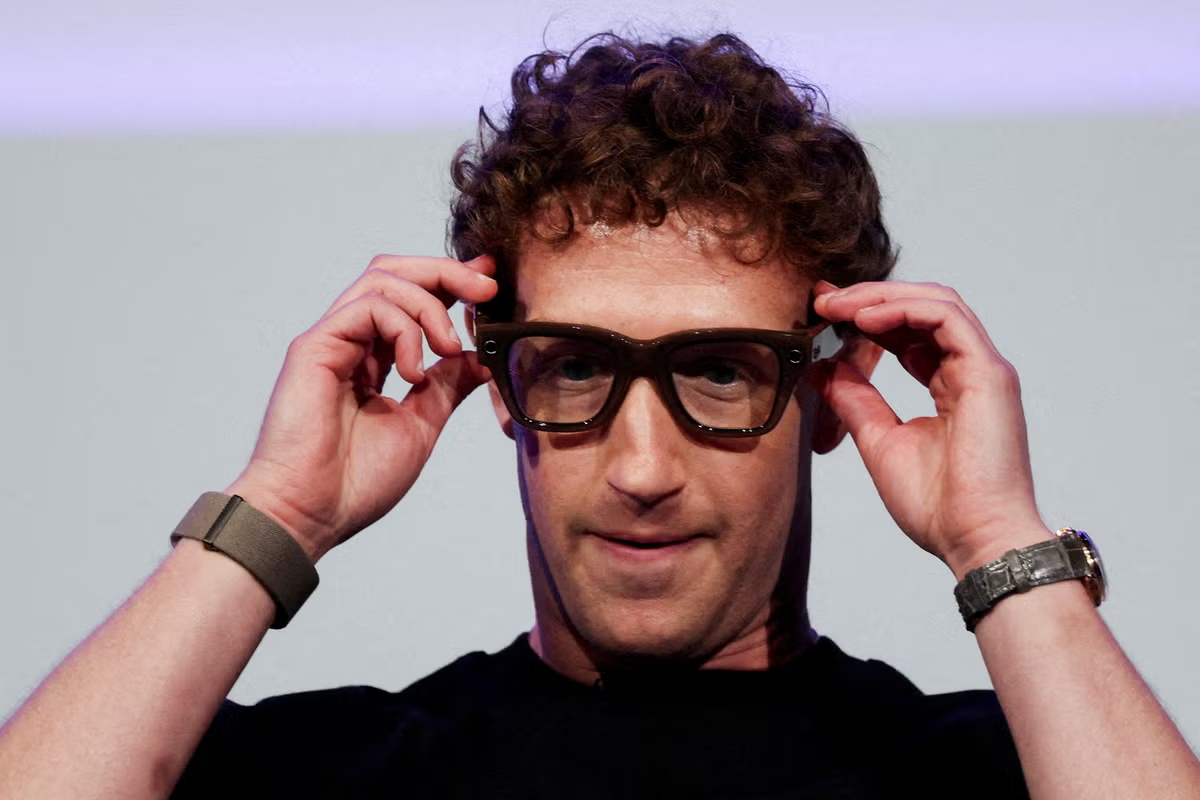
There weren’t many “likes” from Wall Street when Mark Zuckerberg unveiled Meta’s quarterly results on Wednesday.
Investors appear increasingly unsure whether the 42-year-old co-founder, chairman and CEO of Meta Platforms and Facebook has taken his latest gamble on artificial intelligence that will confirm his genius and secure his trillion-dollar company’s future… or turn out to be the most expensive bet in corporate history.
Meta’s core businesses – Facebook, Instagram and its advertising empire – remain formidable. Revenues of around $61bn in the second quarter beat expectations, the sort of performance that would once have guaranteed investor applause.
But these are not normal times at Meta.
The company is no longer being judged simply as a social media giant. It is being judged as an AI company. And shareholders are asking whether Zuckerberg’s extraordinary spending spree – investing hundreds of billions into artificial intelligence that can outperform humans – will create the next great technology platform or simply burn through mountains of cash.
The warning sign was free cash flow, the money left after paying for operations and investment. It collapsed to $784m in the latest quarter, compared with $8.5bn a year earlier.
For a company once celebrated as one of the world’s greatest cash-generating machines, this marks a dramatic change. Meta is behaving less like a mature technology business and more like a start-up betting everything on a future that has not yet arrived.
Zuckerberg is spending billions on data centres, computing power and AI talent, in an attempt to compete with Google’s parent company, Alphabet, OpenAI, and the growing number of firms racing to dominate the next technological era.
OpenAI chief executive Sam Altman has been making a similar argument in Washington, warning lawmakers that the next generation of AI models will require vast investment in infrastructure, energy and computing power. The stakes could hardly be higher.
Zuckerberg’s fear is simple: Meta could become a victim of the next technological revolution.
The company owns some of the most influential digital platforms ever created, but it remains dependent on operating systems and devices controlled by others.
Apple has already demonstrated the danger. Its privacy changes have restricted access to some advertising data and challenged Meta’s ability to track users across the internet. For Zuckerberg, the lesson was obvious: it is risky building a global empire on somebody else’s foundations.
That helps explain why Meta has repeatedly searched for the next platform.
Its most famous attempt was the metaverse – the virtual universe where we were all supposed to wear headsets and interact through digital avatars. It consumed billions but failed to capture public enthusiasm.
Now AI has replaced the metaverse as Zuckerberg’s great strategic obsession.
Meta’s AI-powered glasses offer more promise. Sales are rising, and wearable technology could eventually become the gateway to personal AI assistants. If smartphones defined the previous technological revolution, Zuckerberg believes glasses could define the next.
But there is a problem. They are not iPhones.
Consumers may appreciate AI tools that make life easier, but they may be less enthusiastic about devices that make them feel constantly watched. How comfortable are you eating a chocolate bar on a bus when the person opposite wearing smart glasses may be quietly recording you?
Technology companies have repeatedly underestimated the importance of trust.
The challenge for Meta is that the AI race is no longer confined to Silicon Valley. China’s rapidly developing technology sector is also becoming a serious competitor, despite US attempts to restrict access to advanced chips and systems.
Zuckerberg has criticised some elements of Washington’s approach, arguing that America should compete through innovation rather than relying solely on restrictions. He has also backed open-AI models, which developers can adapt and run themselves.
That position is intriguing coming from the boss of Meta, a company whose success has been built on controlling digital platforms and user networks. But it reflects the reality of AI: the winners may not simply be those with the biggest budgets, but those who attract the widest community of developers and users.
Which raises the uncomfortable question: from what we know about Meta, what should worry us more – China’s AI ambitions or Meta’s?
Shares in AI chip companies such as Nvidia fell this week after it was revealed that China’s homegrown giants had made technological breakthroughs that could lower prices and end global hardware-manufacturing monopolies.
This news came as the AI sector was still reeling from the revelation that an experimental next-gen version of ChatGPT, while undergoing testing, managed to access the internet and attack rival systems. These are not science-fiction fantasies, but reminders that increasingly powerful technologies can create risks their makers do not fully understand.
For investors, however, the calculation is simpler. Can Zuckerberg turn hundreds of billions of dollars of spending into a profitable advantage?
Some analysts believe he can. Meta has extraordinary strengths: billions of users, huge advertising revenues and the financial firepower to keep investing when others cannot.
But scepticism is growing. The company that once delivered predictable profits is now asking shareholders to believe in a future built largely on promises. Zuckerberg’s answer is to think bigger – much bigger.
He talks about AI “superintelligence”, and personal assistants that could become constant companions, helping us organise our lives and answer our questions.
It is an extraordinary vision. It is also one that raises another question: do we really want technology companies becoming the invisible managers of our daily existence?
Meta remains one of the great corporate success stories of the modern era. But the greatest winner of one technological revolution does not automatically dominate the next.
The danger for Zuckerberg is not that Meta disappears. It is that it becomes yesterday’s champion – the company that mastered social media but failed to control artificial intelligence.
The gamble is breathtaking. If he is right, Meta could become one of the defining companies of the AI age. If he is wrong, investors may wonder whether hundreds of billions of dollars were spent chasing a future that never arrived.
Hey Siri: can you point me to the exit?
Related Stories
 AI News
Scaling cloud migrations with agentic AI on Amazon Bedrock AgentCore
11 minutes ago
 AI News
AWS vector solutions: Build agentic AI where your data lives
11 minutes ago
 AI News
Top Five Unethical Uses of Artificial Intelligence by Attorneys and Four More
2 hours ago
 AI News
Trial of AI intersections could change traffic management forever
2 hours ago
 AI News
Deere Gets Rolling as AI Buildout Fuels Construction Sales Boom
3 hours ago
 AI News
Many recent grads say AI is making it harder to get a job. Economists aren’t so sure
4 hours ago
 AI News
Artificial Intelligence and the lines I won’t cross
5 hours ago
 AI News
How Frontier AI Models Could Leapfrog Robotics Progress
5 hours ago