
U.S. military strikes targets in southern Iran, citing 'threats posed by Iranian forces'
U.S. military strikes targets in southern Iran, citing 'threats posed by Iranian forces'
U.S. says forces will continue to defend themselves during 'ongoing ceasefire'
The U.S. military carried out strikes in southern Iran Monday against targets including boats attempting to lay mines and missile launch sites, in what it described as defensive actions.
U.S. Central Command said in a statement the strikes were designed "to protect our troops from threats posed by Iranian forces."
"U.S. Central Command continues to defend our forces while using restraint during the ongoing ceasefire," said Navy Captain Tim Hawkins, a Central Command spokesperson.
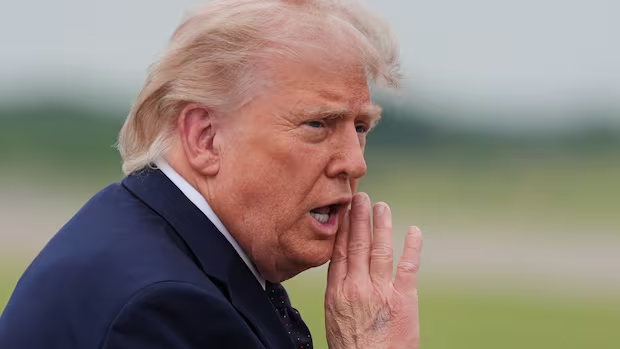
The strikes came hours after Iran and the United States played down hopes for an imminent breakthrough in the three-month-old war, and U.S. President Donald Trump called on several countries to join the U.S.-led Abraham Accords as part of an effort to reach a deal with Iran.
In a Monday morning Truth Social post, Trump said negotiations with Iran were "proceeding nicely" but gave no indication a deal was imminent, describing the process as a "very complex puzzle."
Trump added that he spoke to the leaders of Qatar, Pakistan, Egypt, Jordan and Turkey on Saturday and that "it should be mandatory" that those countries sign on to the Abraham Accords to normalize relations with Israel, given the effort Washington has put into trying to end the nearly three-month long war.
Signing on would "bring true Power, Strength, and Peace to the Middle East," Trump argued.
Abraham Accords signed at the White House
Trump said he also spoke to the leaders of Saudi Arabia and Bahrain, who've previously agreed to the accords.
The linking of a permanent ceasefire to the accords was previewed this weekend by Sen. Lindsey Graham of South Carolina and other Trump-supporting U.S. officials.
"To Saudi Arabia and others: Now is the time to be bold for the future of a new Middle East. I expect, as President Trump has suggested, you will in fact join the Abraham Accords effectively ending the Arab-Israeli conflict," Graham posted on social media.
"If you refuse to go down this path as suggested by President Trump, it will have severe repercussions for our future relationships and make this peace proposal unacceptable."
Israeli Prime Minister Benjamin Netanyahu's office did not immediately respond to a request for comment on Trump's post. Netanyahu said on Sunday that he and Trump agreed that any final agreement with Iran must remove the nuclear threat posed by Tehran, including dismantling Iran's nuclear enrichment facilities and removing enriched nuclear material from its territory.
Nuclear issues not being discussed, Iran says
Earlier, U.S. Secretary of State Marco Rubio told reporters in New Delhi that the U.S. would give diplomacy every chance to succeed before exploring "alternatives," after Trump said on Sunday that he had told his representatives not to rush into any Iran deal.
There was a "pretty solid thing on the table in terms of their ability to open up the [Strait of Hormuz], get the strait open, enter into a very real, significant, time-limited negotiation on the nuclear matter, and hopefully we can pull it off," Rubio said.
Iran's foreign ministry spokesperson Esmaeil Baghaei said on Monday that Iran was negotiating an end to the war and was not currently discussing nuclear issues.
The spokesperson added that a framework had been reached but no one could say an agreement between the United States and Iran was imminent.
The potential memorandum of understanding contained no specific details about the management of the Strait of Hormuz, which belongs to the coastal countries, he said.
U.S., Iran claim progress on peace deal
Trump raised expectations of an imminent deal on Saturday when he said Washington and Tehran had "largely negotiated" a memorandum of understanding on a peace agreement that would reopen the strait.
Iran's foreign ministry spokesperson said on Monday that Iran would not take tolls for passage through the vital waterway, but added that it was "normal for services provided to require a price."
Before the conflict, the strait had carried a fifth of global shipments of oil and liquefied natural gas.
The two sides remain at odds on several difficult issues, such as Iran's nuclear ambitions, Israel's war in Lebanon with the Iranian-backed Hezbollah militia and Tehran's demands for the lifting of sanctions and the release of tens of billions of dollars of Iranian oil revenues frozen in foreign banks.
Tehran has also demanded a halt to all Israeli attacks in Lebanon as a condition in talks with the U.S. aimed at ending the broader war.
But Netanyahu said he and Trump agreed in a weekend phone call that Israel would retain the right to confront perceived threats on all fronts, including Lebanon.
Netanyahu doubled down on that message on Monday night, saying in a video released on Telegram: "We are at war with Hezbollah, and we will intensify our strikes."
He said Israel's military was not taking its "foot off the gas. On the contrary, I said to step on the gas even more."
There was no immediate comment from Hezbollah or from Lebanese officials.
Iran has long denied U.S. and Israeli accusations that it is pursuing nuclear weapons and says it has a right to enrich uranium for civilian purposes, although the purity it has achieved far exceeds that needed for power generation.
Trump, whose approval ratings have been hit by the war's impact on U.S. energy prices, and who has faced congressional efforts to curb his war powers, has repeatedly played up the prospect of a deal to end the conflict started by the U.S. and Israel on Feb. 28.
A tenuous ceasefire has held since early April.
Any deal reinforcing the current fragile ceasefire would bring relief to markets but not immediately defuse a global energy crisis, which has driven up costs of fuel, fertilizer and food.
Why the U.S. 'silver bullet' strategy isn't working against Iran | About That
The U.S.-Israeli bombing of Iran killed thousands of people in Iran before it was suspended in early April.
Israel has also killed thousands more and driven hundreds of thousands from their homes in Lebanon, which it invaded in pursuit of militant group Hezbollah, which is allied with Iran. Iranian strikes on Israel and neighbouring Gulf states have killed dozens.
Related Stories
 World
World
Iran increases threat to Strait of Hormuz shipping, and other Middle East developments
29 minutes ago
 World
World
World Athletics seeks two new members for Nominations Panel
1 hour ago
 World
World
Netflix secures 2030 World Cup rights in Spain and Andorra
1 hour ago
 World
World
World Juniors: Saudi Lad Creates a Ripple
2 hours ago
 World
World
Hurricane Simon, storm Rachel leave 5 dead in western Mexico
2 hours ago
 World
World
Video. Latest news bulletin | October 13th, 2026
2 hours ago
 World
World
Heathrow's Northern Runway has tarmac replaced in overnight works
3 hours ago
 World
World
Report: Gianni Infantino received undisclosed US$1.7M World Cup payment
3 hours ago