
U.S. kills 3 people on alleged drug
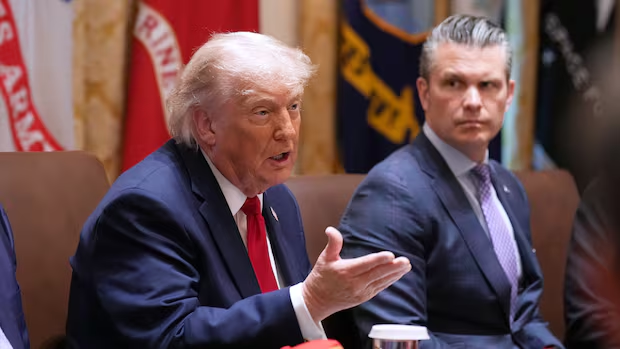
U.S. kills 3 people on alleged drug-carrying boat, as senators demand to see unedited video of strikes
Capitol Hill frustration over strikes is spilling over into negotiations on military spending bill
The U.S. military attacked a boat accused of smuggling drugs in the eastern Pacific Ocean on Thursday, killing three people, as the Trump administration continues its campaign against alleged traffickers in Latin America.
The latest attack brings the number of people killed in boat strikes by the U.S. military to at least 211 since the Trump administration began targeting those it calls "narcoterrorists" last September.
As with most of the military's statements on strikes in the eastern Pacific Ocean and Caribbean Sea, U.S. Southern Command said it targeted the alleged drug traffickers along known smuggling routes. The military did not provide evidence that the vessel was ferrying drugs.
A video posted on X showed a boat speeding through the water before being struck and bursting into flames.
President Donald Trump has said the U.S. is in "armed conflict" with cartels in Latin America and has justified the attacks as a necessary escalation to stem the flow of drugs into the United States and fatal overdoses claiming American lives. But his administration and U.S. Secretary of War Pete Hegseth have offered little evidence to support its claims of killing narcoterrorists.
Trump's homeland security chief says pressure on Mexican cartels pushing crime to Canadian border
Trump says Tren de Aragua gang leader killed via U.S. military strike
Critics have questioned the overall legality of the boat strikes as well as their effectiveness, in part because the fentanyl behind many fatal overdoses is typically trafficked to the U.S. over land from Mexico, where it is produced with chemicals imported from China and India.
Gen. Francis Donovan, who leads the U.S. military's Southern Command, said in testimony to Congress in March that boat strikes "will be one of the main tools, and probably not the most effective," in stemming the flow of drugs to North America.
Insight Crime, a think-tank tracking the flow of illegal drugs globally, said in an April report that while the campaign has disrupted specific routes, its effect on cocaine trafficking is questionable.
Senators on Thursday demanded that the Pentagon release "unedited video" of the strikes.
According to reports from both Politico and the Washington Post on Thursday, several senators are promising a fight over the next military spending bill. The senators are reportedly threatening to cut Hegseth's travel budget, due to frustration over a lack of transparency from the Pentagon about the boat strikes in Latin America, as well as a U.S. airstrike in late February that struck a school for girls in Iran.
The U.S. military's first strike in early September drew particular concern from some lawmakers and those who study military law. Two men on the boat initially survived the attack that killed nine others, and they were clinging to the wreckage when the vessel was struck again, killing them.
U.S. lawmakers ramp up pressure to release boat strike video
The White House confirmed the follow-up strike, insisting it was done "in self-defence" to ensure the boat was destroyed and in accordance with the laws of armed conflict.
But some legal scholars said a second strike killing survivors would have been illegal under any circumstance, armed conflict or not.
As well, some experts are concerned by that strike because a drug-carrying vessel would typically have far fewer than 11 people on onboard.
Volker Türk, the UN high commissioner for human rights, called for an investigation into the strikes, while independent legal experts appointed by the UN have said the use of such lethal force violates international laws of the sea and amounts to "extrajudicial executions."
The Pentagon's watchdog said in May that it plans to look into whether the U.S. military followed an established targeting framework when carrying out the strikes. However, the evaluation is focused specifically on what's known as the six-phase Joint Targeting Cycle and not on the legality of the strikes, the inspector general's office said.
Canada 'continues to monitor' U.S. boat strikes in Caribbean as questions swirl and allies squirm
U.S. says it worked with Ecuador to bomb alleged drug-trafficking operations site
The first several strikes beginning in September focused on vessels in waters between Venezuela and Trinidad and Tobago. But they soon expanded to other waters in the Caribbean.
The handful of survivors from the dozens of strikes were quickly repatriated to countries such as Ecuador and Colombia, instead of being detained for arrest or to gain more information about the drug smuggling.
While the flow of dangerous drugs to the U.S. has been cited as the legal underpinning for the strikes, Trump recently pardoned former Honduran president Juan Orlando Hernández just one year into a 45-year sentence in a U.S. prison for helping drug traffickers aligned with Mexico's Sinaloa cartel move cocaine into the U.S.
Trump framed the prosecution of the right-wing Honduran as politically motivated and a "setup" by the Justice Department in predecessor Joe Biden's administration, even though the origins of the prosecution predate Biden's term. As well, Tony Hernández, the politician's brother, remains imprisoned in the U.S. for similar crimes.
Related Stories
 World
World
Manchester United weigh up stunning move for Real Betis and ex-Tottenham forward Troy Parrott
2 days ago
 World
World
Israeli police arrest 10 following weekend attacks by settlers on journalist and diplomats
2 days ago
 World
World
Trump says suspension of Russia sanctions is to keep peace negotiations going
2 days ago
 World
World
Ukrainian drones strike St. Petersburg oil facilities | NHK WORLD
2 days ago
 World
World
Victoria Falls stadium in Zimbabwe nears completion for CWC27
2 days ago
 World
World
‘The world will be amazed:’ Iran’s commanders prepare for further war
2 days ago
 World
World
Festival opens with musket salute in Sakai, Osaka
2 days ago
 World
World
Trump's new pitch for Republican candidates — they're really good
2 days ago