
University-backed funds target Hong Kong’s deep
Two of Hong Kong’s leading universities this week launched separate investment vehicles to speed the commercialization of academic research, marking a broader shift toward direct university-backed venture investing as the city seeks to build a deeper innovation economy.
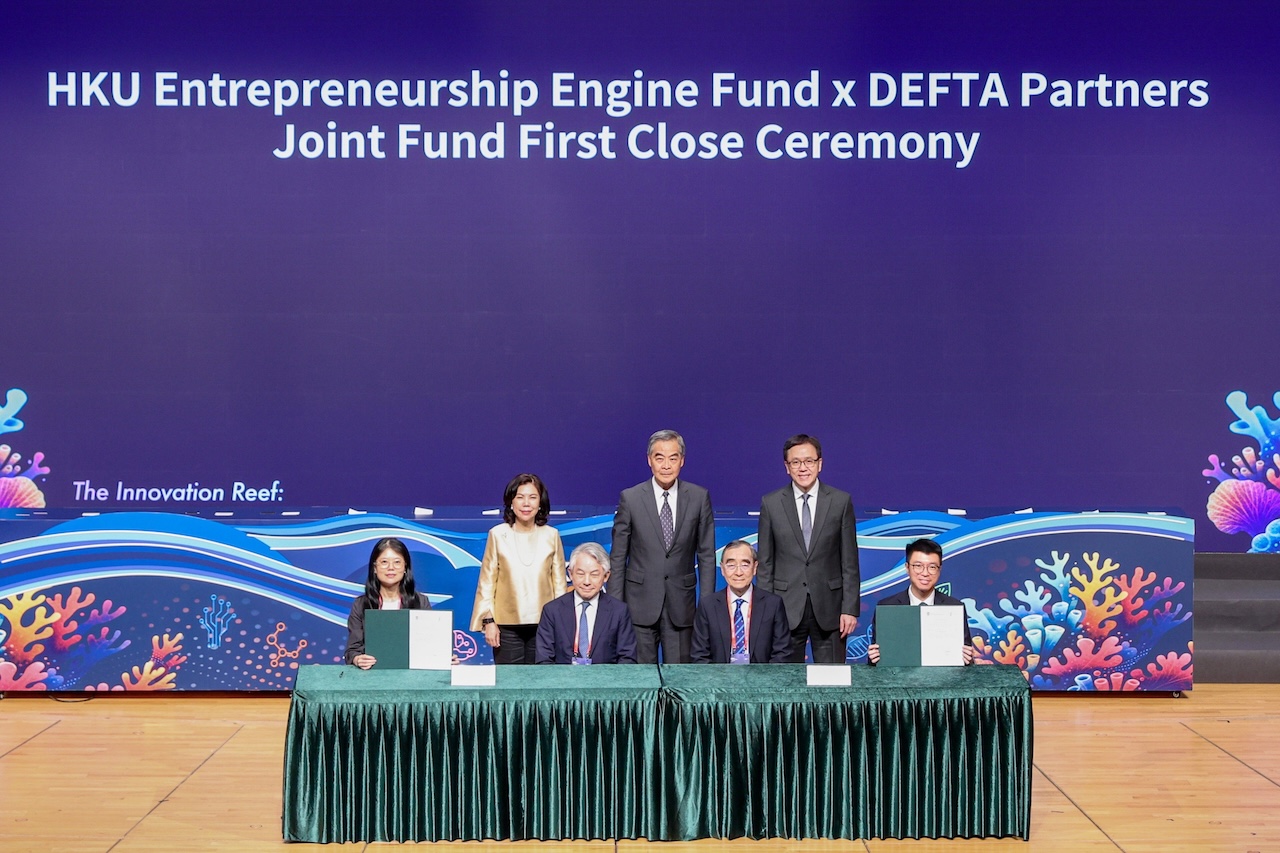
The University of Hong Kong (HKU) announced on 14 October the first close of a joint fund between its HKD 1 billion Entrepreneurship Engine Fund (EEF) – a strategic fund-of-funds initiative – and Silicon Valley venture capital firm DEFTA Partners.
The joint fund is targeting HKD 160 million (USD 20.4 million). HKU also launched the Strategic Partnership Alliance for Research and Commercialisation (SPARC), a network of more than 40 corporate and institutional partners.
Two days later, the Hong Kong University of Science and Technology (HKUST) launched its HKD 100 million RAISe+ Project Fund (RPF), capitalized entirely by returns from its previous spin-out companies – a structure the university described as the city’s first dedicated reinvestment of commercialization proceeds into a new generation of research ventures.
Both initiatives provide patient capital to early-stage, deep-tech ventures that typically face a funding gap between laboratory validation and market-ready products. But their approaches differ in notable ways.
HKU’s fund is a partnership with an external venture capital firm with a four-decade track record in life sciences and information technology, and forms part of a broader HKD 1 billion fund-of-funds strategy.
Startupbusiness.it learned that the first close amounted to roughly half of the HKD 160 million target, with fundraising for a second close ongoing and possible participation from European limited partners, among others.
The vehicle is expected to have a 7+3-year structure and will target seed- and early-stage ventures emerging from HKU’s ecosystem, with an initial focus on life sciences and medical technologies.
Ambassador George Hara, the founder of DEFTA Partners – a venture capital firm with offices in San Francisco, Tokyo and Hong Kong – framed the partnership in terms of industrial creation rather than incremental funding.
“Hong Kong has been very successful because of real estate, financial, logistics and tourism,” he said at the launch. “But in order to create a new future for Hong Kong, I believe Hong Kong should create new technology-based industries.”
Hara pointed to a brain-drain concern: biotechnology PhD graduates often leave Hong Kong for lack of local employment opportunities. Creating technology industries, he argued, would provide qualified jobs and retain talent.
HKU’s SPARC alliance complements the fund by connecting researchers with industry partners to establish joint laboratories and support market-driven innovation. Professor Richard Wong,
HKU’s Provost and Deputy Vice-Chancellor, said the alliance aligns with national priorities and strategies, positioning the university to translate fundamental knowledge into tangible societal benefits.
HKUST’s initiative is centered on a HKD 100 million fund financed not from university reserves but from the realization of equity in an earlier HKUST-incubated company that went public. The fund will commit HKD 2 million per selected project, signaling institutional confidence and helping research teams strengthen applications to the government’s RAISe+ scheme.
All HKUST projects participating in RAISe+, including those funded in the first three rounds, are eligible to apply, though an internal selection mechanism will determine which receive support.
Professor Tim Cheng, HKUST’s Vice-President for Research and Development, described the fund as closing a loop. “This is really a powerful model of continuity, the renewal,” he said. “It shows how successful innovation can create the resources that are needed for the future.”
He noted that HKUST’s broader ecosystem – including a HKD 500 million Redbird Innovation Fund, the InnoBay deep-tech incubator and an entrepreneurship center operating since 1999—has supported more than 2,000 active startups, including 11 unicorns and 23 exits through IPOs or mergers and acquisitions.
HKUST has also secured 19 approved projects under the government’s RAISe+ programme, the highest number among Hong Kong universities, attracting funding commitments totaling HKD 1.765 billion from government and private investors.
The announcements come as Hong Kong intensifies efforts to diversify an economy long reliant on financial services, trade, logistics and real estate. The government’s HK$10 billion RAISe+ scheme, launched in 2023, has approved 73 projects with government funding commitments exceeding HKD 3 billion.
The programme requires matching industry investment and allows inventors to retain most intellectual property. It was created to address one of the most persistent challenges in innovation ecosystems globally: securing sufficient funding and industry engagement during the transition from research to commercial deployment.
The strategic context extends beyond individual universities. Hong Kong’s First Five-Year Plan and 2026 Policy Address have set a goal of establishing an international innovation and technology center based in the Greater Bay Area after 2030.
Professor Sun Dong, Secretary for Innovation, Technology and Industry, noted that the government is exploring an Innovation Technology Application Scenario Promotion Center to match innovative technologies with public and private sector needs.
“Promising research must be validated to meet market needs before it can be transformed into viable products and services,” he said at the HKUST launch.
Both funds also reflect a broader shift in how universities view their role. Rather than merely licensing intellectual property or hosting incubators, HKU and HKUST are becoming direct investors, sharing both risk and reward with researchers.
Deep tech, advanced materials, semiconductors, medical devices and other science-based businesses often require long development timelines, substantial technical validation and specialized expertise. Such characteristics can make them less attractive to investors seeking quicker returns. University-linked funds may help partially bridge that gap.
Because universities possess deep technical knowledge and direct access to research teams, they can potentially absorb more early-stage risk than conventional investors. Their involvement may also provide a form of validation that helps startups attract outside capital.
Hong Kong’s high labor and land costs, small local market and limited manufacturing base have historically constrained deep-tech scale-ups. Panelists at the HKUST launch acknowledged these constraints but pointed to the Greater Bay Area’s engineering talent and supply-chain capabilities, as well as Hong Kong’s international connectivity and teaching hospitals for clinical validation.
As Hong Kong pursues its ambition of becoming an international innovation and technology center, competition from Singapore, Shenzhen and other regional innovation hubs is intensifying, placing a premium on differentiated research strengths and access to global capital. (in the opening photo: standing from left to right Cordelia Chung (HKSTP Chairman); The Hon Leung Chun-ying (Vice-Chairman of the National Committee of the CPPCC); Sun Dong (Secretary for Innovation, Technology and Industry of Hong Kong), sitting from left to right: Dr Abby GAO (Deputy Head of DEFTA); George Hara (founder of DEFTA Partners); Richard Wong (Provost of HKU), Professor Anderson Shum Ho Cheung (Vice-President and Pro-Vice-Chancellor, Research at HKU)
Related Stories
 Technology
New technology improves timekeeping accuracy
22 seconds ago
 Technology
Join the Pumpkaboo’s Sweet Surprises! event in Pokémon Pokopia
2 hours ago
 Technology
PLC Exclusion From Capital Market Crowdfunding Sparks Concern For Startups, MSMEs
4 hours ago
 Technology
I went to a techie screening of the Elizabeth Holmes doc to see why they can't stop laughing at her
4 hours ago
 Technology
Flock safety cameras aid probe into Bakersfield news station shootings, leading to arrest
4 hours ago
 Technology
Quebec health
6 hours ago
 Technology
NetApp Selects Five Deep
7 hours ago
![Masters’ Union Launches Road to YC for 6 Startups [2026]](https://www.the1news.com.tamilzha.com/storage/news/news_1792211480_RSQa56lCSm.webp) Technology
Technology
Masters’ Union Launches Road to YC for 6 Startups [2026]
10 hours ago