
Trump’s top trade negotiator disputes Canadian assertion that U.S. made last-minute demands
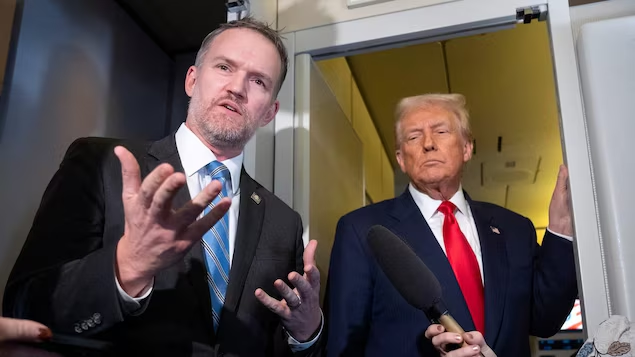
U.S. Trade Representative Jamieson Greer, left, speaks with reporters aboard Air Force One alongside U.S. President Donald Trump on Oct. 30, 2025.
Photo: Associated Press / Mark Schiefelbein
CBC News With files from Philip Ling
The Trump administration's top trade negotiator disputes Ottawa's assertion that last-minute demands from the U.S. derailed a trade deal between the two countries last week, saying Canadians' concerns about the deal's implementation led Ottawa to pull the plug.
In an interview with CBC News on Wednesday, Greer said the Canadian side had new requests when Canada-U.S. Trade Minister Dominic LeBlanc returned from Ottawa after the tentative deal was struck on Aug. 18.
We had agreed to, as I've shared before in the press, really the best deal available to any country on the planet with respect to Canada, Greer told CBC News chief political correspondent Rosemary Barton in his first one-on-one interview with a Canadian news outlet since trade talks broke down on Friday.
When [LeBlanc] came back, they had some additional views. They had some additional requests. They had some additional things that that were too much, too much for the United States.
Greer, the cabinet member in charge of delivering the Trump administration's tariff regime, also disputed Prime Minister Mark Carney's view that the terms would've encroached on Canada's ability to pursue trade agreements with other countries, threatened key industries and undermined French language protections.
The ambassador said it wasn't clear when the two countries might return to the negotiation table. He confirmed he and LeBlanc were not in contact as of Wednesday.
I would say we don't have open channels right now, Greer said. I have a good relationship with Minister LeBlanc, but right now, I think the Canadian side is talking about their next steps.
The interview comes after the dispute between Canada and the United States moved into new territory in recent days.
The United States delivered on its threat to impose new tariffs on billions of dollars in Canadian products on Saturday after trade negotiations with Canada fell apart at the 11th hour. Canada plans to match those levies dollar-for-dollar (new window) after Labour Day, and is rolling out $7.5 billion in support for workers and businesses at home.
The new measures and deteriorating political rhetoric (new window) from both sides of the border were a marked departure from the conciliatory tone last week, when the two countries appeared closer than ever to an agreement after months of tension.
Last week, Greer andd his Canadian counterpart appeared shoulder-to-shoulder in front of Greer's office, assuring the cameras they effectively only needed to cross T's and dot I's to get the agreement over the finish line. That night, U.S. President Donald Trump granted a tariff extension so negotiators could keep working for three more days.
But by Friday, the deal had fallen apart. Carney said his government walked away from the table after the U.S. team tried to squeeze in last-minute changes that were unfair, uneconomic and called into question the reliability of any deal.
Asked about last-minute demands in an interview with CNN this week (new window), Trump said: That sounds like me.
Greer said Wednesday that the president didn't interfere in the negotiations and described the remark as off the cuff. He also denied that the U.S. wanted to restrict Canada's ability to sign trade deals with other countries.
We didn't have any text like that, he said.
I think that characterization goes far beyond anything we've discussed for a year and a half. We've had Canadian officials at federal provincial levels coming to America and saying, we want to create Fortress North America, he said, referring to a concept floated by Ontario Premier Doug Ford to prioritizes continental co-operation in the face of Chinese economic threats.
WATCH | Where do negotiations go from here?
At Issue | Carney’s decision to abandon trade talks
At Issue special edition: Canada-U.S. trade talks collapse and President Donald Trump threatens even more tariffs. Was it the right decision for Prime Minister Mark Carney’s government to walk away and is a deal still possible?
On Saturday, Carney made clear he would rather bear the consequences of a painful, drawn-out trade war than concede to the terms proposed by the United States.
He said the government will instead focus its energy on pursuing trade relationships with global allies and shoring up the economy at home, moving Canada away from its reliance on the United States toward a new world order.
Some of the biggest payoffs of this plan, of this transformation, will take time, the prime minister said.
The White House said Canada had turned its nose up at the best deal offered to any trade partner, an agreement that would've included cuts to existing tariffs on steel, aluminum, lumber and Canadian-made automobiles.
WATCH | An economist explains how counter-tariffs affect Canadians:
Canada hits back at U.S. with $28B worth of retaliatory tariffs
The president later indicated a willingness online to stay the course after talks collapsed, threatening another tariff hike in 2027.
Greer, 46, is a trade lawyer who served in Trump's first term as chief of staff to former U.S. trade representative Robert Lighthizer, who oversaw the president's original trade war with China and American negotiations to finalize Canada-United States-Mexico Agreement, or CUSMA.
Related Stories
 Canada
Canada's tariffs target certain U.S. states. See which regions are most vulnerable.
29 minutes ago
 Canada
Looking to the past to understand Canada’s security future
29 minutes ago
 Canada
'Elbows up': Why Canadian Prime Minister Mark Carney may be the right leader for this moment: ANALYSIS
29 minutes ago
 Canada
Police investigating suspected arson after car at Liberal MP's home torched
29 minutes ago
 Canada
Ratko Mladic, ex
1 hour ago
 Canada
2 Air Canada employees arrested by RCMP in connection with alleged drug trafficking
1 hour ago
 Canada
U.S. confirms language, culture protections won’t be subject to trade actions: LeBlanc
1 hour ago
 Canada
Blockbuster Sale: Save big on select digital games!
1 hour ago