
Trump really wants to make ‘super intelligence’ happen. Is it going to happen?
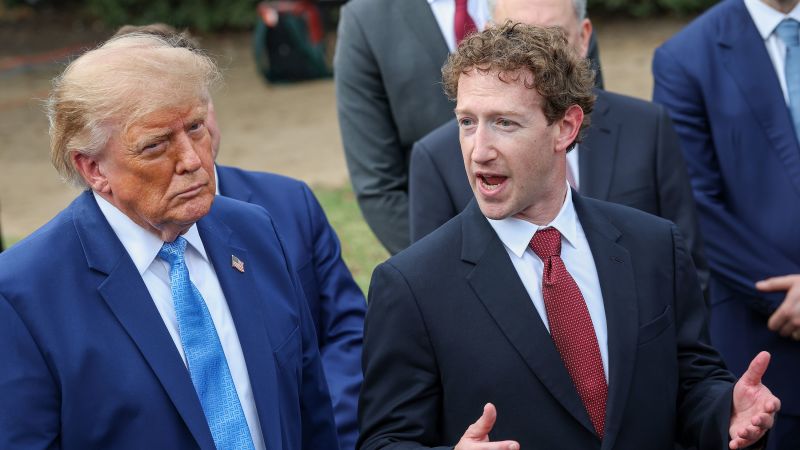
A version of this story appeared in CNN’s What Matters newsletter. To get it in your inbox, sign up for free here.
Unable to convince Americans to embrace the AI data centers they hate, President Donald Trump is instead exercising the one power he believes is absolute in the presidency: a rebrand.
But unlike Lake America, the Gulf of America, military bases or a mountain, this change is about altering public opinion rather than scoring political points.
Trump first told fellow world leaders at the United Nations last month that “use of the word artificial makes intelligence fake, it makes it sound fake.”
It’s not fake, Trump says; it’s amazing
After Trump signed an executive order in late September, the US government has been changing official documents and websites. Cabinet secretaries and other aides immediately used the new term.
Elon Musk said on X that he would change the name of his company from SpaceXAI to SpaceXSI, although that particular change has not yet occurred.
Trump has refused to answer questions that use the old term. He told supporters at a campaign rally in Nebraska that he would henceforth repurpose “artificial” — an “ugly” word, he said — for the news media.
On Thursday, the president said on social media that anyone who uses the term artificial intelligence instead of super intelligence will be viewed by his White House as “THE ENEMY!”
All of this might feel very much like Trump’s “weave” — the mental meanderings of Trump’s public statements — but it has also been fascinating to watch the infrastructure of the federal government respond to what many Americans might write off as a semantic distinction.
Renaming things is within Trump’s power
There are things that are out of Trump’s power — passing spending bills, renaming the Kennedy Center, ending his war against Iran — but he has shown that presidents have power to change names.
It’s also evidence he knows the unpopularity of data centers and concerns about AI in general at a time when he is a major booster of AI.
Meta CEO Mark Zuckerberg has long pushed to view AI as superintelligence. In August, he published a 6,000-word treatise about how Meta would approach AI. In rose assessments of the future, he referred to the promise of superintelligence. When he referred to AI, it was usually in reference to what he argued were unfounded worries. Zuckerberg said Meta will be committed to an open source model that provides for superintelligent agents working on behalf of every individuals.
OpenAI CEO Sam Altman told Politico’s “Decoded” podcast there are no plans to change the name of his company to OpenSI. But he did say that people in the industry have been using the term superintelligence for a while.
It might be a better term, ultimately, than artificial intelligence, but “still sort of understates the magnitude of what I think is happening,” Altman said.
Altman predicted people would still use the term AI and questioned whether Trump’s rebrand would accomplish its goal of changing people’s opinions of AI.
“Does superintelligence sound obviously less scary to people than artificial intelligence?” Altman wondered. Time will tell.
Superintelligence is a separate concept
What is definitely true is that the concept of superintelligence, while it sounds better in Trump’s view, is arguably distinct from AI and should be no less intimidating to Americans.
The term artificial intelligence has its roots in the 1950s, when a group of Dartmouth professors held a summertime conference “on the basis of the conjecture that every aspect of learning or any other feature of intelligence can in principle be so precisely described that a machine can be made to simulate it.”
Superintelligence, at least academically, seems more like the next step of artificial intelligence, or artificial generative intelligence. That happens when the machines learn.
The Oxford philosopher Nick Bostrom has written extensively about superintelligence, including in the 2014 book “Superintelligence: Paths, Dangers, Strategies.”
Here’s how Bostrum first defined superintelligence in a 1997 essay:
Asked how he views Trump’s rebrand, Bostrum said that from a technical perspective AI has traditionally “been this wide umbrella term that refers to every form of intelligent information processing in machines.”
We’re talking everything from the Google searches and email spam filters, the current crop of AIs and “hypothetical future more powerful ones.”
“If the idea is to use the new word superintelligence to cover all of that, it’s a little bit of a stretch, maybe, to call my spam filter a superintelligence,” Bostrum told CNN.
In the theoretical evolution of AI, what comes next, he said is AGI, or artificial general intelligence, which refers to a system that has the same kind of learning and reasoning as humans, something Atman says might already have occurred.
“Superintelligence was reserved for this sort of hypothetical future form of artificial intelligence that not only matched but radically exceeded humans across all cognitive domain,” according to Bostrum.
That is exactly the thing that frightens the AI “doomers.” But it is incomprehensible to Trump that the machines could outwit him.
Trump moves to control the narrative
“The only control or ‘guardrails’ that AI needs is a STRONG AND SMART (High IQ!) PRESIDENT, and the U.S.A. has that, in spades!” Trump wrote in September, arguing against any sort of AI regulation.
Bostrum has written both about potential pitfalls of superintelligence as well as the enormous potential to improve and extend human life. But by changing the name, Trump seems to just want to control the narrative.
Bostrum doesn’t necessarily think it’s a bad idea.
“It’s not up to me to decide how English language should be used,” he said. “I mean, it’s good for my book sales, I guess.”
He does see the rhetorical argument for a new term: It’s harder to argue against super intelligence than artificial intelligence.
“If you define superintelligence as we already have superintelligence and it hasn’t caused any catastrophe yet, then what’s the big deal? And you then would need to introduce some new term to refer to this like hypothetical future capability that’s even more powerful.”
Trump knows a thing or two about saying things so much that they take hold in the public. He rarely speaks in public without repeating the same talking points about “fake” news, the “radical left” Democrats, or about how wonderful his own leadership has been, regardless of what the facts are.
At the UN, Trump compared his rebrand to the evolution of “global warming,” which he said was “reborn to climate change because the planet was cooling, not warming, and nobody was dead.”
That’s not exactly what happened, as anyone paying attention to the warming climate in recent years can pretty easily confirm.
Related Stories
 AI News
The $800,000 jobs fuelling Sydney’s hidden R
34 minutes ago
 AI News
Transcript: Shyam Sankar, chief technology officer of Palantir, on "Face the Nation with Margaret Brennan," Oct. 11, 2026
34 minutes ago
 AI News
Bill Gates warns cyberattacks most imminent AI threat
35 minutes ago
 AI News
Georgia Tech And Emory Invest More Than $1 Billion In Artificial Intelligence
35 minutes ago
 AI News
Nuclear war and malicious use of AI threaten end of humanity by 2100, says Lancet assessment
1 hour ago
 AI News
Ukraine supports energy ceasefire with Russia: Zelenskyy
1 hour ago
 AI News
AI May Reshape Military Workforce, Key Questions Unresolved
1 hour ago
 AI News
Artificial Intelligence Stocks To Keep An Eye On
1 hour ago