
Trump is hailing his new deal with Greenland and Denmark
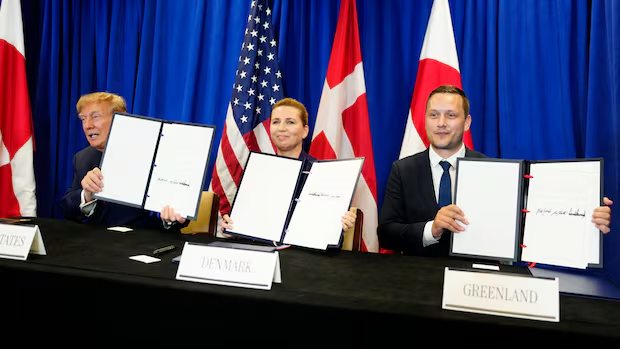
Trump is hailing his new deal with Greenland and Denmark — but a deal already existed. So what changed?
The United States signed a security arrangement with Denmark and Greenland in 1951
Recently, U.S. President Donald Trump said on his social media platform that for over 100 years, presidents have recognized the strategic importance of Greenland, "but NONE of them were able to do anything about it."
The president then wrote that he had "permanently and conclusively addressed this very important situation." On Tuesday, a new security agreement between the U.S., Denmark and Greenland was officially signed at the UN General Assembly in New York.
However, the U.S. already had a security arrangement with Denmark and Greenland dating back 75 years. So what, if anything, has changed?
"If we try to look at the new defence agreement compared to the old defence agreement, I would characterize it as a moderate improvement for the U.S.," Mikkel Runge Olesen, a senior researcher at the Danish Institute of International Studies, told CBC News.
"But it's a moderate improvement that has come at an immense cost."
NATO will share Arctic responsibility as Greenland security deal with U.S. moves forward, Denmark says
Trump flexes 'American power' on UN's biggest stage
That cost, some observers say, is the damage done to the relationships between the U.S. and some of its NATO allies including Denmark and Greenland, borne from Trump's repeated threats to seize the northern island and make it part of the U.S.
"Even though I don't think this deal has a lot of new stuff in it, I think everyone should be happy that it's finally getting signed," said Imran Bayoumi, a deputy director with the GeoStrategy Initiative in the Atlantic Council's Scowcroft Center for Strategy and Security.
But he added that the "gains are minimal" considering the harm inflicted on the direct relationships between the U.S. and its NATO allies.
Greenlanders 'will never forget that he threatened us,' former MP says of Trump
In 1951, the U.S. and Denmark signed the Defense of Greenland Treaty that authorized U.S. military presence in agreed upon areas on the island.
During the Cold War, the U.S. maintained 17 military installations and more than 10,000 personnel in Greenland. Today, only Pituffik Space Base remains, staffed by some 150 U.S. military personnel.
With this new deal, it was also announced that the U.S. plans to open two new military bases.
But under the previous arrangement, the U.S. already had the right to expand its bases. Instead, it decreased its presence in terms of numbers and size over the years, according to Marc Weller, the director of the Global Governance and Security Centre and the International Law Programme at Chatham House, a think-tank based in London, England.
"Now they have the right, in consultation with the Danes and the Greenlanders, to agree on additional bases," Weller said.
But he says both parties had already indicated they were happy to accept an expansion of U.S. bases.
Trump says deal struck to boost U.S. military presence in Greenland
Greenland, Denmark say deal with U.S. will not cede sovereignty
The new agreement also prohibits foreign adversaries of the U.S., like Russia and China, from establishing bases on Greenland.
But even under the 1951 agreement, that kind of scenario would have been "unthinkable," said Olesen.
"How many Russian and Chinese bases do we really see in NATO countries these days? It is sort of a given that of course it was never going to happen. But now it's on paper."
Trump gets his Greenland security deal, but without U.S. ownership
The new agreement gives the U.S. the ability to veto investments in critical infrastructure and other mining sectors from geopolitical adversaries.
But Bayoumi notes that there are logistic obstacles already preventing that. He says it's very difficult to build in Greenland, and that the infrastructure to support the launch of a critical mineral extraction project just isn't there.
Not only would it be costly and time consuming to build that infrastructure, he says Greenlanders themselves have vetoed and voted against some other mineral extraction projects in the past over concerns about environmental degradation.
But if the U.S. is going to veto other countries from investing in Greenland, Bayoumi wondered if it's ready to potentially take on a broader role "in facilitating economic development in the island."
The deal also does not have an end date, something Trump described as an "Infinite Life" agreement.
Bayoumi says this is a new development, as the 1951 pact was tied to the existence of NATO. The new agreement also makes provisions for Greenland to exercise its right to determine its independence.
But Bayoumi also notes that NATO is unlikely to disappear in the near future, and Greenland independence is unlikely to come any time soon.
Iceland summons U.S. ambassador over Trump's threat to take over Arctic nation
Inuit delegation in Greenland for opening of Canadian consulate has a message for Trump: 'Back off'
According to the new pact, if Greenland chooses to become independent, it will agree to remain in NATO and take on Denmark's rights and obligations under the deal.
"This would have been implied probably in the previous stages, but it is useful for the U.S. to clarify this," Weller said.
Mark Gollom is a Toronto-based reporter with CBC News. He covers Canadian and U.S. politics and current affairs.
With files from The Associated Press, Reuters
Related Stories
 World
World
The World of Motorcycling- News detail
7 minutes ago
 World
World
Carney to co
7 minutes ago
 World
World
Iran's president blames U.S., Israel for global instability in defiant UN speech
1 hour ago
 World
World
Watch: Key moments from Andy Burnham's first UN speech
2 hours ago
 World
World
Startup World Cup Announces World
2 hours ago
 World
World
NITDA Seeks Global Partnerships to Accelerate Nigeria’s Digital Transformation
2 hours ago
 World
World
Belleville synagogue shooting suspect dies in hospital: SIU
3 hours ago
 World
World
Pope appeals for care and protection of migrant children
5 hours ago