
This $5.5 billion robotics startup built a school for humanoids
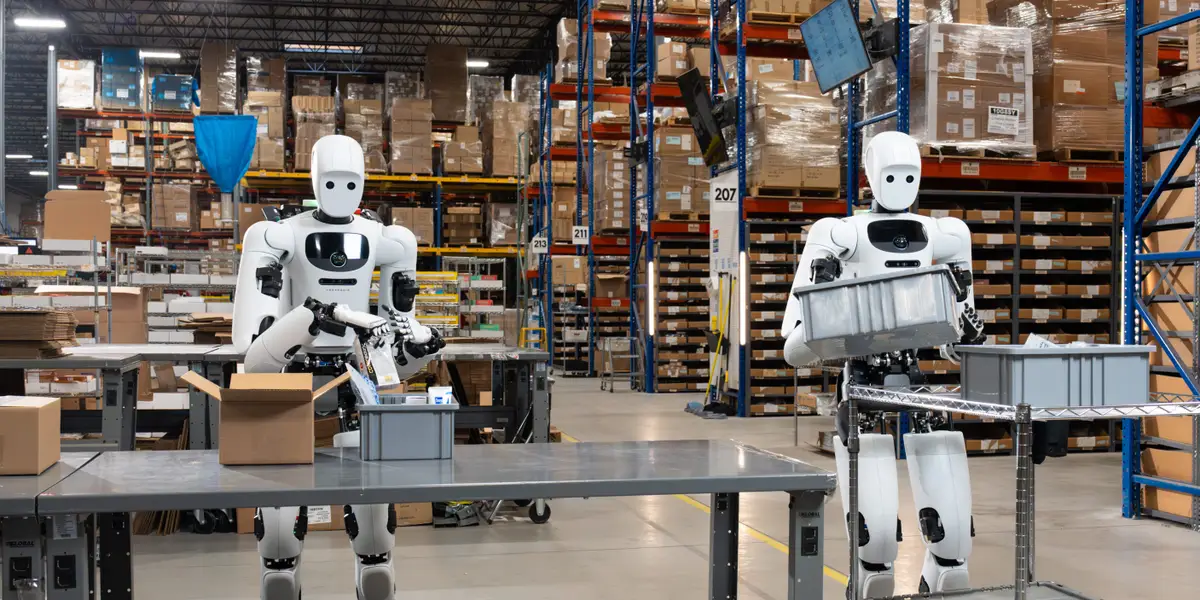
Before the robots go to work, they have to go to school.
Apptronik, a Texas-based humanoid startup that counts Google and Mercedes among its investors, has opened a "Robot Park" in Austin. At the nearly 90,000-square-foot warehouse, its Apollo robots practice tasks like loading boxes onto conveyor belts and sorting toys into bins.
Most of the time, the robots are controlled remotely. The facility runs seven days a week, with Apollo robots practicing tasks as operators stand beside them, guiding and monitoring their movements. The data from those sessions is used to improve the AI models that act as the robots' "brains," with the goal of making humanoids useful in factories, service jobs, and homes.
"Just like you have a factory to build robots, we have a data factory to generate the kind of data we need," said Jeff Cardenas, Apptronik's cofounder and CEO. "This is a robot learning playground."
One of the biggest challenges in building autonomous robots is the shortage of real-world training data. AI chatbots were trained on vast amounts of text and images from the internet, but no comparable trove exists for robots. Robot Park is Apptronik's attempt to generate that data.
Elon Musk is pursuing a similar approach. He has talked about putting Tesla's Optimus robots in an "Optimus Academy," where they can test different tasks and kick off a data flywheel.
Apptronik spun out of the Human-Centered Robotics Laboratory at the University of Texas in 2016 to commercialize technology developed during the DARPA Robotics Challenge, a US military competition to build robots that could operate in disaster zones. The company initially built robot parts for other companies, but Cardenas said the goal was always to create a general-purpose humanoid robot.
Take a smarter break in your day - and see how far you get.
The startup has raised about $1 billion and is valued at more than $5.5 billion. One of its investors, Mercedes, uses Apollo robots in its factories for simple tasks such as gathering components and tools for assembly-line jobs. DeepMind, Google's AI research division, also uses Apollo robots to improve Gemini Robotics, Google's AI models for robotics.
Apptronik released the first version of Apollo in 2023. It is now working with Apollo 2, which Cardenas said has an upgraded battery, motors, and sensors. The robot is designed for data collection and customer pilots. It can run for four hours, stands about 6 feet tall, and can lift 55 pounds with both hands.
Apollo 3, the version Apptronik plans to sell to customers for commercial work, is in development. Cardenas declined to say when it will be ready.
Cardenas sees the humanoid market developing in three phases: first proving the technology works, then proving customers will pay for it, and finally scaling it into a profitable business. He said the industry is entering the second stage.
"Humanoids are the personal computer of our time, and if you believe that's true, we're in the early '80s," Cardenas said. "We're in the word-processing, spreadsheet phase of the game."
The humanoid race is starting to move from lab demos into early commercial tests. San Jose-based Figure AI, most recently valued at $39 billion, is beginning deployments in logistics and distribution centers. 1X, headquartered in Palo Alto, plans to ship more than 10,000 humanoids to homes later this year.
Oregon-based Agility Robotics is further along. The company plans to go public soon, and Digit, its humanoid robot, is deployed across nine customer facilities, including Amazon, Toyota, and logistics company GXO.
Unlike most humanoid companies that are only building walking robots, Apptronik has both legged and wheeled versions of Apollo. Cardenas sees the biggest long-term potential in legged humanoids because they could eventually do anything a human can physically do. But he expects wheeled robots to be deployed sooner because they are safer. Legged robots have to support heavy batteries in their torsos, which consumes more power and creates safety risks if they fall.
Apptronik has other Robot Parks at customer sites across the world. Cardenas said more are coming.
"The dream is to have Robot Parks all over the world, and actually make them open to the public, so people can see how the future is being built," he said.
Related Stories
 Business
Robot factories and hypersonic missiles: JPMorgan Chase’s first $5 billion of defense investments
16 hours ago
 Business
Police say a car has hit an Australian lawmaker, critically injuring her; the driver was arrested
17 hours ago
 Business
Boomi acquires Israeli startup Elementary for $43 million
17 hours ago
 Business
Mega chicken farm expansion plan withdrawn
19 hours ago
 Business
Data Breach at Hankyu Hanshin Department Store Common ID System Affects Nearly All 1.26 Million Members
19 hours ago
 Business
Global Startup EXPO and Nippon Startup Awards 2026: METI Showcases Japan's Deep
19 hours ago
 Business
FANCL and Attenir Suffer Data Breach Affecting 780,000 Customers, Exposing Addresses, Names, Phone Numbers
21 hours ago
 Business
DeepSeek Quietly Ships V4.1-Flash
21 hours ago