
The uninherited art: Rahul Gandhi and the making of an opposition leader
Rahul Gandhi: A legacy earned, not inherited
Published : Oct 15, 2026 19:06 IST - 9 MINS READ
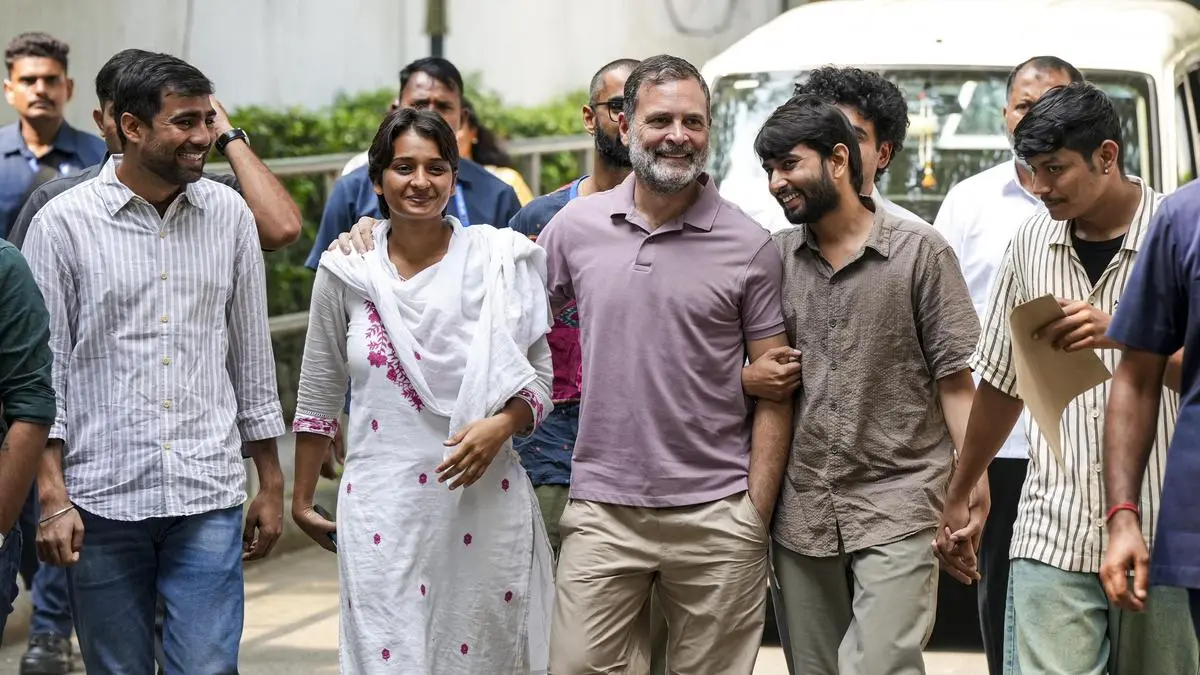
Congress leader Rahul Gandhi with National Students’ Union of India president Vinod Jakhar and others protesting against Chief Election Commissioner Gyanesh Kumar, in New Delhi, on October 14, 2026. | Photo Credit: Arun Sharma/PTI
Whenever Rahul Gandhi’s political inheritance comes under scrutiny, the debate invariably gravitates towards dynastic politics: the Gandhi surname, the 140-year-old Congress party legacy, and the leadership he inherited by virtue of his lineage. Yet, there is a far more consequential dimension to his political journey that rarely receives the attention it deserves: his politics of opposition. He may have inherited a political legacy, but he did not inherit a playbook for challenging a formidable government from the opposition benches. For a Congress leadership accustomed to the privileges of power, sustained opposition at the national level was largely uncharted territory. In many ways, Rahul’s most consequential political challenge has been to learn, from scratch, an art that his party’s senior leadership had little experience practising over an extended period.
When Rahul entered electoral politics in 2004, the Congress-led United Progressive Alliance formed government at the Centre. The Congress was out of power between 1996 and 2004, although it extended support to two United Front governments at the Centre: H.D. Deve Gowda’s from June 1, 1996, to April 21, 1997, and I.K. Gujral’s between April and November 1997. A non-Congress government—the Atal Bihari Vajpayee-led National Democratic Alliance (NDA) government—completed a full five-year term for the first time between 1998 and 2004; it was subsequently voted out of office.
During the NDA period, the Congress remained entirely in the opposition for the first time. But beyond these five years, the party had little experience navigating a prolonged opposition period. Rahul did not inherit this crucial aspect of Indian politics for which the Congress had few institutional precedents to offer him.
In 2014, when the Congress was voted out of power with just 44 Lok Sabha seats, it still had several formidable and experienced leaders, including P. Chidambaram, Kapil Sibal, Ahmed Patel, and A.K. Antony. Yet, none had extensive experience in leading an opposition party under a government with a strong parliamentary majority.
The 2014 government was one of the most powerful in independent India. The BJP secured its first single-party majority in Lok Sabha, riding on its Hindutva agenda and Narendra Modi’s appeal as a strong nationalist leader. A section of the electorate viewed Modi as the “Hindu Hriday Samrat” (the king of Hindu hearts), while the Congress was increasingly branded by opponents as sympathetic to Muslims. The A.K. Antony committee report, submitted to Congress president Sonia Gandhi on August 14, 2014, which examined the reasons behind the party’s worst-ever Lok Sabha performance, found this to be the main cause.
It was in this political climate when the Congress and particularly the Gandhi family faced a severe crisis of credibility that Rahul confronted his biggest challenge: learning to lead an opposition against a powerful and politically dominant government.
The challenge involved not merely opposing the government but establishing his own credibility as a full-time politician and disproving his image of an ineffectual leader that his critics and online troll networks sought to project by calling him “Pappu”. Unless he could overcome this perception, would people take his arguments seriously? And would voters who regarded Modi as a messianic figure of the times heed criticisms against him?
Rahul had to find his own way of confronting the challenge. From 2014 onwards, he repeatedly attacked Modi and his government. He described demonetisation as an anti-people measure, accused the government of working in the interests of big business, and alleged a major scam in the Rafale fighter jet deal. But these attacks did not yet translate into his greater public acceptance. Many voters appeared to regard them as routine opposition rhetoric rather than credible challenges to the government.
In 2019, Rahul made Rafale a central issue in his election campaign. Yet, the BJP returned to power with a larger majority, increasing its tally from 282 seats in 2014 to 303 in 2019. The Congress also improved its tally, but only marginally, from 44 to 52 seats. It remained short of the 10 per cent threshold traditionally used to determine eligibility for recognition as Leader of the Opposition in the Lok Sabha.
Rahul’s opposition politics continued to largely revolve around allegations against the Modi government. His broader public acceptability did not improve sufficiently enough to translate into a major electoral breakthrough. In 2019, he also lost Amethi, long regarded as a Gandhi-family stronghold, although he retained his parliamentary presence by winning from Wayanad in Kerala.
Rahul Gandhi at the “March for Democracy” rally to the Supreme Court organised by INDIA bloc leaders, at Barakhamba road in New Delhi. Image received on October 12, 2026. | Photo Credit: AICC via PTI
In 2022, he made a significant decision that would change the course of his political journey: he undertook a padyatra from Kanyakumari to Kashmir, calling it the “Bharat Jodo Yatra” (Unite India March). Its primary objective was to counter what the Congress described as the BJP’s politics of hatred and polarisation with a politics of love and unity. Between September 2022 and January 2023, he walked nearly 4,000 km, interacting with people from different backgrounds along the way. His team also amplified the yatra through conventional and social media, ensuring visibility beyond its physical coverage.
The exercise appeared to coincide with an improvement in his public perception. CVoter tracked his acceptability throughout the yatra. In its January 2021 “Mood of the Nation” survey, only 16 per cent respondents considered him best suited to lead the opposition. By January 2023, that figure rose to 24 per cent.
The change was significant because the yatra offered him what his earlier style of opposition politics struggled to establish: sustained direct contact with citizens and a politics not confined to press conferences, parliamentary speeches, and allegations against the Prime Minister.
The second leg of this effort was the “Bharat Jodo Nyay Yatra” (India Unity and Justice March), which ran from January to March 2024. Its focus was social justice and protection of the Constitution. The central message was framed sharply around the idea that the Constitution was “under threat”.
Following these journeys, Rahul’s public acceptability appeared to improve, as did the Congress’ political standing. The 2024 Lok Sabha election results provided an important electoral indicator of this change. The Congress won 99 seats, while the BJP fell to 240, short of the 272 required for a majority on its own. Rahul became Leader of the Opposition in the Lok Sabha, while the BJP-led government depended on the support of its NDA partners to maintain its parliamentary majority.
The Congress remained in the opposition, but Rahul emerged as a central figure in the national opposition politics. His position became more prominent within the opposition landscape, alongside leaders such as Mamata Banerjee and Arvind Kejriwal.
He appeared to have recognised that raising public issues through press conferences and parliamentary interventions was not enough. To establish himself as an opposition leader, he would also have to take those issues to the streets and sustain public engagement around them.
He increasingly adopted this approach after the 2024 election. And following the protests at Jantar Mantar in July this year over the National Eligibility cum Entrance Test controversy and other student-related concerns, he has been seen engaging more frequently with street-level political mobilisation. He has taken to the streets his campaign against alleged electoral irregularities, described by him and the Congress as “vote chori” (vote theft), questioning the Election Commission of India’s conduct and demanding accountability.
Rahul Gandhi with a young labourer during the Congress’ Bharat Jodo Nyay Yatra, in Jharkhand, on February 5, 2024. | Photo Credit: ANI
This approach marks an important evolution in his opposition politics, from primarily accusing the government of wrongdoing to attempting to mobilise public attention and participation around specific issues.
The political implications of this strategy can be examined through CVoter’slong-term tracking data on the approval ratings of Narendra Modi and Rahul Gandhi as preferred choices for Prime Minister, which show a gradual narrowing of the gap between them. Between 2014 and 2019, the gap stood at approximately 30 percentage points, with Modi commanding around 60 per cent support against Rahul’s 30 per cent. During the 2019-24 period, the gap narrowed to roughly 20 percentage points, as Modi’s rating settled at around 50 per cent while Rahul’s remained close to 30 per cent.
One of the most significant moments in Rahul’s political trajectory came after the 2022 Punjab Assembly election. Following the AAP’s landslide victory in Punjab, Rahul and AAP chief Arvind Kejriwal registered nearly identical ratings as potential choices for Prime Minister, suggesting a shift in the relative standing of opposition leaders.
The latest CVotertracking data points to a further change in this dynamic. Modi’s rating has slipped below the 50 per cent mark, while Rahul’s has climbed to nearly 40 per cent. The widening challenge to Modi’s dominance, therefore, is not merely a decline in his rating; it is also Rahul’s gradual consolidation as a national alternative.
While these numbers do not establish any single strategy as responsible for this shift, they reflect a notable evolution in Rahul’s standing in national politics since the Congress’ 2014 defeat. His journey has been neither linear nor free of setbacks, but his gradual emergence as a more credible national challenger to Modi suggests that he may be mastering an art of opposition that was never part of his political inheritance. He inherited a formidable political legacy, but challenging an entrenched government, sustaining a fight from the opposition benches, and positioning himself as an alternative to the Prime Minister are lessons he has had to learn on his own.
Khalid Akhter is a journalist with nearly two decades of experience. Specialising in data journalism, he currently serves as an output editor at CVoter News Services.
Also Read | All the king’s horses and all the king’s men
Also Read | Rahul Gandhi, Bharat Jodo Nyay Yatra, and the power of walking
Related Stories
 India
India
DP World India Championship: Eugenio Chacarra leads but Rory McIlroy fades before play halted
1 hour ago
 India
India
DP World India Championship: Rory McIlroy drops 10 shots off the lead as Eugenio Chacarra moving into position for another big win
1 hour ago
 India
India
Diaspora living bridge of friendship between India and Samoa: MoS Margherita
1 hour ago
 India
India
L.K. Advani Admitted to Delhi Hospital With Chest Infection, Condition Stable in ICU
4 hours ago
 India
India
Indian diaspora rallies in London in support of PM Modi amid ‘anti
9 hours ago
 India
India
'Rapist Mindset': Inside The Problematic Online Sexualisation of Neha Bora
10 hours ago
 India
India
Indian diaspora rallies in London amid anti
10 hours ago
 India
India
PM Shah’s India visit likely in last week of November
15 hours ago