
The Transatlantic Artificial Intelligence Calculus
As global artificial intelligence (AI) competition intensifies, the United States faces critical decisions about how to structure AI partnerships, particularly with the European Union (EU) and EU member states that have developed valuable yet often overlooked AI capabilities. This report provides a framework for assessing the conditional value of AI partnerships and presents options for transatlantic efforts that advance U.S. strategic interests.
The Transatlantic Artificial Intelligence Calculus
U.S.–European Union and Member State AI Cooperation in an Era of Strategic Competition
As global artificial intelligence (AI) competition intensifies, the United States faces critical decisions about how to structure AI partnerships, particularly with the European Union (EU) and EU member states that have developed valuable yet often overlooked AI capabilities. The existing transatlantic institutional architecture, though underused, enables bilateral dialogue, research collaboration, venture capital for the most visible EU firms, and market access with reasonable competence. What it has not produced is a strategic AI partnership—a formal, durable collaboration that aligns resources, rules, and incentives across the AI development and deployment life cycle, enabling each partner to gain capabilities or leverage that it could not efficiently secure on its own while providing a degree of insulation from short-term political or commercial volatility.
This analysis uses a scenario-based approach to structuring U.S.–EU and member state AI cooperation amid intensifying U.S.-China rivalry, at a moment when AI leadership is becoming central to economic competitiveness, global standard-setting, and the maintenance of democratic governance. The author identifies four archetypal scenarios that represent the structural pathways along which AI development could unfold, defined by two variables: (1) the ultimate locus of AI value creation and (2) the degree of advanced model openness.
The author proposes a framework for assessing the conditional value of AI partnerships against these potential futures to identify under which conditions different forms of engagement generate the greatest returns for U.S. strategic interests.
This research was independently initiated and conducted by the Center for the Geopolitics of Artificial General Intelligence within RAND Global and Emerging Risks using income from operations and gifts from RAND supporters.
This publication is part of the RAND research report series. Research reports present research findings and objective analysis that address the challenges facing the public and private sectors. All RAND research reports undergo rigorous peer review to ensure high standards for research quality and objectivity.
This document and trademark(s) contained herein are protected by law. This representation of RAND intellectual property is provided for noncommercial use only. Unauthorized posting of this publication online is prohibited; linking directly to this product page is encouraged. Permission is required from RAND to reproduce, or reuse in another form, any of its research documents for commercial purposes. For information on reprint and reuse permissions, please visit www.rand.org/pubs/permissions.
RAND is a nonprofit institution that helps improve policy and decisionmaking through research and analysis. RAND's publications do not necessarily reflect the opinions of its research clients and sponsors.
Related Stories
 AI News
Bill Gross bets AI can help mass
1 day ago
 AI News
Nigeria records 93% rise in AI micro
1 day ago
 AI News
The Italian gelato maker using AI to invent new flavours
1 day ago
 AI News
Closing the Gap Between Agentic CX Pilots and Production
1 day ago
 AI News
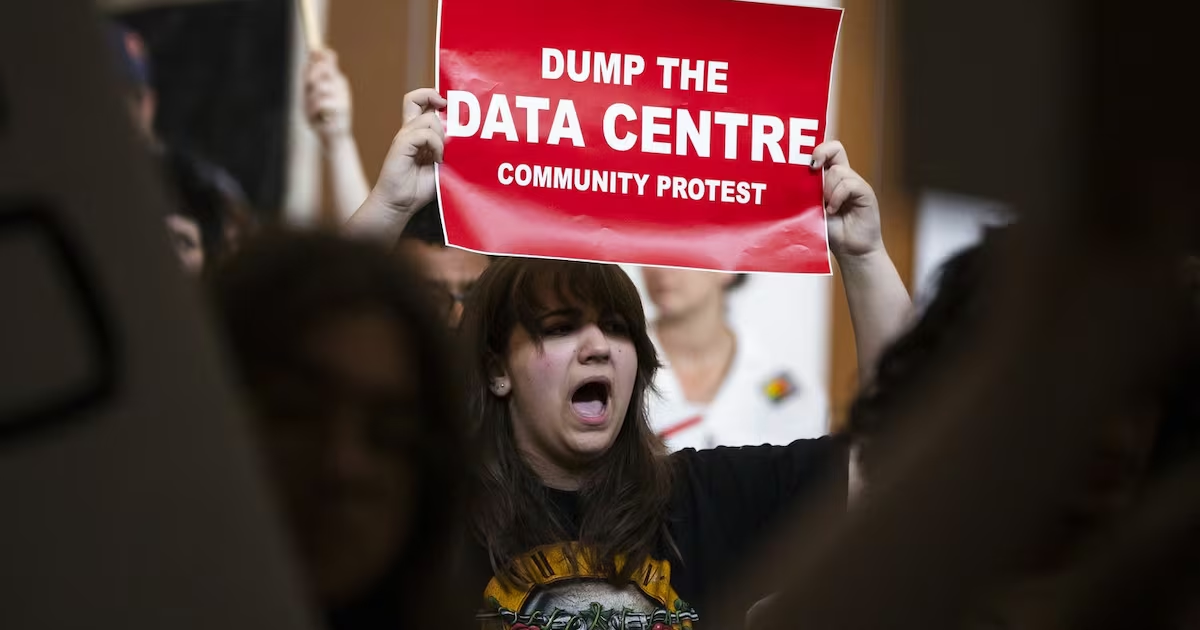
New Brunswick data centre debate highlights cross
1 day ago
 AI News
How to Structure an AI Agent Referral Fee Agreement Between Startups
1 day ago
 AI News
No, AI didn’t delete a Swedish reality TV series
1 day ago
 AI News
There is no AI in Armageddon. Artificial intelligence is a tool, not an apocalypse
1 day ago