
The science of sprinting
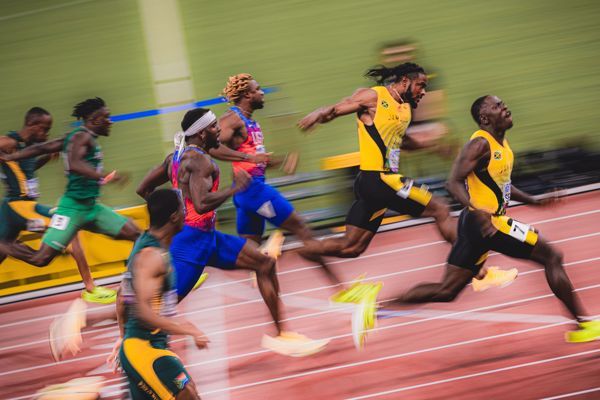
World Athletics goes inside the numbers behind the disciplines on the Ultimate Championship programme. Guiding us from the starting gun to the finish line in the 100m are Edrick Floreal, coach of Olympic champion Julien Alfred, and former world sprint medallist Craig Pickering, now Director of Performance Sustainability at Australian Athletics.
Pickering sees the 100m as akin to a maths problem which needs the perfect equation to solve it. “The person who wins has the highest average velocity,” he explains. “It’s not the person with the best top speed or best acceleration.” Despite his years of coaching experience, Floreal still describes the event as “complicated” and relishes the challenge of unpicking it. For him, it is less a maths equation and more a fast-paced jigsaw puzzle: “There’s elements of the 60m dash in it, elements of the 200m and elements of the 400m. I like the 100m because of the numerous factors that play a part in being good at it. You can’t just get out of the blocks and race as hard as you can.”
Every generation of sprinters – men and women – includes fast starters and those who are slower from the blocks, but all share the same goal: to get away as quickly as possible and generate maximum power. Elite athletes’ reaction time is generally between 0.120 and 0.150s. Explaining the start, Pickering says: “Imagine going from no speed at all and into the fastest speed in the shortest time possible. Unlike the rest of the 100m, at this point the more time on the ground is good as you need to generate that power. Here it’s about maximum strength and the stronger-looking sprinters are traditionally better at that.”
The acceleration phase follows the first two strides out of the blocks and can continue as far as 65m, according to Pickering. As he says: “For most that might be 45 to 50m, some are really good at force early on and others not so good. Most of the best male sprinters in the world, for example, will be aiming to do 10m in 1.9 seconds, 30m in about 3.7ish, and 60m about 6.40-6.50. There is some variation but it’s not massive if you’re all generally aiming for under 10 seconds.”
Every sprinter hits their top speed at some point in a race and then the speed diminishes despite how it may look to those watching in the stands or on television. “Nobody really accelerates beyond a certain point,” adds Floreal. “It’s about who decelerates the least from one point to another. You’ve got to completely remove tension from the body to do that. You look at Usain Bolt, his finishing ability was magnificent.”
Remarkably, step frequency does not vary as much between runners – or between elite athletes and the wider population – as might be expected. Pickering states: “If you get a five-year-old or a 50-year-old and an elite athlete, even Usain Bolt, they generally take about 4.5-5 steps per second. That seems to be how many steps humans take, that doesn’t change a lot. The main area to get faster is how big those steps are and a 2.5m stride length is what you see in the best athletes, and that’s where they basically get the advantage.”
Whatever the phase of the race, the key is simply to run your own race and, as much as possible, ignore those around you… easier said than done with the fastest men or women in the world either side of you.
For Floreal, the secret to the perfect sprint is “maturity and patience to stay within your lane and do what you’re supposed to and not get caught up with what everyone else is doing. For example, being dead last or at least well back at 50m, the trick is not freaking out but staying with the race plan and knowing they’re going to come back to me. Noah Lyles, in particular, is so good at that.”
Opinion is divided over the importance of the upper body in sprinting – a subject Pickering describes as “reasonably contentious”. “Some research says the upper body does nothing, others say it plays a role. The arms move slightly before the legs so there’s a balancing capability and it stops too much rotation in the torso. Bad arm technique might hold you back and it looks really scruffy but most top sprinters have an efficient technique with their arms.”
The ideal 100m is the sum of its parts. Extract too much too early and you can pay the price. “You can’t just go out of the blocks and race as hard as you can - good luck with that,” insists Floreal. “You see guys out all fire and brimstone for 60-70m and the last 30m it’s like 'here come the wolves'; people are running them down and they have no way to respond. It’s like having a $100 bill, they’ve spent $80 in the first 50m and they’ve got 20 bucks left. But I’ve spent 40 and I’ve got 60 left so distributing the elements is key.”
Related Stories
 World
World
Lindsay Clancy jury set to deliberate for another day
1 hour ago
 World
World
Sacha Baron Cohen’s new Ali G movie facing serious backlash with huge petition launched
1 hour ago
 World
World
David Rosenberg: U.S. dollar bear market looms as the world loses confidence in the White House
2 hours ago
 World
World
Watch: Why is the US
3 hours ago
 World
World
CNN’s Anderson Cooper reports from rescue operation at Nepal’s hydropower tunnels
3 hours ago
 World
World
Kākāpō rising: 90 chicks swell population of the world’s heaviest parrot
3 hours ago
 World
World
International Overdose Awareness Day
3 hours ago
 World
World
African Union and International Solar Alliance partner to accelerate Africa’s solar transition
3 hours ago