
The next trillion
Something genuinely new is happening in national security.
As the United States refocuses its role in the world around its own strategic interests and asks allies to shoulder more responsibility for their security, countries across the Western alliance are being forced to rebuild capabilities they once assumed someone else would provide.
At the same time, the definition of national security has expanded dramatically. Energy, computing, critical infrastructure, advanced manufacturing, critical materials, communications, and supply chains increasingly sit alongside tanks, aircraft, and missiles as matters of sovereignty. The threat environment has broadened too, and dependence on foreign supply chains has become a national security vulnerability.
Governments are therefore being asked to do two things at once: take responsibility for more of their security and become sovereign across a much wider set of technologies and industrial capabilities.
The problem is that very few can build all of these capabilities themselves. Even the United States, with enormous technical know-how and a deep industrial base, cannot build every strategic capability internally at the pace, scale, and quality now required. For smaller countries, the gap is far greater.
This trend is driving a fundamental shift in the relationship between governments and technology companies. The way states build sovereign capabilities is changing.
For much of the last century, government was the system architect. The Manhattan Project brought talent, capital, and industrial capacity together under one state-led mission. Apollo worked with private industry, but NASA defined the mission, had the best and brightest talent, and coordinated the industrial base.
Today, increasingly, private companies build the technology, infrastructure, and operating stack. Governments define strategic requirements, provide capital and incentives, coordinate procurement and regulation, and become the customer.
SpaceX was doing Sovereignty-as-a-Service before there was a name for it. NASA once built and operated the systems that carried American astronauts into space. Today, SpaceX develops and operates much of the capability, while NASA increasingly acts as customer and strategic partner. Operation Warp Speed showed a version of the same model: government provided capital and coordination, while private companies raced to develop and manufacture vaccines.
Software-as-a-Service may be "dead." Long live SaaS: Sovereignty-as-a-Service.
Under this model, governments turn to tech companies to deliver capabilities that are strategically essential but too slow, expensive, or complex to recreate entirely inside the state. Sovereignty-as-a-Service is not only about providing capabilities, but shrinking the time-to-capability gap.
And for that reason, the product is often much more than just a product. Sovereignty-as-a-Service can include tech, physical buildout, integration, customization, training, deployment, and maintenance. A company may help define the requirements and capabilities, build the infrastructure, integrate vendors, train personnel, and remain embedded as the capability evolves.
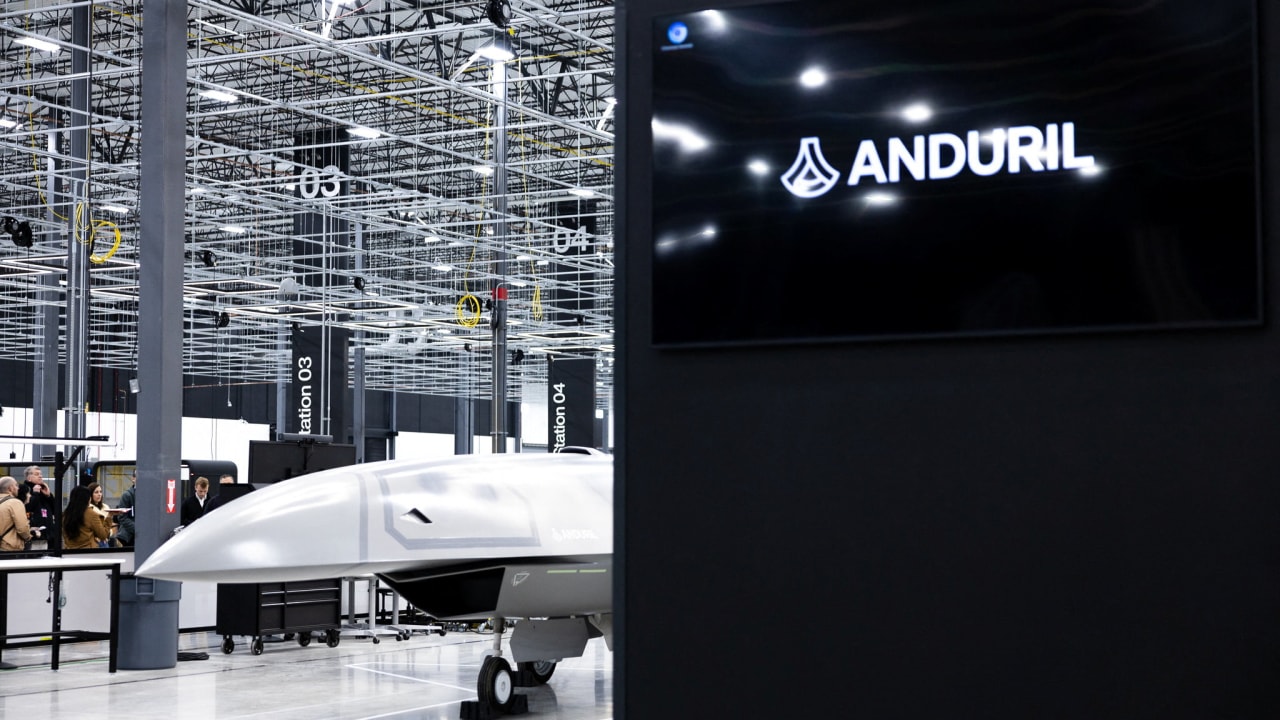
We are already seeing versions of this model emerge. Companies such as Anduril are developing capabilities like autonomous undersea presence and rapidly regenerating industrial capacity in wartime. Saronic is working to rebuild America's shipbuilding capability and restore production velocity. General Matter is building domestic nuclear-fuel capacity. Across space, energy, computing, robotics, and advanced manufacturing, companies are productizing capabilities governments once had to assemble themselves.
The Moon may be the most expansive example. Blue Origin, Intuitive Machines, and others are building pieces of the launch, landing, communications, and infrastructure stack required for a persistent American lunar presence.
The market is enormous. The 2026 Fortune 500 generated over $21 trillion in revenue. Using a roughly 5% technology-spend benchmark, this means over $1 trillion in annual technology budgets. NATO members, meanwhile, have committed to spending 5% of GDP, roughly $60 trillion today, by 2035 across core defense and broader security-related investment. And that doesn't include the rest of the Western-aligned world, including major markets in the Gulf and Asia.
Only a subset of sovereign spending will be addressable by tech companies, but the point is the scale. Tier 1 founders are no longer limited to enterprise technology budgets. They can build for national budgets measured in trillions.
The United States will remain the largest and most attractive individual market. Winning in America matters. Full stop. But building only for America leaves much of this opportunity untouched. The customer is increasingly the Western alliance and, depending on the product, a broader universe of aligned sovereign nations.
For Israel, this creates a particularly interesting opportunity. Israel combines deep technical and entrepreneurial talent with a government and military that can serve as unusually demanding design partners. The last several years have created urgent needs across autonomy, energy, advanced manufacturing, compute, critical materials, and infrastructure, forcing technologies to move from concept to deployment at a speed that is difficult to replicate elsewhere.
You can already see the ingredients across companies such as Kela, Aitan, OHR, Covenant, Voltify, and Civan, spanning defense autonomy, critical materials, energy, and advanced industrial capabilities. The opportunity, however, is not simply to export Israeli technology. The goal is to build companies that can deliver the entire sovereign capability: technology, infrastructure, integration, training, and deployment. Israel can be the design partner and proving ground, while the United States, Europe, the Gulf, and Asia become the scale markets. That requires companies to think internationally from inception and governments to treat domestic technology companies not just as vendors, but as strategic capability builders.
Sovereignty-as-a-Service does not mean outsourcing sovereignty itself. It means giving countries control over critical capabilities without requiring them to reinvent and build every layer themselves.
For the last twenty years, founders dreamed about selling software to the world's largest companies.
The next generation may build much larger companies by selling capabilities to the nations themselves.
The writer is a General Partner at Deep33
Related Stories
 Technology
Facial recognition deployed in county first
54 minutes ago
 Technology
King joins Tidebridge as demand builds for bespoke technology
1 hour ago
 Technology
NASA Calls for Proposals to Accelerate Lunar Surface Technologies
1 hour ago
 Technology
SK Innovation E&S links Korean, Indonesian youth entrepreneurs in Busan
2 hours ago
 Technology
Vietnam’s Khanh Hoa province advances technology
3 hours ago
 Technology
New technology to boost phone signal in city centre
3 hours ago
 Technology
Valuation reset: Startups begin losing unicorn tag
5 hours ago
 Technology
Huawei accused of supplying Tehran with surveillance tech
6 hours ago