
Whose food is ‘dirty’? Politics of purity, impurity on India’s plate
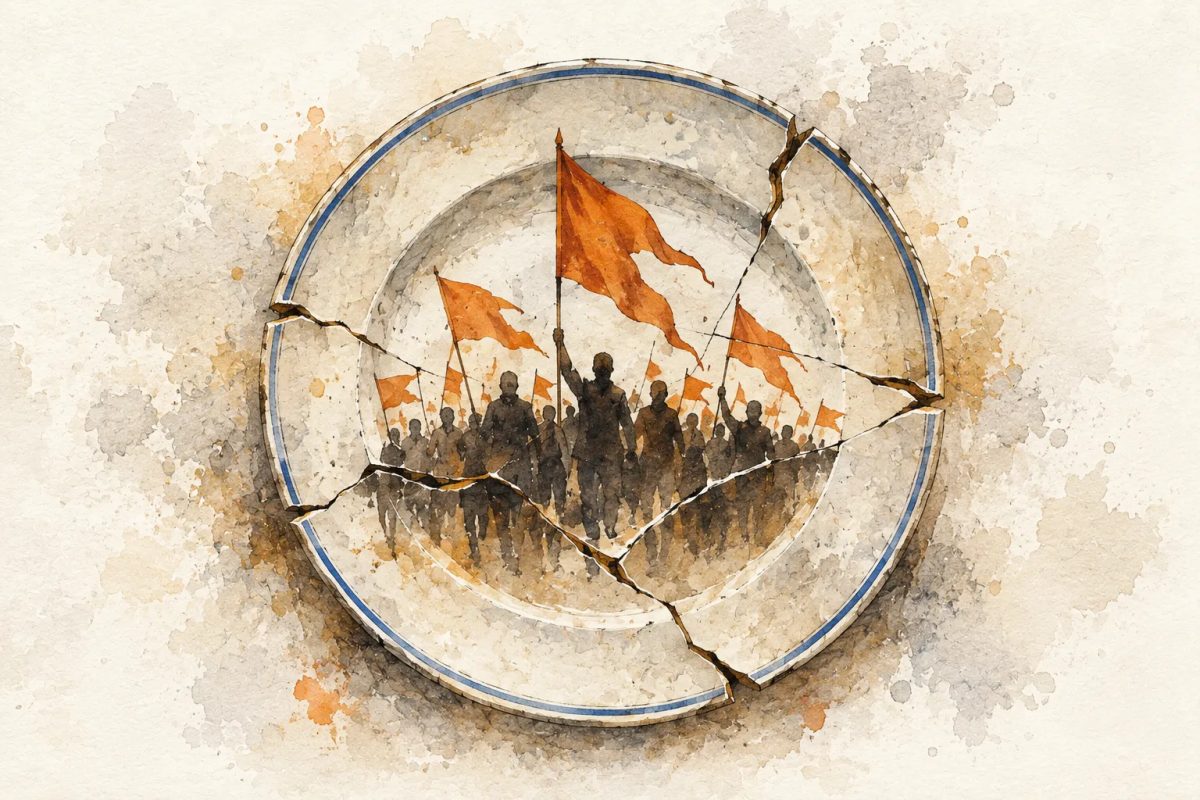
In early September, at a religious gathering in Howrah, the celebrity preacher Dhirendra Krishna Shastri — better known as Bageshwar Baba — offered West Bengal a lesson in what it should and should not eat. With Durga Puja approaching, he condemned the fish and meat cooked and sold around the festival’s pandals as “ganda khana”, dirty food, and branded Bengali Hindus who eat it during the celebration “pakhandi”, hypocrites.
He urged them to observe Navratri instead, and to clear non-vegetarian food away from the pandals altogether. Bageshwar Baba is no fringe figure: he heads a wealthy temple establishment courted by the country’s most powerful politicians. His intervention matters not because a godman prefers vegetables, but because it quietly converts a question of taste into a question of religious purity, moral authenticity and Hindu belonging.
That conversion is the whole trick. The moment food is called ganda — dirty — the conversation leaves the terrain of personal choice and enters the terrain of judgement. “I find this impure” becomes “this food is polluting,” which becomes “the people who eat it are lesser, suspect, not quite Hindu enough.” The label does not describe a plate; it disciplines a population. And it is a remarkable thing to attempt in Bengal, where fish and meat are inseparable from everyday life and from religious practice itself — where Shakta traditions have long accommodated animal sacrifice, and where the very festival Bageshwar Baba claims to defend has never demanded a vegetarian table. The real question his remark forces open is not what is clean or unclean, but who has been granted the authority to decide — and why a preacher from the Hindi heartland assumes it over the kitchens of Bengal.
Because this is not a slip of the tongue or an isolated provocation. It is a script. Over the past decade, Hindutva politics has reached again and again for food as its favourite boundary marker, a convenient way of sorting Indians into the pure and the polluted, us vs them. Figures like Bageshwar Baba function as advance scouts: sent into a new state, they float an inflammatory line, provoke a controversy, and in doing so make the unthinkable debatable and the debatable normal. The outrage is not a by-product. It is the purpose.
The roots of this run deeper than any election cycle. Vegetarianism in India has never been an innocent matter of ethics; it has been a marker of rank. B.R. Ambedkar argued as much in Untouchables: Who Were They and Why They Became Untouchables (1948), reading the Brahmins’ embrace of vegetarianism not as spiritual tenderness but as strategy — a way to out-purify Buddhism by seizing its principle of non-violence and converting it into a claim of superiority. What one refuses to eat, in this schema, measures how high one stands. The purity–pollution binary that organises caste has always been policed most intimately at the table: food and caste in India are bound tightly together, each meal quietly restating the hierarchy, and Brahminical authority resting on the power to classify what — and who — counts as clean.
Modern Hindutva has inherited that machinery and scaled it up. Its culinary politics runs on two engines: the veneration of the cow and the glorification of vegetarianism, and both are aimed squarely at those who fall outside the upper-caste Hindu norm. Muslims have borne its sharpest edge.
Beef has become a pretext for lynching; the ritual sacrifice of Eid al-Adha is met with policing, criminalisation and vigilante threat; halal is demonised; and pilgrimages such as the Kanwar Yatra become moving assertions of purity along which Muslim livelihoods are marked out and squeezed. The meat-eater, here, is not merely unfashionable. He is recast as a polluter.
The Northeast has been the other great laboratory. Some of the region’s most cherished foods — the fermented akhuni or axone of Nagaland, and dishes like it — are dismissed across “mainland” India as smelly and dirty, and denied a place in the imagined “Indian” kitchen. This is not idle prejudice; it has been written into the conduct of the state. A Delhi Police advisory once counselled residents from the Northeast against cooking axone and other fermented foods — an official codification of majoritarian disgust. The anthropologist Dolly Kikon has shown why this matters: the food racism directed at Northeasterners and the caste violence directed at Dalits spring from a single source — the logic of purity and pollution that decides whose food, and whose body, is allowed to belong.
Set against all this is an inconvenient fact: India is overwhelmingly a meat-eating country. The eastern states of West Bengal, Assam, Jharkhand and Odisha, along with north-east and the southern states of Kerala, Tamil Nadu, Telangana and Andhra Pradesh, are decisively non-vegetarian. The vegetarian, cow-protecting, upper-caste, north-Indian diet that Hindutva presents as the authentically “Hindu” and “Indian” way of eating is, in truth, the practice of a minority — a regional and caste norm universalised by sheer force of assertion. What is dressed up as the defence of tradition is really the imposition of one tradition upon all the others.
Which is why the target has now shifted to Bengal. Hindu-nationalist politics first built and consolidated its base in the Hindi heartland; as that politics has advanced in Bengal, the familiar playbook has travelled with it. Bageshwar Baba’s remark is the opening probe — a way to test the waters, to make the fish-eating Bengali feel, perhaps for the first time, that his plate might be a problem. Left unchallenged, the next steps are easy to predict: what begins as a preacher’s aside hardens, over successive festivals, into a demand, then a norm, then a line of exclusion. It is precisely what was done to the Northeast, and precisely what is being prepared here.
So we should call the thing by its name. The controversy over “dirty food” is not really about hygiene, or piety, or even vegetarianism. It is about a dirty politics of purity — a mindset that ranks human beings by what sits on their plates, and dresses domination as devotion. To defend the fish curry, the meat, the fermented soybean is not merely to defend a cuisine. It is to defend the plural, argumentative, many-flavoured India that the heartland’s food politics is determined to flatten.
Mehebub Sahana is an academic based at the University of Manchester, UK. He grew up in Purba Bardhaman district, West Bengal. The views expressed in this article are his own and not those of his academic affiliations.
Related Stories
 Lifestyle
World Food Programme forced to cut aid to Gaza due to funding shortages
1 week ago
 Lifestyle
Airstrike kills at least 9 in rebel
1 week ago
 Lifestyle
Airstrike kills at least 9 in rebel
1 week ago
 Lifestyle
China sentences six for lead
1 week ago
 Lifestyle
St. Clair Catholic makes donation to Canadian Food for Children
1 week ago
 Lifestyle
Mimicking populists will not ease cost of living or boost productivity, Mathias Cormann warns
1 week ago
 Lifestyle
Not cool: who hacked France’s supermarket fridges?
1 week ago
 Lifestyle
A winter of hunger looms for residents trapped in Russian
1 week ago