
TCS Just Turned Into an AI Startup
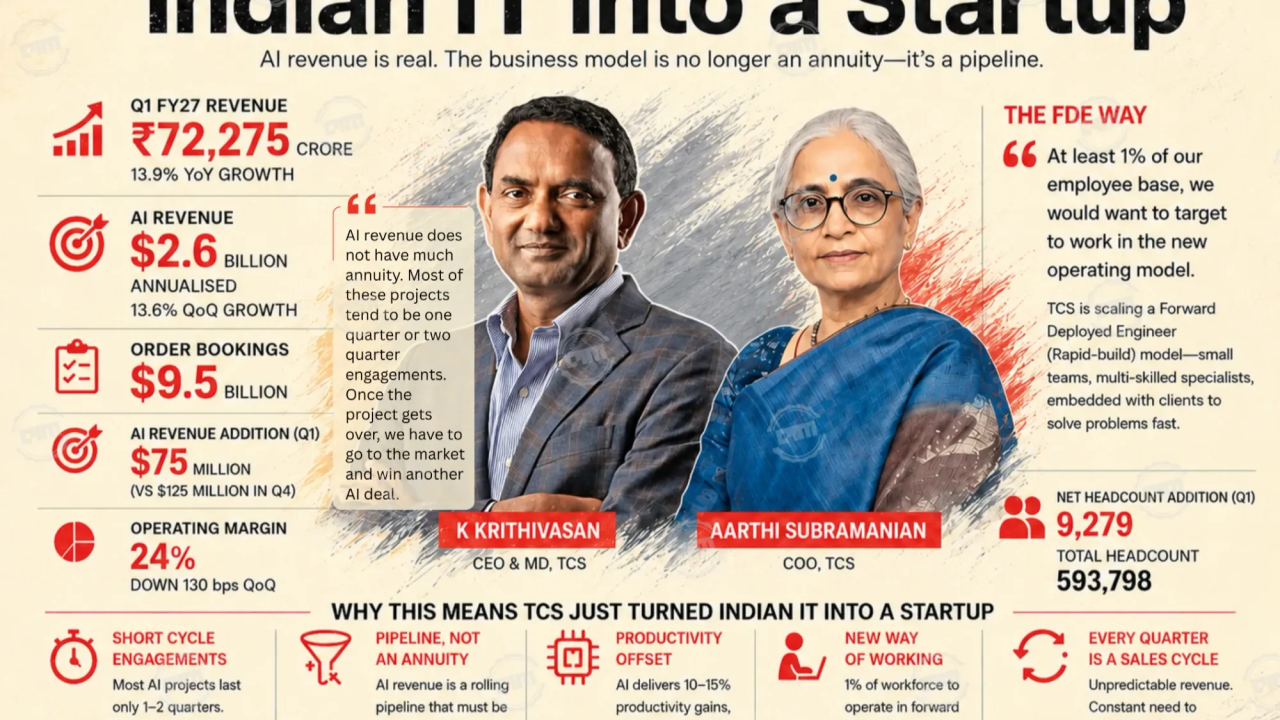
For most of its history, Indian IT tried very hard not to behave like a startup. Startups chase customers every quarter. Indian IT signed contracts that lasted seven years. Startups live with uncertain revenues. Indian IT sold predictability. TCS’ latest quarterly results suggest that the equation is changing faster than most people realise.
The country’s largest IT services company reported a strong June quarter, with revenues rising 13.9% year-on-year to ₹72,275 crore and fresh deal wins touching $9.5 billion. The market liked what it saw. Shares rose after the results, lifting the entire IT pack.
The headline number, however, was AI.
TCS disclosed that annualised revenues from AI-led engagements have now crossed $2.6 billion. Just a couple of years ago, Indian IT companies were struggling to explain how generative AI would become a business. Today, TCS alone has built an AI revenue stream larger than the total revenues of many listed technology companies.
The catch is that this business behaves nothing like the business that once built TCS.
During the earnings call, CEO K Krithivasan revealed something that may end up defining the next decade of Indian IT. Most AI engagements, he said, last only one or two quarters.
That is a radical departure from the outsourcing model.
Traditional IT contracts generated revenue for years. A bank outsourced application management for five years. A retailer outsourced infrastructure operations for seven years. Once the contract was signed, the revenue became predictable, visible and highly sticky.
The work is valuable. The margins may even be attractive. But the revenue disappears quickly.
Suddenly, India’s largest IT company sounds less like an outsourcing giant and more like a startup trying to refill its sales funnel every quarter.
That may sound dramatic, but it is exactly what TCS management described.
“Unlike the traditional business, where there is a lot of annuity revenue, AI revenue does not have much annuity. Most of these projects tend to be one quarter or two quarter engagements. Once the project gets over, we have to go to the market and win another AI deal,” Krithivasan said.
It’s not just TCS shaking things up. Cognizant has taken up another problem to solve. In this episode of Front Page, we break down Cognizant’s frontier workforce plan, how 15,000 certified engineers and business operators will be embedded by Q4 2026, and why this model could set the template for the entire IT services sector.
For decades, predictability was Indian IT’s superpower. Investors loved TCS because they could forecast revenues years in advance. Utilisation, billing rates and employee pyramids mattered because the underlying contracts were stable.
AI changes that equation completely.
The company added approximately $75 million in annualised AI revenues during the quarter, down from roughly $125 million in the previous quarter. That does not necessarily indicate slowing demand. Instead, it reflects the short-cycle nature of AI projects.
Indian IT companies now need to behave more like software startups or consulting firms. They need to continuously generate new opportunities because yesterday’s AI project may already be finished.
There is another challenge lurking beneath the numbers. According to TCS, customers are already seeing productivity improvements of 10-15% after deploying AI inside existing contracts. Those gains are increasingly becoming visible during contract renewals.
This raises a question that nobody in Indian IT is fully prepared to answer. Is AI creating new work faster than it is eliminating old work?
If a contract that previously required 1,000 engineers now requires only 850 because AI automates portions of the work, somebody loses revenue.
The industry’s hope is that customers reinvest those savings into new transformation programmes, AI deployments and automation projects.
But even TCS admitted that it still cannot quantify how much of its overall business has already undergone this AI productivity transition.
That number may become the single most important metric in Indian IT over the next three years. The hiring data from the quarter tells a similar story.
TCS added 9,279 employees during the quarter, marking its second consecutive quarter of net hiring and one of its strongest additions in years.
At the same time, total headcount still stands more than 19,000 lower than it did a year ago.
Both things can be true. Indian IT is hiring again and it is simply hiring differently.
This year, enterprises are moving beyond experimentation with AI. Results now matter. At ABBYY Ascend DevCon, discover how purpose-built Document AI turns business-critical documents into trusted, actionable data—powering intelligent automation, informed decision-making, and next-generation AI use cases. Click here to find out more.
For Indian IT, the old growth model involved recruiting tens of thousands of fresh graduates every year and training them to execute repeatable processes at scale. AI increasingly rewards specialists instead of scale alone.
Companies now want AI engineers, platform architects, data scientists, machine learning specialists and deployment experts who can work directly with customers. The age of volume hiring is slowly giving way to the age of precision hiring.
Perhaps the most interesting announcement from the quarter had nothing to do with revenue or headcount.
Popularised by companies like Palantir and increasingly adopted by OpenAI, Anthropic and Databricks, these engineers sit directly with customers, understand business problems and rapidly build solutions in small teams.
Chief Operating Officer Aarthi Subramanian said TCS wants at least 1% of its workforce operating in this model. For a company employing nearly 6,00,000 people, that translates into thousands of engineers working very differently from the traditional offshore delivery model.
This is perhaps the clearest signal yet that Indian IT is moving closer to Silicon Valley’s operating playbook.
The irony though is hard to miss. For decades, startups wanted to become TCS. Now TCS wants to borrow from startups.
The margin story tells the same story. Operating margins fell to 24% during the quarter as wage hikes affected profitability.
That is startup behaviour. Growth over margins.
Nobody wants to become the company that defended margins while missing the largest technology transition in a generation. The significance of this quarter goes well beyond TCS.
Infosys, HCLTech, Wipro and Tech Mahindra are all wrestling with the same questions.
How do you build predictable businesses around unpredictable AI revenues? TCS may have accidentally provided the answer. You start behaving a little more like a startup.
Rashi Peripherals, an NVIDIA partner, is hosting a session titled ‘GenAI at Your Desk: Building Agentic AI with NVIDIA DGX Spark’, focused on what it takes to move from experimentation to real-world AI systems.
Date & Time: July 23, 2026 | 5.00–6.00 PM
Register here – Limited slots available.
Related Stories
 AI News
Bill Gross bets AI can help mass
3 days ago
 AI News
Nigeria records 93% rise in AI micro
3 days ago
 AI News
The Italian gelato maker using AI to invent new flavours
3 days ago
 AI News
Closing the Gap Between Agentic CX Pilots and Production
3 days ago
 AI News
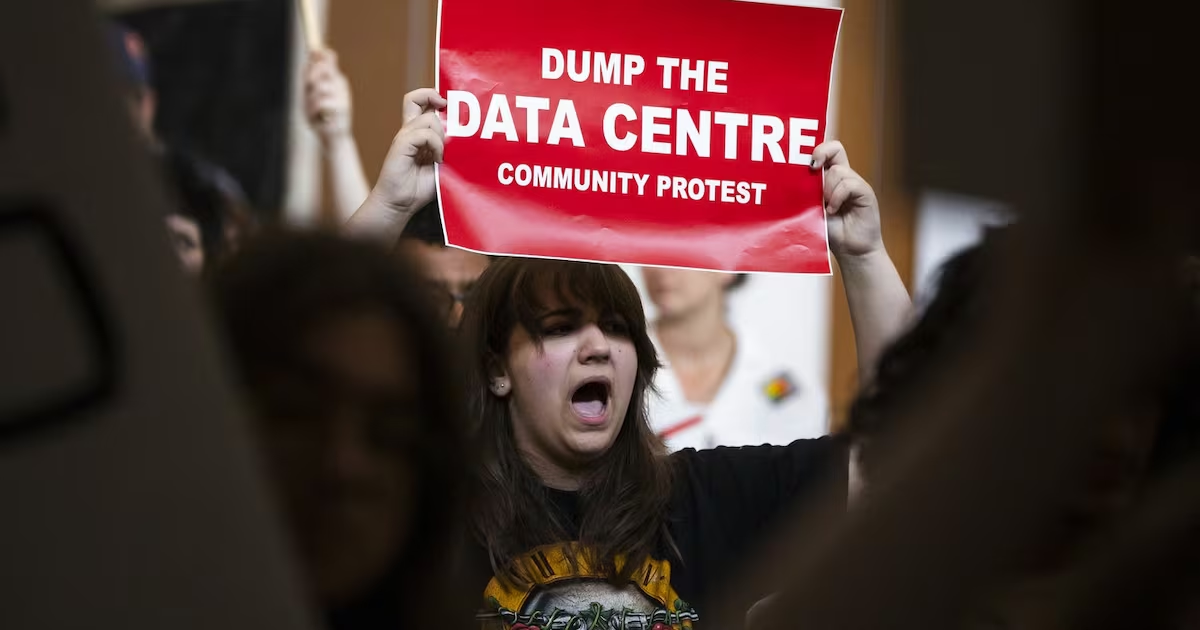
New Brunswick data centre debate highlights cross
3 days ago
 AI News
How to Structure an AI Agent Referral Fee Agreement Between Startups
3 days ago
 AI News
No, AI didn’t delete a Swedish reality TV series
3 days ago
 AI News
There is no AI in Armageddon. Artificial intelligence is a tool, not an apocalypse
3 days ago