
Bank of Canada expected to hold interest rate as weak economy, heightened uncertainty persist
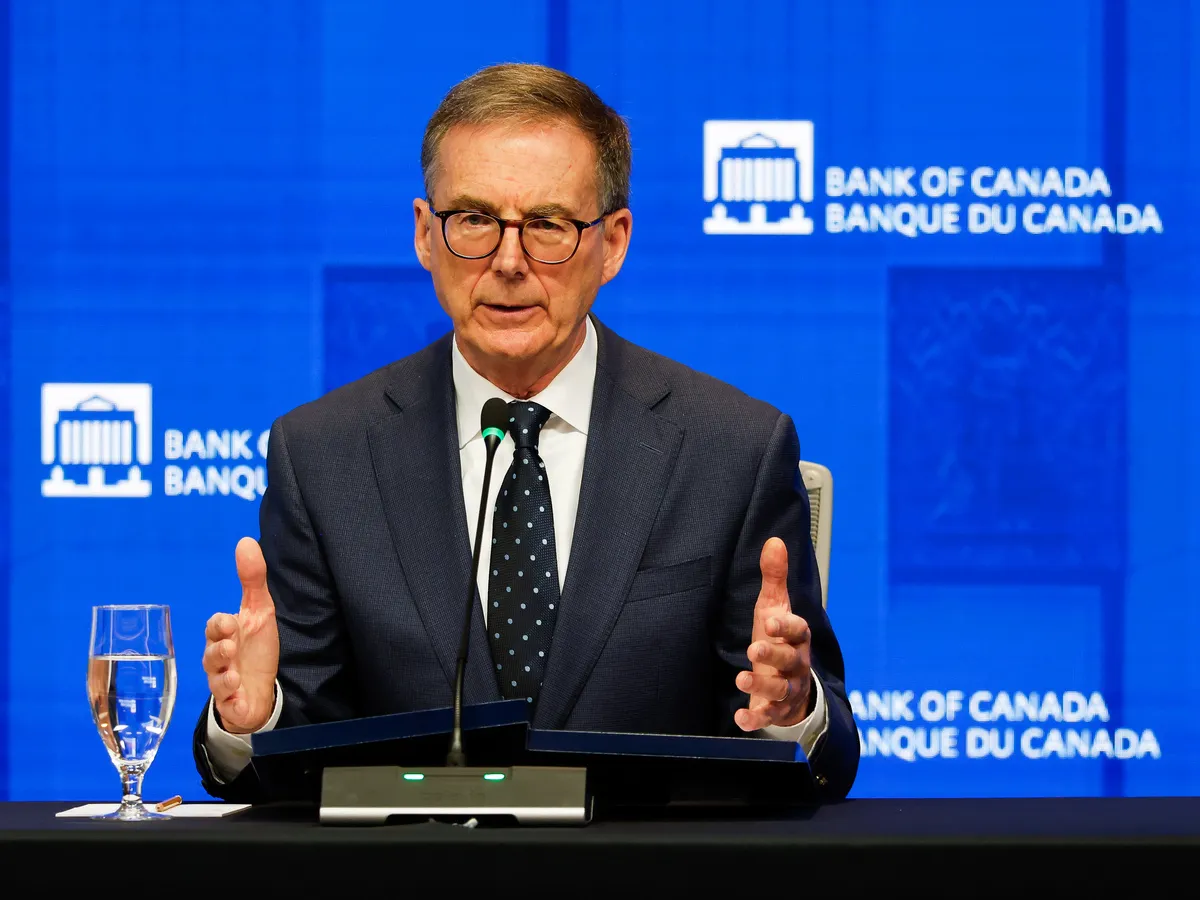
Economists say the Bank of Canada will likely hold its overnight rate at 2.25 per cent on Wednesday because the economy continues to face elevated uncertainty from the conflict in the Middle East and United States tariffs.
If policymakers decide to hold the overnight rate again, it will be the sixth consecutive meeting where it was left unchanged.
The central bank’s latest meeting comes after United States President Donald Trump’s administration said it would not renew the Canada-U.S.-Mexico Agreement (CUSMA) for another 16 years, triggering up to 10 years of annual reviews, and after the interim peace agreement between the U.S. and Iran collapsed when Iranian forces attacked commercial vessels in the Strait of Hormuz and launched ballistic missiles at a U.S. base in Jordan.
Tony Stillo, director of Canada economics at Oxford Economics Ltd., said the recent developments and the sluggish Canadian economy mean the central bank’s governing council will be in a “pickle” for a while.
If policymakers raise rates to combat high inflation and then oil prices quickly came down, he said the higher rates would further weaken the economy, but if they cuts rates to support economic growth, it will increase the risk that inflation remains high and passes through to other goods and services.
“Our take is that they’re going to hold and leave it as is. They’ll have to be nimble and respond depending on where they see the economy going for the next little while,” Stillo said. “The question is whether the latest developments represent a bump in the road or are we just emerging from the eye of the storm and we’re going to see a re-escalation in oil prices.”
Maria Solovieva, an economist at TD Economics, said the Bank of Canada’s main concern will be whether the energy price shock has fed into other goods and services.
TD Economics expects higher energy prices will broadly filter through to other things, but the impact on core inflation will be mitigated by a sluggish economy.
Bank of Canada governor Tiff Macklem has repeatedly said there is little evidence to suggest higher energy prices are feeding generalized inflation. Headline inflation accelerated to 3.2 per cent in May due to surging gas prices, but core inflation measures remained relatively stable.
“We still expect the Bank of Canada to hold interest rates,” Solovieva said. “It would be interesting to see what the Bank of Canada is thinking about inflation expectations.”
Both economists say recession risks remain elevated, especially since the U.S. has threatened to leave CUSMA early, which would negatively impact Canadian private investments and exports.
Oxford Economics recently downgraded its 2027 real gross domestic product growth forecast for Canada to 1.6 per cent, but it still expects the economy to grow by 0.7 per cent in 2026.
Economists no longer expect any CUSMA deal to lower U.S.-Canada tariffs, which will weaken economic growth and prolong uncertainty, especially for key sectors such as steel, aluminum, lumber and auto.
The U.S.-Iran conflict also remains a key risk to the outlook because the decline in global oil prices isn’t expected to provide a boost to Canadian gross domestic product (GDP) growth in the near term, but it does reduce the risk of inflation becoming more generalized.
Related Stories
 Economy
Nobel memorial prize in economics awarded to Robert E. Hall and Michael Woodford
4 hours ago
 Economy
Nobel Prize for economics awarded to 2 U.S. academics
9 hours ago
 Economy
ELDER: The anti
2 days ago
 Economy
Moneycontrol Pro Weekender | Artificial intelligence, real inflation
2 days ago
 Economy
Mayawati slams feel
3 days ago
 Economy
Could the UK really rejoin the EU?
5 days ago
 Economy
‘Tipping recession’: Atlantic Canadian hospitality workers feeling the pinch
5 days ago
 Economy
Iran’s oil minister resigns as country’s economic crisis worsens
6 days ago