
Tariffs are an ‘economic weapon.’ But who actually gets hurt?
Tariffs are an ‘economic weapon.’ But who actually gets hurt?
The Canada-U.S. trade war is as much about political pressure as it is about economics, expert says
As the Canada-U.S. trade war escalates, tariffs are unlikely to strengthen either economy and could leave consumers paying more, experts say.
Trade talks between the two countries fell apart Aug. 21, with about $28 billion in Canadian exports to the U.S. hit with 50 per cent tariffs. The Trump administration has also promised more tariffs in January.
In response, Ottawa plans to bring in retaliatory tariffs on more than $27.6 billion worth of U.S. goods on Sept. 8.
Robert Huish, a professor and associate dean of research at Dalhousie University, says the situation feels like history repeating itself.
Huish said the basic idea behind tariffs dates back to as early as the 1600s: make imported goods more expensive, reduce demand for foreign products and encourage industry to move inside your own borders.
"Tariff is essentially an economic weapon. You impose a financial penalty on goods and products that come into your country," he told This is P.E.I. podcast host Mitch Cormier.
"But this is really an ancient economic idea."
While tariffs are collected by governments at the border, Huish said the cost is often passed on to consumers through higher retail prices.
In a modern economy, he said, growth comes from allowing cheaper goods to enter at competitive prices and from immigration, which increases the size of the workforce and the economy.
"When you start putting up tariffs and you start making anti-immigration (policies), you’re only going to shrink your economy, and that’s exactly what we’re seeing in the United States," Huish said.
He also points out that tariffs are a very small piece of government revenue.
Everything you want to know about the Canada-U.S. tariffs
P.E.I. rolls out $12.5M in support for businesses hit by U.S. tariffs
He noted that even figures such as $20 billion in tariff revenue — numbers he attributes to claims made by Trump — are "only a trickle" compared with more than a trillion dollars a year spent servicing U.S. debt.
"Today, it’s absolutely inefficient in terms of getting that kind of revenue into a country’s economy," Huish said.
He said governments should rely more on taxation, especially targeting the wealthy, and designing tax codes that encourage businesses to put more money back out in the public.
Whether Canada’s retaliatory tariffs inflict significant economic pain in the U.S. will depend largely on what products are targeted, Huish said.
If tariffs fall on essential goods such as food, pharmaceuticals or fuel, "it would cause a lot of pain for consumers," he said.
P.E.I. has a $12.5M plan to combat U.S. tariffs. Here's what's in it
Tariffs can also hurt small businesses that rely on imported materials and products.
"That small business is going to hurt hard. They’re not going to be able to make ends meet, and they’re going to be forced to lay people off," Huish said.
Governments can limit some of that damage by targeting luxury goods or products that can easily be replaced by other suppliers or domestic production, he said.
Huish said tariffs are being used as much for political strategy as for economic reasons.
U.S. tariffs are hitting industries such as steel and lumber in parts of Canada where voting patterns can shift with economic conditions, he said.
Canada’s retaliatory tariffs, meanwhile, are aimed at predominantly red or Republican states such as Kentucky, Tennessee and Indiana, he said.
"It’s really the strategy of Canada to impose those tariffs so that it doesn’t create a lot of economic pain for Canadians, but creates a lot of political disruption for Americans," Huish said.
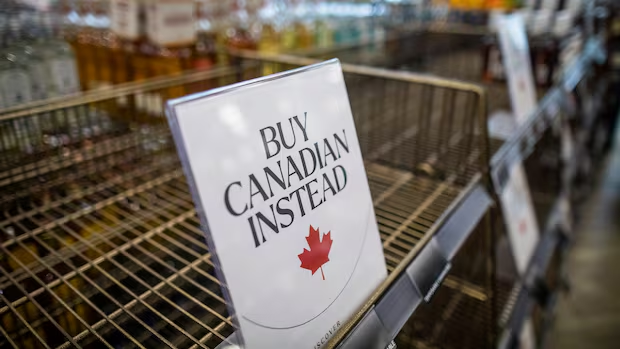
Individual consumers may also try to respond by avoiding U.S. products. Huish said those choices alone won’t "tilt the scales," but widespread boycotts can still put pressure on governments.
He points to the recent boycott of American alcohol in some provinces, where appetite for U.S. products remained low even after some bans were lifted.
"Boycotts have been game changers," he said. "They put that kind of economic pressure on government and create a major role for solidarity as well."
Retailers brace for higher prices
Retailers across Atlantic Canada are already dealing with uncertainty, says Jim Cormier, Atlantic director of the Retail Council of Canada.
"A lot of people are saying, ‘I don’t really know what we’re doing, where we’re at. Can you help us through this uncharted territory?’" Cormier said.
Larger retailers generally have more capacity to navigate tariff lists and find alternative suppliers. Smaller businesses, particularly on P.E.I., may have a harder time, he said.
Retaliatory tariffs could raise costs for Canadian businesses already weathering the trade war
Ottawa's counter-tariffs find broad support in Canada as businesses brace for trade war impact
Some are looking for Canadian products or suppliers in other countries, but Cormier said finding suitable alternatives isn’t always easy.
"It’s not like you can just snap your fingers and find an acceptable alternative that meets all of those other criteria," he said.
If the trade war drags on, he sees one likely outcome.
"Whenever a protracted trade war like this happens, especially when we are the smaller of the two economies, the only result over time is likely going to be increased prices," Cormier said.
"Retail businesses can only hold the line so long… If they’re not making at least a minimal profit, you’re probably going to see prices go up."
Thinh Nguyen is a digital reporter with CBC P.E.I. He can be reached at thinh.duc.nguyen@cbc.ca
Related Stories
 Canada
What’s open, closed on Labour Day?
15 minutes ago
 Canada
One of the last remaining steam tugboats in Canada is heading for restoration
15 minutes ago
 Canada
Matt Bufton: Can the NFL save society?
15 minutes ago
 Canada
Alumina processing plan brings optimism to Tisdale, Sask.
15 minutes ago
 Canada
What some Canadians still get wrong about Type 2 diabetes
15 minutes ago
 Canada
Boy, 10, trapped in Algerian well for days found dead
1 hour ago
 Canada
Elbows up or down? Why Alberta is diplomacy
1 hour ago
 Canada
U.S. diplomat recounts Sept. 11 outpouring from Canadians
1 hour ago