
‘Super Intelligence,’ Trump’s Dopey AI Rebrand, Explained
Americans’ concerns about artificial intelligence have quickly escalated from “it might take our jobs” to “it might kill us all.” In September, top AI executives called for slowing down development shortly after an Anthropic whistleblower warned that the technology could soon spiral beyond human control. Polls show a majority of Americans think AI could someday destroy humanity. It appears they were unmoved when President Trump, who favors “self-regulation” by the AI industry, dismissed this fear as a “HOAX.” A recent Quinnipiac survey found 58 percent of respondents disapprove of the president’s handling of artificial intelligence, versus just 25 percent who approve.
But now Trump has a plan to shut down all this AI doomerism: Simply change the name “artificial intelligence” to “super intelligence.”
When Trump first floated the rebrand, it seemed like a goofy Truth Social musing he’d forget about in a few days, like calling New Mexico “New America.” Then he announced at the United Nations that “artificial intelligence” is “hereinafter officially called ‘super intelligence.’” And on September 29, he followed that up with an executive order directing the U.S. government to switch from “AI” to “SI.”
So can Trump actually change the name of AI? What does “super intelligence” really mean? Is this technology, whatever it’s called, actually going to destroy the human race? Unfortunately, we can’t definitively answer that last one. But here’s everything you need to know about Trump’s dopey renaming ploy.
. When did Trump first propose an AI rebrand?
He posted a poll to Truth Social on September 19, imploring his followers to weigh in on a more “elegant and accurate” name for artificial intelligence:
While Trump has 13.1 million Truth Social followers, he got only 66,000 responses. But it turns out the poll didn’t matter anyway; the name Trump eventually went with wasn’t even an option.
. When did Trump start using “super intelligence”?
He announced the new name during his September 22 address to the United Nations General Assembly, in which he also rejected the “globalist scheme” to control the technology and said AI safety concerns are a “hoax” just like climate change and “Russia, Russia, Russia.”
“The use of the word ‘artificial’ makes intelligence fake. It makes it sound fake,” Trump said. “And it is not fake. It’s actually amazing.”
The president said that all U.S. documents would begin using the terms “super intelligence” or “SI,” and he hoped the rest of the world would follow suit.
“In other words, welcome to the new world of super intelligence, dash, SI,” Trump declared, saying the em-dash in the teleprompter out loud. “Let’s see if I have any power. Maybe I do, and maybe I don’t. We’re going to find out pretty soon.”
. Does Trump actually have the power to rename AI?
He can’t force people, foreign governments, or private companies to stop saying “artificial intelligence.” But he does have control over the terminology used by members of his administration and the federal government.
In the days following Trump’s U.N. address, he and other White House officials started used “SI” publicly, and the State Department ordered diplomats to make the switch in all “remarks, positions, and press elements moving forward.”
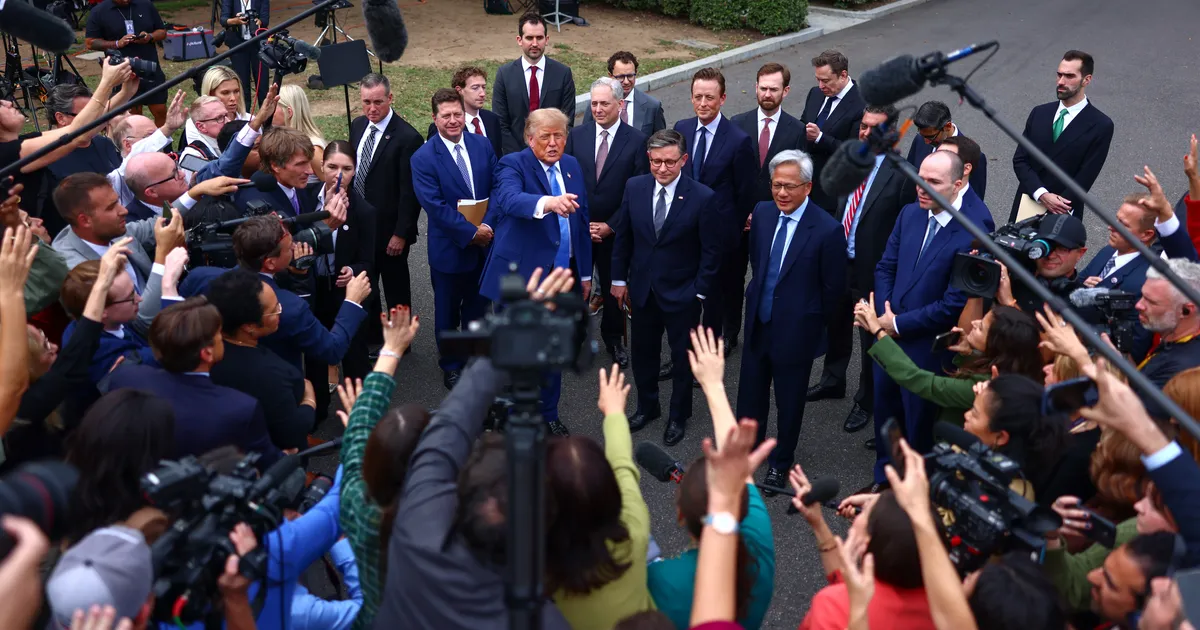
During a White House meeting about AI with top tech leaders on September 29, Trump issued an executive order directing all executive branch agencies to adopt “super intelligence”:
It is therefore the policy of my Administration that, to the maximum extent permitted by law, the executive branch shall use the terms “Super Intelligence” and “SI” in place of “Artificial Intelligence” and “AI” and will not acknowledge the usage of “Artificial Intelligence” and “AI” in any applicable setting.
This applies to “official correspondence, public communications, websites, reports, policy documents, and other non-statutory documents within the executive branch.”
. Are tech companies really going along with the rebrand?
During his September 29 meeting with tech CEOs, Trump suggested they’d all be signing a document agreeing to rename AI:
But it seems Trump was conflating the renaming executive order, which bears only his signature, with a separate constitution on artificial intelligence that was signed by six of the tech leaders (Google’s Sundar Pichai, Anthropic’s Dario Amodei, Meta’s Mark Zuckerberg, Nvidia’s Jensen Huang, OpenAI’s Greg Brockman, and X’s Elon Musk). That document is titled “White House Accord on Super Intelligence,” but it doesn’t specifically address the renaming (or legally hold them to implementing AI guardrails, as it’s only “morally binding”).
Musk, at least, appears to be onboard with the rebrand. He posted the words “Super Intelligence” to X during the meeting, and later when he referred to “AI” in Trump’s presence, he quickly corrected himself.
. Do these White House documents contain some embarrassing typo?
Of course. The “Accord on Super Intelligence” lists Trump’s title as “President of the Unites States”:
. Has anyone else endorsed Trump’s AI rebrand?
Trump said he discussed the name change with Xi Jinping during the Chinese leader’s recent U.S. visit, and he “seemed to like” it:
However, China has not confirmed this, and Xi stuck with “AI” in his own remarks. Days later, the Chinese Foreign Ministry did say in a statement, “Regarding the artificial intelligence phrasing question, the Chinese side attaches importance to the U.S. side’s position and respects the U.S. side’s wording.”
. Doesn’t “superintelligence” already mean something else?
Yes. “Artificial intelligence” has been in use since Dartmouth computer scientist John McCarthy coined it in 1956. Over the past 70 years, other terms have developed for different levels of AI advancement.
Everything available to the public right now is “narrow AI.” Chatbots like Siri, Alexa, and ChatGPT can perform defined tasks but are not as smart as humans. The next level, “artificial general intelligence,” or AGI, refers to AI that can think on the same level as a human. There’s currently debate over whether AGI has been achieved in a lab. The third level, “superintelligence,” has been used within the tech industry for years to refer to AI that is more capable than humans, as the BBC noted:
The term is often linked to the author and philosopher Nick Bostrom, who more than a decade ago defined the idea as an “intellect” that is superior to humans in all forms. It is still entirely hypothetical.
So when Trump says “super intelligence,” is he referring to this third category, or is his phrase supposed to be new and different because he threw a space in there? It’s unclear. The president’s EO does attempt to justify the switch to “SI” on the grounds that we’re quickly moving toward AI that is more advanced than humans:
The extraordinary technologies being pioneered by American innovators far exceed what was envisioned when the term “Artificial Intelligence” first came into use. The capabilities of today’s frontier systems do much more than imitate or automate discrete aspects of human intelligence. They increasingly amplify human ingenuity and unlock new forms of creativity, empowering Americans to achieve what was previously impossible across science, medicine, and nearly every other domain of human endeavor. As these capabilities continue to improve, they increasingly represent not merely artificial intelligence, but a new era of Super Intelligence.
The terminology used by the Federal Government should reflect the transformative capabilities of these technologies and the limitless opportunities they create for the American people. Accordingly, the term “Super Intelligence” more appropriately captures the promise, potential, and rapidly advancing capabilities of these technologies.
But it seems unlikely that the president, an 80-year-old man who can barely use a computer, had a hand in composing this. Trump’s own explanations suggest he just thinks “super” sounds cooler and less threatening than “artificial”:
. Is everyone really going to switch to “super intelligence” now?
Trump is certainly putting a lot of effort into making “SI” happen. But several experts told the BBC that they don’t think “super intelligence” will catch on soon, as it already refers to a higher level of AI that’s still theoretical:
The rebranding is “misleading”, as super intelligence typically refers to a system that has the ability to improve by itself, said digital ethics lecturer Simon Coghlan from The University of Melbourne.
“I doubt ‘SI’ will stick, in part because it exaggerates the current capacities of AI,” he said.
“A superintelligent system, if it came about, would be regarded by experts as the most consequential technology ever made,” Coghlan said.
“Not all AI platforms today exude super intelligence”, said computer scientist Kokil Jaidka, adding that the new name “borrows the prestige of a term researchers reserve for a much bigger leap”.
National University of Singapore computer science lecturer Ben Leong said: “My guess is that professionals will want to save ‘SI’ for a higher level of AI, not so much to describe AI today. It doesn’t feel like it’s at that level yet.”
As for the general public, only time will tell. But let’s consider the fact that, despite Trump’s urging, people in everyday life don’t usually say things like, “I saw on X that a storm’s moving across the Gulf of America this weekend. Good thing we’ll be up at Lake America!” The president may be alone on this one.
Related Stories
 AI News
Canadian websites take down articles written by suspected fake, AI
21 minutes ago
 AI News
A startup wants to replace human creativity. But first, it needs to eliminate slop.
23 minutes ago
 AI News
Why two of Silicon Valley's hottest AI coding startups are publicly feuding over one executive
1 hour ago
 AI News
Google rolls out Gemini 4 Argon, its most advanced AI model
1 hour ago
 AI News
Google’s new Gemini 4 Argon equals GPT
1 hour ago
 AI News
FTC is investigating OpenAI and Anthropic over possible risks to consumers
1 hour ago
 AI News
Google announces Gemini 4 flagship AI model after months of delays
1 hour ago
 AI News
Regulating AI 'not the right place to start' says Bank of England governor
2 hours ago