
Stellantis' new eBoost Air tech fixes turbo lag, adds power
Turbochargers are a pretty clever invention, using a fan spinning in the exhaust system to turn another fan to pressurize air going into the engine. The energy of the exhaust gases would just otherwise go to waste, and adding more oxygen into the intake means you can add more fuel, too, for a bigger bang. Bigger bang equals more power on demand, without increasing displacement. So where’s the drawback?
Well, packaging is one problem, as is heat management and the need to have good software coordinating what’s going on in the combustion chamber. However, these are mostly solved issues, which is why you can buy a Porsche 911 with a turbocharged engine, and also a Honda CR-V with one. Turbo went mainstream a long time ago.
However, there is still the question of lag. This again is a largely resolved problem, and the current 911’s turbo pressure comes on with cat-like reflexes. The original’s had sleepy-golden-retriever-that’s-just-finished-a-large-lunch reflexes. Porsche achieves this response with a very clever hybridized turbocharger, one with a tiny electric motor to spin up the turbine before the exhaust gases get flowing.
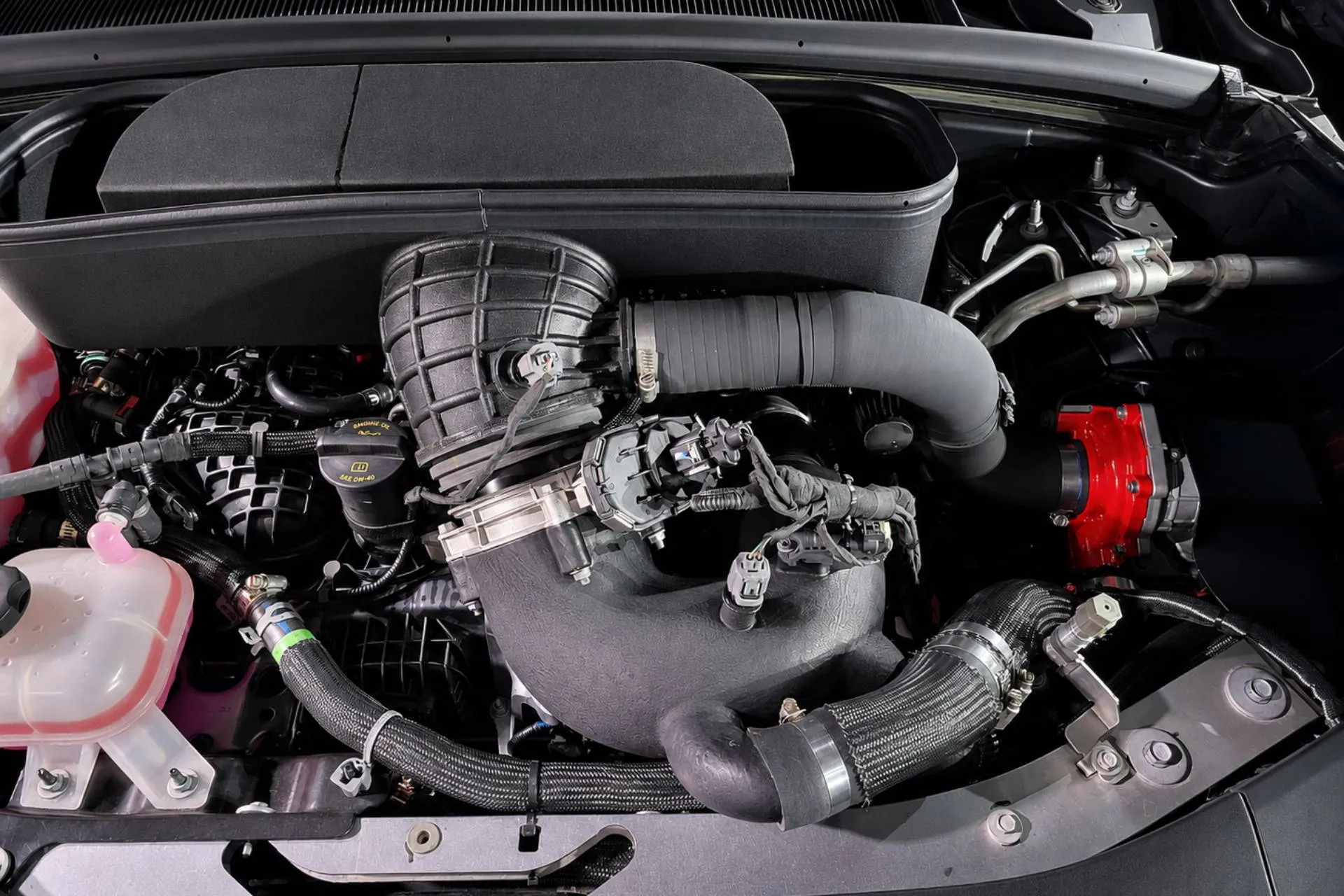
Now Stellantis has a novel solution for its turbocharged inline-six engine, and if you want to talk about low lag times, its engineers came up with the system in just seven weeks. Instead of fiddling with the turbochargers themselves, it involves an electric compressor set in parallel to the regular intake system, one capable of adding 10 psi of boost up until roughly 2,500 rpm.
They’re calling it “eBoost Air,” and it’s not some theoretical experiment, but tech affixed to a fully functioning engine bolted into a Jeep Grand Cherokee. Because this is the SRT team, the engine does make a little more power than in the High Output form found in the Charger – figure 600 hp or so – but peak power wasn’t the goal. Response was.
The electric compressor builds boost with a speed that depends on accelerator-pedal travel. Stomp it from a stop and it can achieve peak pressure in 650 nanoseconds. That’s enough time for the increased combustion chamber pressure to have the two normal turbochargers spinning away, and the system closes the electric compressor loop while the engine charges off to red-line.
The system gives the Hurricane inline-six something of a fighting chance in its battle to fill in the Sasquatch-sized shoes left by the supercharged V8 of the Hellcat Dodges. Because a supercharger is belt-fed off the engine, it doesn’t have lag, and Dodge’s big V8s made the most of their displacement.
With the eBoost Air, the next logical thing to do is hang a couple of bigger turbos off the engine and see what happens. How big? Well, again, this is SRT. They’ll probably find something the size of a basketball, bolt it on, and see if anything explodes.
Again, this is experimental tech that was developed rapidly, so it’s not nearly ready for production. In a factory-supported car, the eBoost Air will have to have its power supply calibrated to how consumers actually use the feature. It also doesn’t quite fit into the engine bay of the Grand Cherokee, requiring a large bulge on the carbon-fibre hood.
But to have a fully functioning test mule in just under seven weeks from concept to reality is supercharged responsive. Right-now power defined the way SRT’s products behaved in the V8 era. It appears it defines the way its engineers work, too.
Sign up for our newsletter Blind-Spot Monitor and follow our social channels on X, Tiktok and LinkedIn to stay up to date on the latest automotive news, reviews, car culture, and vehicle shopping advice.
email: brendanmcaleer@gmail.com
Bluesky: brendanmcaleer.bsky.social
Related Stories
 Technology
Big tech companies will have to pay to publish Australian news content under new laws
2 hours ago
 Technology
Australia closes Meta's 'no news, no payment' loophole
3 hours ago
 Technology
$15 million federal grant will fund fishing tech projects
3 hours ago
 Technology
BlackSky Technology (BKSY) Secured A New International Contract, Is The Pullback An Opportunity?
3 hours ago
 Technology
Nvidia Pays $6 Billion to License Poolside AI Model
3 hours ago
 Technology
PM Modi meets CEOs of 20 space startups, ask them for wider applications of space tech to improve people
6 hours ago
 Technology
Studies show year-round shipping potential from Manitoba’s Port of Churchill
7 hours ago
 Technology
Does Nova Scotia need shark
7 hours ago