
Seven ANZ startups that raised $111.5 million this week
With fresh funding deals across banking, scientific research, defence, water transport and customer service, this week’s funding round-up captures the breadth of the local startup sector.
This week we’ve counted seven Australian and New Zealand startups that collectively raised $111.5 million.
Keep reading to learn more about Constantinople, Vessev, Nbryo, Sophiie.ai, Seitec, Bower and Visaible.ai.
Australian fintech startup Constantinople has quietly raised $62.5 million in new funding from its existing investors and is edging closer to unicorn status, according to The Australian Financial Review (AFR).
The funding round was led by leading Australian venture capital firms Airtree Ventures and Square Peg Capital, which both backed Constantinople’s $32 million seed funding round in 2022 and its $50 million Series A round in April 2024.
Founded by former Westpac executives Dianne Challenor and Macgregor Duncan in 2022, Constantinople helps small and medium-sized banks by providing them with a “bank in a box”, or a suite of operational tools, which allows them to then focus on customer relationships and the business of banking.
According to the AFR, Constantinople is working with eight client banks, with two more due to sign up by the end of the year.
This includes Move Bank, which recently moved its whole operation on to the Constantinople platform in what the company described as a “genuine world first bank migration”.
New Zealand deep tech marine startup Vessev has raised $27 million in a Series A and follow-on financing round, led by major VC firm Blackbird Ventures.
Vessev is commercialising its electric hydrofoiling technology across projects underway in Australia, New Zealand, the US and Europe.
Founded by Max Olson and Eric Laakmann in 2017, Vessev now employs a team of 58.
The new funding has been earmarked for scaling production of the company’s VS–9 and VS–12 vessels, expanding its go-to-market team, and developing its onboard software and telemetry platform.
Vessev’s vessels lift out of the water as they move, which means they can travel through waterways without the same noise, emissions or wake of traditional boats.
This makes them particularly well suited to Australia, said Laakmann in a statement provided to SmartCompany.
“Australia currently has more planned electric hydrofoiling transport networks than any other country,” said Laakmann.
“Its cities are built around waterways that are still underused as transport corridors and we’re seeing strong demand for a new kind of water transport that is quiet, efficient, sustainable and commercially practical.
Vessev attracted a number of new investors in its latest funding round, including GD1 and Rypples, alongside existing investors K1W1, Icehouse Ventures, Shasta Ventures and NZVC.
Queensland agtech startup Nbryo has topped up its seed round, doubling it from $10 million in November 2025 to $20 million, with the Queensland government’s new Sowing the Seeds of Farming Innovation Fund chipping in $2 million.
Sowing the Seed is managed by QIC Ventures, which backed last year’s raise. This is the first investment from the $30 million fund.
Sowing the Seed invested alongside existing backers including the Gates Foundation, AgriZero and Tenacious Ventures.
Nbryo CEO Paul Niven said Queensland has the opportunity to lead the world in agtech innovation.
“We’re proud to showcase the work being undertaken at Nbryo and the role advanced reproductive technologies can play in helping make better herds faster,” he said.
“Translating scientific innovation into practical outcomes for farmers is at the core of our mission.
“Every improvement in reproductive efficiency has the potential to deliver significant benefits for producers, the supply chain and the broader agricultural sector.”
A Gold Coast startup using artificial intelligence to manage admin for tradies and service businesses has raised $5 million in seed funding.
The round for Sophiie AI was backed by Archangel Ventures, Admiralty Capital Group, Antler, Gandel Invest and Aussie Angels, and values the business at $30 million.
The funds will go towards product development, adding headcount, and international expansion, including the US later this year.
Co-founders Jacob Banks, Luke Kelleher, and Juan Castro launched Sophiie in 2024 as an AI-powered administrative and virtual receptionist for tradies.
Sophiie tackles a key challenge: managing time lost to admin — an estimated 16 hours a week — from dealing with work enquiries, while also coordinating tradies, schedules, jobs, quotes, invoices, and customer communication.
The startup recently launched a new version of its platform, evolving from an AI receptionist into an AI operating system.
Banks, Sophiie’s CEO, previously built an online marketplace featuring more than 35,000 trades businesses. He saw firsthand the pressure admin puts on someone like a plumber or electrician, taking them away from their actual job.
“We started Sophiie to take that burden away. With our new platform, we’re going much further. We’re building an AI operating system that can sit at the centre of a service business and help manage the journey from the first customer enquiry through to getting the job done and getting paid.”
“This $5 million round gives us the capital to take what we’ve built in Australia and scale it internationally. We already have thousands of businesses using Sophiie across Australia, New Zealand and the UK, and we’re seeing 10-15% growth month-on-month.
Canberra defence tech startup Seitec has raised $4 million as it looks to sell its conflict zone monitoring platform to global allies.
The round was led by local VC ACTivate Capital, which tipped in $1.5 million, with support from specialist defence fund Beaten Zone Venture Partners and UNSW.
ACT government-backed ACTivate has hit a $23 million first close on its $50 million fund to turn Canberra research and innovation into global companies, with UNSW Canberra, Epicorp among its supporters.
Veteran RAAF avionics technician Daniel Stevens founded Seitec in 2021 after 20 years in the Air Force. The startup develops passive sensing technology to detect, classify and monitor activity in difficult and contested environments without giving away the user’s position.
The investment will support expanding the team, product development and Seitec’s global push amid growing demand from allied nations for the stealth detection technology.
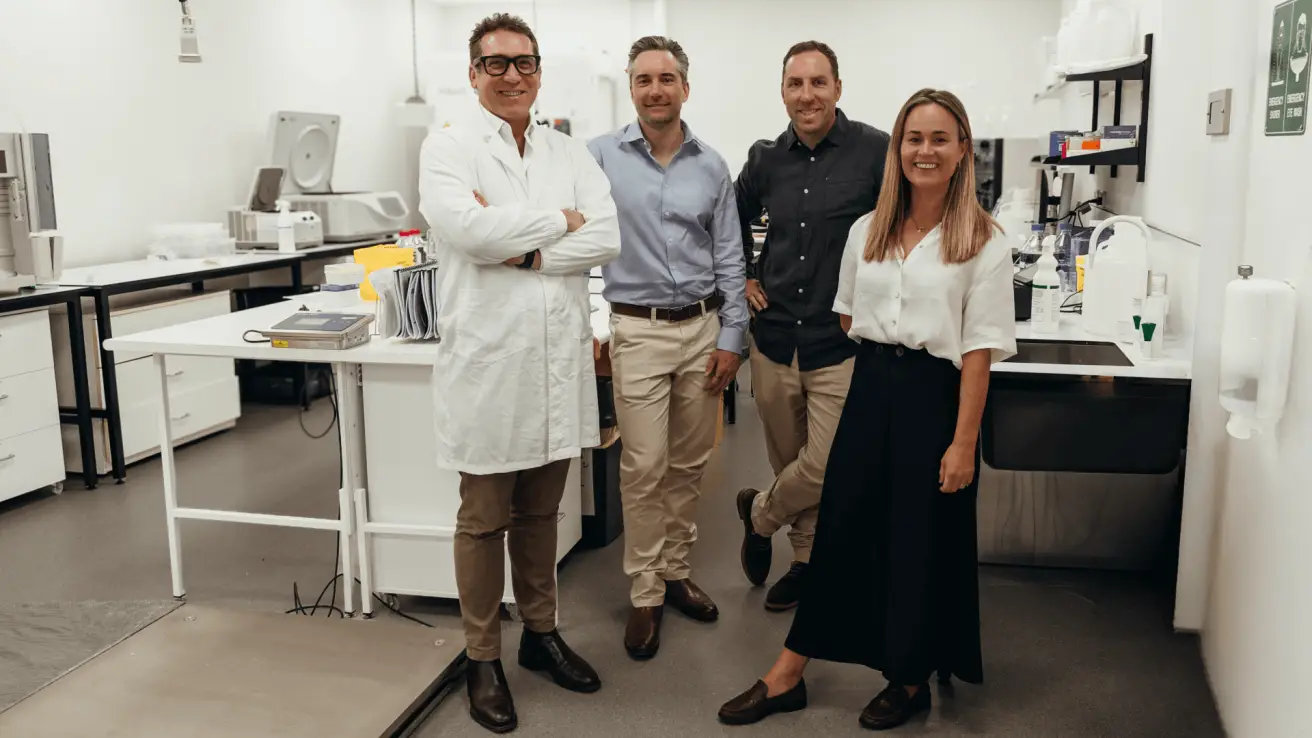
Gold Coast-based AI startup Bower has raised $2 million in pre-seed funding to pioneer a category it has termed “augmented research”.
The funding round was led by TEN13, with Admiralty Capital Group and Edale Capital participating in the round.
The startup has also secured the backing of a number of angel investors, including Heidi Health chief technology officer Yu Liu, former Eucalyptus-backer Dean Kelly, former AirBnB executive Harry Uffindell and Emma Ferrier, as well as the startup’s strategic advisor Bernhard Hans Weigl.
Bower wants to improve how scientific work is documented in lab settings and speed up scientific discoveries through the use of smart glasses and mobile and desktop applications that can capture experiments as they are taking place.
The company was founded by CEO Michelle MacRae, who was the AI product lead behind Microsoft’s generative video technology, along with chief science officer Renaud Joannes-Boyau, chief operating officer James Boysons, and chief technology officer David Lyon.
MacRae said in a statement that science is “the perfect use case” for wearables.
“Researchers already wear PPE glasses for hours a day. With Bower, that same interface becomes intelligent,” she said.
“It can understand what a scientist is doing, capture what they learn, automate the administrative work around the experiment and bring the organisation’s collective knowledge back to them in real time. The scientist stays focused on the science while Bower handles everything around it.”
Sydney startup Visaible.ai has raised $1 million to help hotels check visibility with potential customers in the AI search era.
The round was led by Blacksheep Capital. The capital will be used to build out an end-to-end agentic automation and expand into the US, UK and Europe.
Founder Sam Rich launched Visaible last year to give hoteliers an insight into whether their properties appear in AI responses by the likes of Gemini, ChatGPT and Claude – the fastest growing travel discovery channel – and if they do, how.
The startup tracks how a hotel appears across LLMs, identifying where information is missing or wrong, and the Visaible’s AI agents fix it, updating a hotel’s website content, structured data, FAQs and listings directly.
Rich explained that hotel teams only need to step in to give approvals on brand-sensitive changes.
“The hotel sector understands the scale of the shift, which is quickly becoming a commercial issue rather than just a branding exercise,” he said.
“Many hotel teams have invested heavily in search, reputation and travel agency strategy, but AI recommendation systems are now becoming a separate discovery layer with their own logic, sources and ranking behaviour.”
Never miss a story: sign up to SmartCompany’s free daily newsletter and find our best stories on LinkedIn.
Related Stories
 Business
Robot factories and hypersonic missiles: JPMorgan Chase’s first $5 billion of defense investments
3 days ago
 Business
Police say a car has hit an Australian lawmaker, critically injuring her; the driver was arrested
3 days ago
 Business
Boomi acquires Israeli startup Elementary for $43 million
3 days ago
 Business
Mega chicken farm expansion plan withdrawn
3 days ago
 Business
Data Breach at Hankyu Hanshin Department Store Common ID System Affects Nearly All 1.26 Million Members
3 days ago
 Business
Global Startup EXPO and Nippon Startup Awards 2026: METI Showcases Japan's Deep
3 days ago
 Business
FANCL and Attenir Suffer Data Breach Affecting 780,000 Customers, Exposing Addresses, Names, Phone Numbers
3 days ago
 Business
DeepSeek Quietly Ships V4.1-Flash
3 days ago