
Report forecasts 3
Report forecasts 3- to 6-degree temperature increase for Banff National Park
'We’re losing it all right before our eyes,' says glacier expert
A Parks Canada report says the temperature in Banff National Park could rise by three to six degrees in the next few decades due to climate change.
The report cautions warming temperatures can lead to more rain in winter months, drier summers, increased wildfire risk and higher chances of glacial melt.
The projections are based on existing emissions and whether they peak in 2050 and decline, or continue to rise annually.
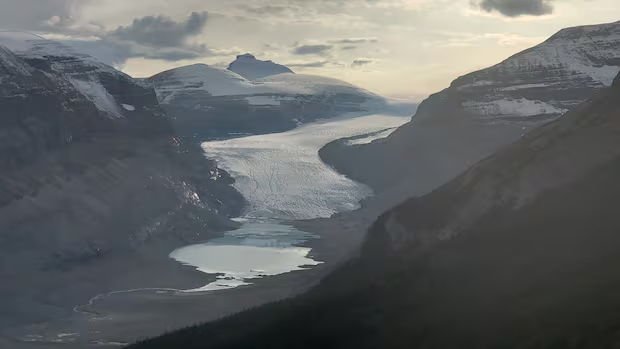
John Pomeroy, director of the University of Saskatchewan's Centre of Hydrology, who is based in Canmore, Alta., said monitoring in the national park indicates at least 75 per cent of glaciers will be lost by the end of the century.
For example, Peyto Glacier has retreated 500 metres and lost roughly 56 metres of ice surface since 2019, Pomeroy said.
“It’s stunningly horrible. … We’re losing it all right before our eyes,” he said. “If anything, it’s coming faster than what they’re suggesting.”
There are 39 monitoring stations at high elevations near glaciers across the Canadian Rockies, in places such as Peyto Lake, Helen Lake and Bow Hut.
How long will Canada’s glaciers last?
Expect 'lots of shifts ecologically'
Roughly 44 per cent of Banff National Park's 6,500 square kilometres is alpine ecoregion. A small amount is alpine meadows, which are “highly sensitive to climate change,” stated the report.
Popular spots like Sunshine Meadows, Healy Pass and Citadel Pass are “particularly sensitive areas,” and more restricted use and seasonal closures could be on the horizon.
Pomeroy said climate change can lead to “lots of shifts ecologically": forests become grasslands; warmer and rainier weather in the winter can mess with hibernation; and food supply is disrupted as growing patterns change.
Climate change impacting national parks
Daniella Rubeling, acting superintendent of the Banff field unit, said at the park's annual planning forum earlier this year that climate change is “increasingly influencing how we plan, operate and make decisions.”
She said climate change summaries are designed to see “how they may affect all areas of Parks Canada responsibilities from ecosystem health to infrastructure, all the way to visitor experience.”
Banff is Canada’s first national park and welcomes about 4.5 million visitors annually.
A climate change profile for the Lake Minnewanka area is ongoing. Climate summaries for Yoho and Kootenay national parks were done in 2024.
CBC News was unable to get an interview with Parks Canada before publication.
Pomeroy said national parks have a small footprint in terms of overall climate change impacts in Canada. Still, "ambitious and rigorous" climate change policies are needed "right away."
“I think future generations will have very strong views on some of the decisions that were made right now," he said.
Greg Colgan is a journalist for CBC in the Bow Valley. He was previously the editor of the Rocky Mountain Outlook in Banff and Canmore. He has also worked for media outlets in Ontario and has experience covering topics such as sports, politics, housing and development, courts and arts and entertainment. He joined CBC in 2025. He can be reached at greg.colgan@cbc.ca.
Related Stories
 Canada
Canadian businesses deal with cancelled orders amid trade war with U.S.
1 hour ago
 Canada
CTV National News: Trump floats 'Lake America' as U.S.
1 hour ago
 Canada
Newsom says Trump will reverse Canadian tariffs to ‘save face’
1 hour ago
 Canada
Trump widely blamed in international coverage of Canada
1 hour ago
 Canada
Alberta Premier Danielle Smith wants Ottawa to resume trade talks with U.S. before counter
2 hours ago
 Canada
‘Horror show’: Canadian businesses prepare for worst as Ottawa readies counter
2 hours ago
 Canada
Vancouver Canadians have bad news for fans hoping to see fireworks this week
2 hours ago
 Canada
Canada retaliates with tariffs on $20b in US goods
3 hours ago