
Rebalancing or retreat? Canada's peacekeeping legacy fades away
Rebalancing or retreat? Canada's peacekeeping legacy fades away
Military says it's keeping deployments 'relevant' as critics see abandoned heritage
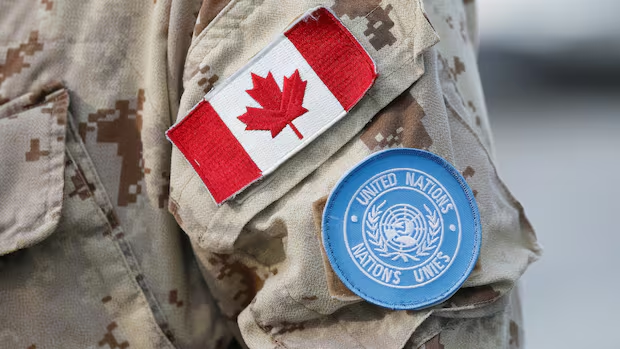
The Department of National Defence calls it "rebalancing" but others believe we are witnessing the death of Canada's contribution to peacekeeping with the winding down of a series of long-standing overseas missions.
The country has — for years — contributed only a handful of soldiers to United Nations-sanctioned missions around the world. But in mid-July, late on a Friday, the department quietly announced it was closing four missions and reducing its commitment to a fifth non-UN force in Egypt.
Up to 60 military members were assigned to the peacekeeping forces, a sharp drop from 1993 when almost 4,000 Canadians served with various UN forces, most of them at the time in the former Yugoslavia.
The department said the closing of operations KOBOLD (Kosovo), SNOWGOOSE (Cyprus), SOPRANO (South Sudan) and CROCODILE (Democratic Republic of Congo) and the reduction to Operation CALUMET (Sinai) will take place over the next two years.
Canada's next defence fight won’t be over spending. It’ll be over trust
Canada remains anti-nuke, but its potential path to the bomb is getting shorter
Canada urges U.K. to join new global bank for defence projects
The decision was made to "better align CAF resources with current defence priorities," which include the NATO deterrence mission in Latvia and possible future missions in the Indo-Pacific region, the department said in a statement.
"This approach focuses personnel and capabilities where they have the greatest impact, while sustaining commitments, maintaining readiness for emerging challenges and enhancing operational effectiveness with allies and partners."
In the case of the deployment to Cyprus, Canadian troops first set foot on the Mediterranean island in March 1964 and military expert Walter Dorn said closing down the mission is the end of an era.
Canadians 'expect us to be sensible' around ramped up defence spending, Carney says
"This looks like the death of Canada's contribution because it's very hard to revive once you've closed out a mission," Dorn said, suggesting that an important part of modern Canadian heritage was being allowed to wither and die.
"Peacekeeping is part of the Canadian identity. It is something that we are uniquely qualified to do as opposed to the United States. It's a major role for middle powers in the world where the great powers are having their competition.
"The role for peacekeepers is really a great one for middle powers because they can be more impartial. They don't have the colonial baggage."
Military says troops will be ready and relevant
In his now famous speech to the World Economic Forum last January, Prime Minister Mark Carney urged middle powers to co-operate more closely in a globe that is being divided by great powers.
Dorn said peacekeeping was a perfect vehicle to help implement Carney's vision because international values are being backed up by "boots on the ground."
Peggy Mason, president of the Ottawa-based Rideau Institute, said the decision is a major mistake.
"This is very bad news indeed and shockingly tone deaf when it comes to the increasingly empty Davos promise of Canadian leadership when it matters," said Mason, who served as Canada's ambassador for disarmament from 1989 to 1995.
When the decision was announced, the country's top military commander said Canadian troops made lasting contributions to peace and stability through peacekeeping missions over many years. Gen. Jennie Carignan, the chief of the defence staff, said rebalancing the missions is meant to keep the force "ready, relevant and positioned to meet current and future operational demands.”
But Dorn said he doesn't buy the notion that the Canadian military can't spare the troops in a time when recruiting has turned a corner and the Defence Department is receiving billions of dollars in new funding.
Canada was one of the world's most active contributors to UN peace operations down the decades. In total, more than 125,000 members of the Canadian military served in dozens of peacekeeping and peace support missions, alongside more than 4,000 Canadian police officers, diplomats and civilians. Roughly 130 Canadian peacekeepers have been killed on various missions.
Troop contributions have been dwindling for almost two decades and Dorn argues that much of Canada's hard-won influence in the developing world is now being ceded to Beijing.
"China wants to have a major role in peacekeeping. It's contributing in a major way whereas the United States is not," Dorn said.
Lurkers in the deep: How Canada's new submarines will be used in peace and potential war
Ottawa sidelines foreign firms in $4.9B army vehicle competition
"If we, as Western countries, as the Canadian nation, decide to withdraw from peacekeeping — as we currently decided to do — then we're ceding more rights and more territory for China to take over leadership."
Many in the Canadian military are deeply skeptical, even openly hostile, to the peacekeeping legacy, mostly because of the deep frustration related to UN restrictions and bureaucracy that contributed to civilian deaths, including the 1994 Rwandan genocide.
Over the years peacekeeping has evolved from traditional Cold War ceasefire monitoring to more dangerous "peace support" operations in failed states, where peacekeepers often found themselves amid active combat and ethnic violence.
Even still, well into the early 2000s, the mythology over Canadian peacekeeping operations persisted. At the height of the Afghan war, Defence Department public opinion surveys consistently showed a desire for the country to return to its "traditional role" of peacekeeping.
Senior reporter, defence and security
Murray Brewster is the senior defence writer for CBC News, based in Ottawa. He has covered the Canadian military and foreign policy from Parliament Hill for over a decade. Among other assignments, he spent a total of 15 months on the ground covering the Afghan war for The Canadian Press. Prior to that, he covered defence issues and politics for CP in Nova Scotia for 11 years and was bureau chief for Standard Broadcast News in Ottawa.
Related Stories
 Canada
Canada is no U.S. ‘subsidiary,’ Carney says, urging world to take lesson
1 minute ago
 Canada
A psychologist at Lindsay Clancy's murder trial says she has bipolar disorder
1 minute ago
 Canada
Doug Ford’s 'emotional' response to Trump doesn't help Canada: political scientist
1 minute ago
 Canada
Donald Trump says ‘we don’t need Canada’ as trade war sparks vocal U.S. backlash
1 minute ago
 Canada
Ontario premier says Trump can ‘kiss my ass’ as U.S. president threatens new tariffs on vehicles
1 minute ago
 Canada
Carney says he'll resume negotiating when Trump team has the 'right attitude'
2 minutes ago
 Canada
Trump tells Canada to ‘fall in line’ as Carney rejects subordination
2 minutes ago
 Canada
U.S. trade war sparks economic concern
1 hour ago