
Rahul Gandhi’s politics of resistance needs a credible path to power
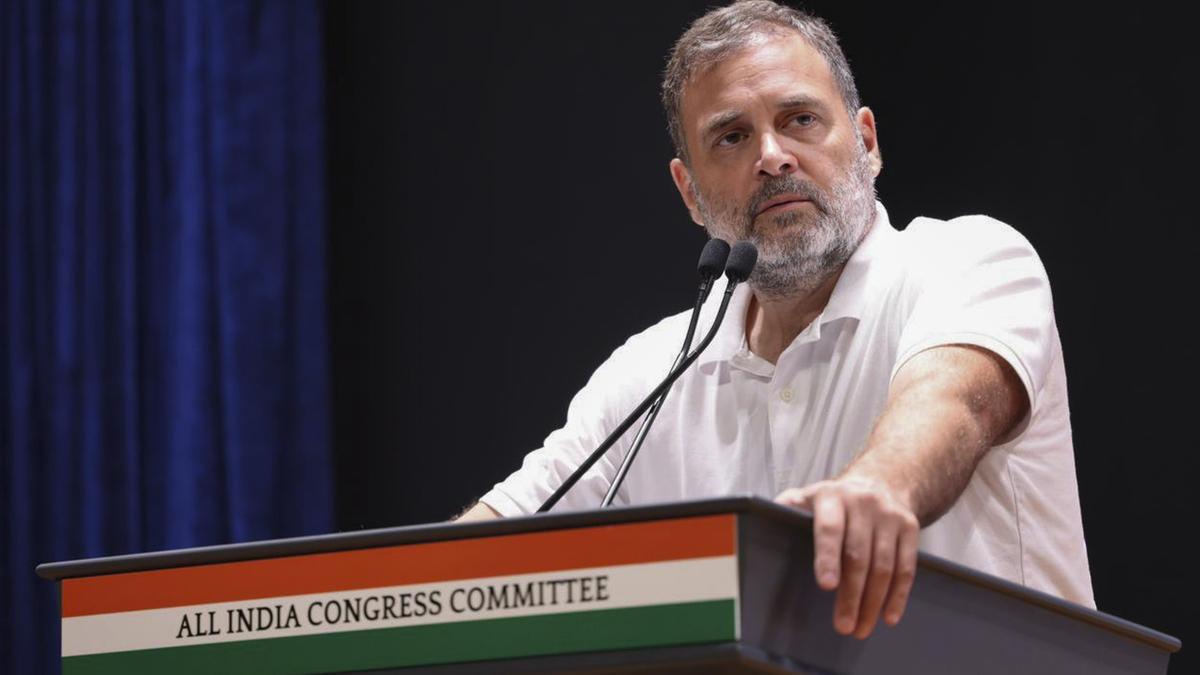
The Bharatiya Janata Party (BJP), which recently celebrated Modi government 3.0 to mark Prime Minister Narendra Modi’s completion of 12 years in office, has often ridiculed the “multiple relaunches” of Congress leader Rahul Gandhi, who leads the Opposition parties in the Lok Sabha.
To underscore its claim that Mr. Gandhi is not a serious political challenger, the ruling party has frequently deployed a battery of spokespersons and Ministers to rebut his statements, often seeking to portray him as politically inconsistent.
Also Read | Unity in diversity: On the INDIA bloc meeting
Yet Mr. Gandhi’s address at the Indian National Developmental, Inclusive Alliance (INDIA) bloc meeting on June 8 merits closer attention.
The speech not only criticised the BJP but also framed the political contest in terms of the neutrality of institutions and the need for organised resistance. This approach marks an evolution in the Opposition leader’s political argument.
For years, he has accused the Narendra Modi government of undermining constitutional institutions. At the INDIA bloc meeting, however, he advanced the proposition that Opposition parties were fighting their battle with outdated tools. Those instruments worked only when the Indian state “provided a fair field for them to operate in”, he argued.
“That field doesn’t exist anymore,” Mr. Gandhi said, adding, “The BJP controls the legal system. The BJP controls the bureaucracy. The BJP controls the intelligence agencies. The BJP even controls the Election Commission.”
The most striking aspect of his speech was that it was aimed at more than the INDIA bloc’s constituents. The repeated invocation of institutions serves a dual political purpose. It mobilises Opposition supporters by framing the contest as one between constitutional values and political power. Simultaneously, it signals to officials within these institutions that their actions are being publicly scrutinised and recorded as part of a larger democratic struggle.
“The entire architecture — media, social media, the legal system, bureaucracy, intelligence agencies — is aligned to keep this government in power,” Mr. Gandhi said.
The Election Commission, bureaucracy, investigative agencies, the legal system, and the media are thus portrayed as active participants in furthering a particular political narrative. This is where the theme of resistance emerges as a significant trope.
“The Congress party is a party of resistance. It does not require the neutrality of the Indian state to operate. In fact, the more the institutions of the Indian state are throttled, the more aggressively the Congress party will fight to defend the Constitution,” Mr. Gandhi said.
“You don’t need the bureaucracy. You don’t need the intelligence agencies. You need the act of resistance — meaning: I will resist. I will not allow injustice. Full stop, the end. It is a spirit. It is not an organisation,” he added, invoking the Congress’s role in the freedom movement.
Whether this strategy can translate into electoral success remains an open question. Resistance can mobilise supporters around questions of democratic accountability, but political parties require a compelling alternative narrative and a robust organisation on the ground to convert sentiment into votes.
The party must also build a coalition of interests among voters and develop effective messaging to translate dissatisfaction with a particular government into electoral support.
Mr. Gandhi’s emphasis on social justice and backward classes is yet to yield significant electoral dividends for the Congress. His latest outreach to students and Gen Z appears to be part of a broader effort to cultivate a new political constituency.
The challenge before Mr. Gandhi, therefore, is to convert a narrative of democratic resistance into a broad-based political project capable of persuading voters that the Congress can effectively take on the BJP’s organisational and electoral dominance. If resistance is to become more than a slogan, it must evolve into a political coalition with a credible programme and a path to power. Whether Mr. Gandhi can make that transition may well determine not only his own political future but also the trajectory of Opposition politics in India.
Related Stories
 India
India
Badminton Star Saina Nehwal Open to Future in Electoral Politics
1 hour ago
89th Know India Programme for Scholars and Innovators (Brunei Darussalam)
1 hour ago
 India
India
"Why destroy India's heritage?": UP CM Yogi Adityanath attacks Rahul Gandhi over Manusmriti remarks
3 hours ago
89th Know India Programme
3 hours ago
Modi government strangulating, emasculating ISRO, says Congress General Secretary Jairam Ramesh
5 hours ago
 India
India
Rahul Gandhi's Politics Of The Street Wins New Fans
6 hours ago
 India
India
Vietnam: Gen Z seek justice for teen killed in ex
10 hours ago
 India
India
When I first moved to Glasgow from India, I felt welcomed and included. Now I just feel scrutinised | Sanghmitra Singh
10 hours ago