
Project digitally recreates a buried World War I battlefield
Imagine walking through a World War I excavation site — not wading through mud-filled trenches, but navigating a digital landscape rich with history, artifacts, and human stories.
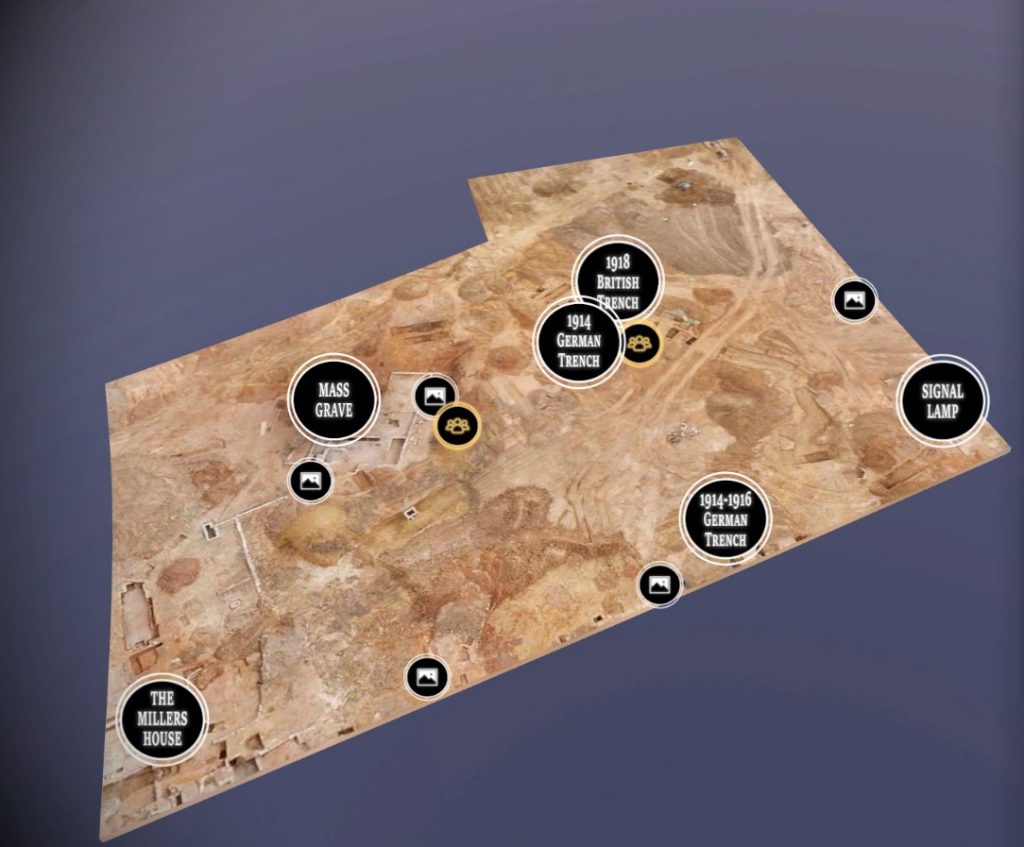
The Applied Research in Immersive Experiences and Simulations (ARIES) team in University Libraries at Virginia Tech created an immersive digital experience that allows researchers and the public to explore Hill 80, a German stronghold and trench fortress near Wijtschate, Belgium, captured during the 1917 Battle of Messines.
From physical dig to digital archive
Dig Hill 80 was a rescue archaeology project prompted by plans to build a housing development on the site. For generations, local residents had repeated a saying that “there is an army buried there,” sparking interest in what might lie beneath the ground. Flemish archaeologist Simon Verdegem led the project, which was crowdfunded beginning in late 2017.
Enough funding was secured for the excavation to take place from mid-April to early June 2018. Archaeologists uncovered trench systems, dugouts, artifacts, and soldier remains.
“The ground was fought over for nearly the entirety of the First World War,” said Todd Ogle, executive director of ARIES. “Evidence in the form of equipment and human remains was found of fighting from the very first months of the war, all the way through the final German offensive in 1918. The volume of remains, combined with the preservation level of finds and the complex nature of the site, made it important to investigate and preserve prior to the construction of the housing estate on the site in late 2018.”
The ARIES team, along with experts in digital cultural preservation and history, visited Dig Hill 80 for a week in June 2018. They documented the excavation and began developing ways to preserve its artifacts, layout, context, and human stories.
Today, the housing development covers the former excavation area. Its history, however, will remain available through an extensive digital archive. Rather than remaining a collection of digital records, the excavation became the starting point for something far more dynamic.
Transforming data into experience
ARIES became involved with the Dig Hill 80 project through Ogle’s scholarly work in cultural preservation and visualization of the past. It was a unique opportunity for Virginia Tech students to engage in authentic project-based, experiential learning work with real-world partners.
“The same skills that students use to develop simulations and entertainment are used in preservation projects like this one,” said Ogle. “Portfolio material students gained from this project helped them get jobs in engineering simulation, game development, and more.”
Rather than simply storing archaeological findings, the team looked for a way to move beyond a traditional database. “I work at the intersection of digital humanities, immersive learning, and conflict heritage, exploring how digital experiences can connect people with sites and their histories,” said Sarah Tucker, manager for immersive learning and research with ARIES. “My work on this project focuses on the curation of digital assets and creating meaningful ways for people to explore the excavation remotely.”
The plan was digital preservation and connection. “My goal was to transform that archive into a publicly accessible digital experience that preserves the scholarly value of the excavation while making it understandable and engaging for broader audiences,” said Tucker. “We created a platform that allows people to experience the excavation in context and understand the stories behind the discoveries.”
An interactive window into the past
At the heart of the project is an immersive, web-based 3D environment that lets users navigate the excavation site as if they were standing on Belgian soil. They can interact with artifacts and receive insights from historians along the way. Creative technologies students Matt Finn ’26 and senior Jason Hodge worked with Tucker and created the digital site model and the models of artifacts.
“Visitors will be able to navigate a complete 3D model of the excavation through an interactive web experience,” said Tucker. “As they move through the site, they'll encounter points of interest that include interactive 3D models of artifacts and embedded commentary from the lead archaeologist, allowing visitors to explore both the physical evidence and the interpretation behind it.”
The technical side is equally impressive. “The project combines multiple types of digital documentation, including high-resolution orthophotos, photogrammetric models, and structured-light scans of artifacts,” said Tucker. “One of the biggest challenges has been balancing scientific accuracy with web accessibility by optimizing these large datasets without losing the context that makes them meaningful.”
While many archaeological efforts scan and upload photos, this project goes further, recreating the experience of exploration itself. “What's unique is that we're moving beyond simply digitizing archaeological documentation,” said Tucker. “We're creating an experience that allows people to explore the excavation spatially and contextually.”
This shift marks a turning point in how history can be shared in an environment where people can actively engage. It also underscores how the very definition of a university library is evolving. Beyond repositories of information, modern libraries are active participants in research and storytelling.
“The project demonstrates how University Libraries can play a central role in preserving and sharing cultural heritage through digital scholarship,” said Tucker. “Libraries are increasingly more than repositories. They're partners in research, digital preservation, public engagement, and storytelling.”
Ethics, design, and human stories
Translating a battlefield into pixels requires thoughtful planning.
“One aspect people often don't realize is that creating a digital experience isn't simply a technical process,” said Tucker. “Every design decision, what to include, how to organize information, and how people move through the site, shapes how they understand the archaeology.”
The project also raises deeper ethical considerations regarding the presentation of war. “Making these materials publicly accessible requires careful thought about preservation, interpretation, and respectful representation,” said Tucker.
For Tucker, the project exemplifies the team’s commitment to accessibility and meaningful engagement. “I'm passionate about making research accessible without oversimplifying it,” said Tucker. “Archaeological excavations often disappear once they're completed, and unless you're part of the excavation team, you can never experience the site.”
Technology changes that reality.
“Digital tools give us the chance to preserve not only the artifacts but also the spatial relationships, context, and stories that make archaeology meaningful,” said Tucker. “If we can help someone better understand the human experiences behind World War I or inspire someone who otherwise would never engage with archaeology, that's incredibly rewarding.”
Preserving the past for the future
The Dig Hill 80 project demonstrates how immersive technology can preserve the results of archaeological research after an excavation ends. Although the original site has been lost to modern development, ARIES has ensured that its trenches, artifacts, and human stories remain accessible. By blending archaeology, technology, and storytelling, the project transforms a vanished battlefield into a living digital resource that invites visitors not just to observe history, but to step inside it.
The project is planned to go live at the end of the fall semester 2026.
Related Stories
 World
World
U.S. strikes Iranian tankers after attempted attacks on Navy warship
1 hour ago
 World
World
Iran claims to have seized American drone US says had ‘malfunctioned’
1 hour ago
 World
World
Key commissioning tests completed at Changjiang 4
2 hours ago
 World
World
Zaporizhzhia reconnected to external power after 18 days
2 hours ago
 World
World
Netanyahu was warned of 7 October Hamas attacks, book claims
3 hours ago
 World
World
Neave leads standings as FIM Flat Track World Championship heads to Hungary
4 hours ago
 World
World
Smithsonian Institution secretary to retire amid Trump attacks on museum independence
4 hours ago
 World
World
NPS Students Apply Graduate Research to Real
6 hours ago