
Power electronic converter research fuels CAREER award
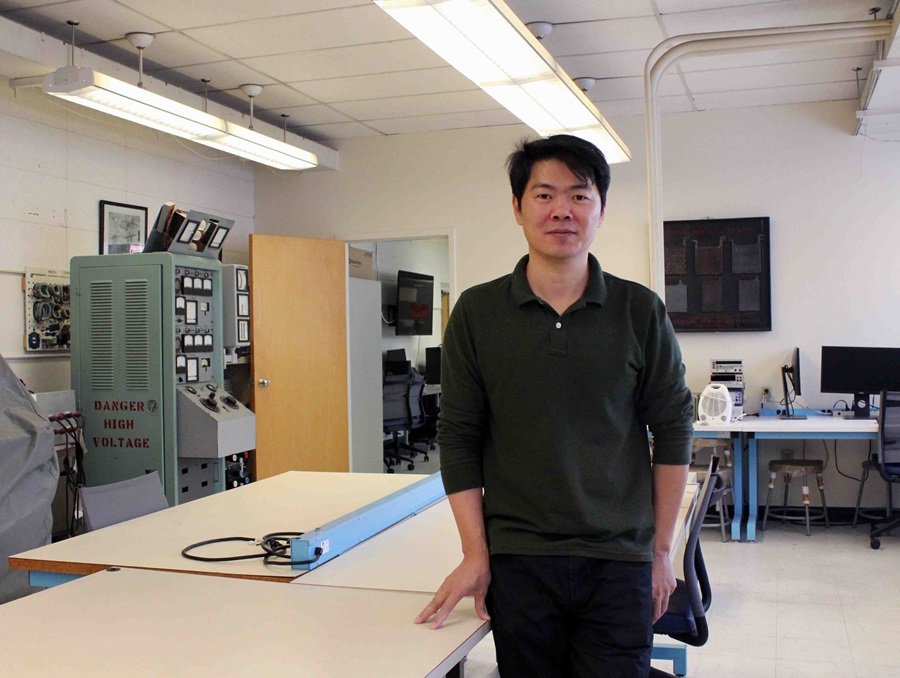
Artificial intelligence is opening new possibilities for the technologies that manage and control electrical power, including the power electronic converters that play a critical role in modern energy conversion, power management and grid-interactive systems.
Electrical Engineering Assistant Professor Xingang Fu is advancing the knowledge in this area by establishing the scientific foundations needed to safely apply AI to the control of power electronic converters. His research project, “Foundations of Safe and Explainable Embedded Artificial Intelligence-Controlled Smart Power Converters,” is supported by a five-year, $550,000 National Science Foundation (NSF) CAREER Award granted July 15.
The NSF’s Faculty Early Career Development (CAREER) Program is the agency’s most prestigious award in support of early-career faculty.
“Professor Fu’s CAREER Award reflects the innovative research taking place in the College of Engineering and the growing importance of trustworthy AI in critical technologies,” Shamik Sengupta, school head of the College of Engineering's School of Computer Science, Electrical and Biomedical Engineering, said. “By developing methods to ensure AI-controlled power electronic converters operate safely and reliably, his work has the potential to strengthen the electrical systems that communities depend on every day.”
Power electronic converters are critical enabling components in modern electrical systems, including electric power grids, which are the vast networks of power plants, transformers, power lines, and control systems that connect electricity producers to consumers.
“A power electronic converter changes electricity from one form to another, such as converting direct current (DC) to alternating current (AC),” Fu said. “It controls that process, so electricity can be used safely and efficiently on the electric grid.”
In other words, power electronic converters that support an electric power grid help manage such aspects of electrical power as voltage, current, power flow and frequency. Their performance directly affects the reliability and efficiency of electrical systems.
“Today’s electronic converters rely on control systems that engineers carefully design and test,” Fu said.
Fu's research investigates whether artificial intelligence can make these controllers more adaptive to changing operating conditions while maintaining the high levels of safety and reliability required in engineering applications.
“AI has the potential to provide greater adaptability,” he said, “but it also must be proven to be stable, safe, explainable and robust.
“This project develops the methods needed to achieve that,” he added.
Fu’s research explores neural-network-based AI, which can learn from electrical measurements and help power electronic converters make control decisions. It’s different from AI models like CoPilot or ChatGPT, which work with language. Because these converters are used in safety-critical electrical systems, AI controllers must be thoroughly understood and rigorously verified before they can be deployed. That’s the point of Fu’s project.
“My research focuses on combining AI and power electronics to develop trustworthy control methods,” he said. “I became interested in this area because AI has tremendous potential, but its use in safety-critical engineering systems requires new methods to ensure stability, safety, explainability and robustness."
Fu will develop methods to verify that AI-controlled converters operate predictably and remain within safe operating limits, according to his project proposal.
He’ll study the AI decisions so engineers can understand why those decisions were made. He’ll also test the AI under difficult conditions and test it on power grid simulators such as the one in Nevada Engineering’s Power Systems Research Lab.
The project, like all CAREER projects, has an education component.
“It supports education, STEM outreach and public awareness while contributing to a more resilient and efficient energy infrastructure,” Fu said.
Fu earned his bachelor’s and master’s degrees in applied mathematics at Ocean University of China, and a doctorate in electrical engineering from the University of Alabama. His research focuses on AI-controlled power electronics, and he joined the University of Nevada, Reno in 2023.
Related Stories
 AI News
Brazil Announces $444M AI Investment Plan
1 hour ago
 AI News
Alabama launches probe into OpenAI after agent hacks tech company during testing
1 hour ago
 AI News
Valor, Point72 back General Intuition at $6B valuation as AI startup pushes into robotics
1 hour ago
 AI News
BMW has unveiled the 2027 X3: a new look, artificial intelligence and 258 «horses»
2 hours ago
 AI News
Porsche inks $1.5 billion deal for AI deployment with India’s largest IT services firm Tata Consultancy
2 hours ago
 AI News
Nvidia begins Groq AI rack production after $20B deal
3 hours ago
 AI News
AI is turning the semiconductor market into a $1.6 trillion industry
3 hours ago
 AI News
Nvidia to hike prices by 15%, on top of an even larger increase in July
4 hours ago