
Pope Leo gives Spain’s 'phoenix' prime minister another turn in the global spotlight
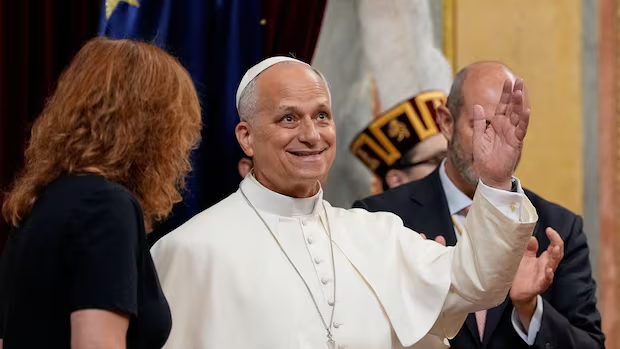
Pope Leo gives Spain’s 'phoenix' prime minister another turn in the global spotlight
U.S.-born Pope preaches against polarity, in a nation whose politics are defined by it
Earlier this spring, Spain’s defiance of U.S. President Donald Trump’s war plans in Iran briefly made the country the centre of global geopolitical friction. Now, Pope Leo XIV is visiting, thrusting the country back into the spotlight — only this time, welcoming an American who wields moral authority, rather than military might.
Leo, who was born Robert Francis Prevost in Chicago, has been met with near-rapturous crowds in Madrid ever since his plane touched down on the Iberian Peninsula on Saturday. It's a visit that has the potential to reshape the dynamics of Spanish politics and influence what’s arguably Europe's most toxic current debate: migration.
In a furiously polarized nation, the Pope has focused on consensus, urging young Spaniards not to view the world through a lens of tribalism and extreme positions.
But for Spanish Prime Minister Pedro Sánchez, the papal visit offers yet another timely platform for his country to be the centre of global attention, an opportunity the sometimes-controversial Sánchez has embraced with enthusiasm.
1st Pope to speak to Spanish Parliament
On Monday, Leo became the first Pope ever to deliver a speech before the Spanish Parliament, receiving a lengthy standing ovation after doing so. Among his key messages was that a widespread disregard for human rights has created a global crisis.
A day earlier, more than an estimated 1.2 million people had lined the streets near Cibeles Square in Madrid for Sunday Mass, where he preached against political polarity, urging national leaders to stop dividing populations and instead work to find points of commonality.
The Pope doubled down on the message as he posted on social media, "We understand that ideologies pass away, while truth remains."
While papal visits are officially framed as nonpartisan and pastoral, Spanish Prime Minister Sánchez has capitalized on the moment, repeatedly asserting that his government’s key — and highly contentious — policies are "on the same wavelength" as the pontiff's.
Meeting with the Pope in Madrid prior to his speech to Parliament, Sánchez said he and Leo "share the commitment to defend the value of migrations and the rights of all people."
Spanish political watchers say the visit comes at an opportune time for the prime minister.
"It's ... very difficult not to imagine that a papal visit cannot give the host a political boost," said Grégoire Roos, director of the Europe, Russia and Eurasia programmes at the London-based think-tank Chatham House.
That, he said, is one of the reasons Leo's predecessor, Pope Francis, didn't visit many countries, including his native Argentina — "where he never set foot after his election in 2013, because he never wanted to be used politically."
Sánchez, 54, has been prime minister for eight years and has made political resurrection an art form. Admirers say his ability to repeatedly defy predictions of his political demise is legendary, with his government widely seen as among the most left-leaning in Europe.
Despite suffering devastating electoral losses on more than one occasion, and even having his wife charged in a political corruption probe, Sanchez has managed to survive it all.
"We say he's like the phoenix, because he keeps standing up, and while many things have happened, nothing tears him down," said Sonia Andolz Rodríguez, international politics professor at the University of Barcelona.
Nonetheless, Sánchez’s political challenges at the moment are formidable.
His Spanish Socialist Workers' Party has been buffeted by ongoing allegations of corruption, causing its right-wing counterparts, like Partido Popular and Vox, to surge in popularity. The next general election is set for 2027, but it could happen sooner.
His brother is on trial for influence peddling, and close political allies are facing money laundering allegations. Internationally, Sánchez blew up Spain’s relationship with U.S. President Donald Trump by blocking the U.S. military from using two airbases for strikes on Iran and then closing his country's skies to its aircraft.
A furious Trump called Spain a terrible partner and threatened to cut it off economically — although domestically for Sánchez, the move appeared to be a political winner.
"When Trump started to mention Spain almost every day for two weeks in a row, people here were like, 'How did we become famous suddenly?'" said Andolz Rodríguez.
Trump threatens to cut trade ties with Spain
"We took it with humor, but I would also say a kind of pride."
Spain’s government has also faced isolation within Europe over its repeated and emphatic condemnations of Israel for the immense loss of life and destruction it has inflicted in Gaza and Lebanon.
But it's Sánchez's policy on migrants that may turn out to be his government’s signature achievement.
While most other European nations are hardening their borders and turning back migrants, Spain is moving decisively in the opposite direction.
Its government has approved legislation to grant legal work and residency status to over 500,000 undocumented migrants, arguing the country’s rapidly aging population needs them to fund welfare payments and to keep the economy functioning.
In his speech to Spain’s Parliament, Leo explicitly said the issue of migration is a challenge to the world’s "‘moral foundations," as he urged nations to provide migrants with "safe and legal pathways" to escape dire circumstances in their homelands but also to work to "ensure that no one has to leave their home due to a lack of peace."
In practice, Andolz Rodríguez says Sánchez's "regularizing" policy is actually proving to be less controversial domestically than many observers had initially expected.
"Many of the businesspeople know that they are hiring people in a non-legal way. So it was more like a pragmatic thing," she told CBC News.
Leo’s week-long Spanish trip will be punctuated by other high-stakes political moments. Another one will come Thursday when he visits the Canary Islands, to meet migrants at a detention centre in Tenerife.
Migrant advocates say as many as 15,000 people have died trying to make the journey to the EU’s southernmost point since 2024.
Chris Brown is a foreign correspondent based in the CBC’s London bureau. Previously in Moscow, Chris has a passion for great stories and has travelled all over Canada and the world to find them.
Related Stories
 World
World
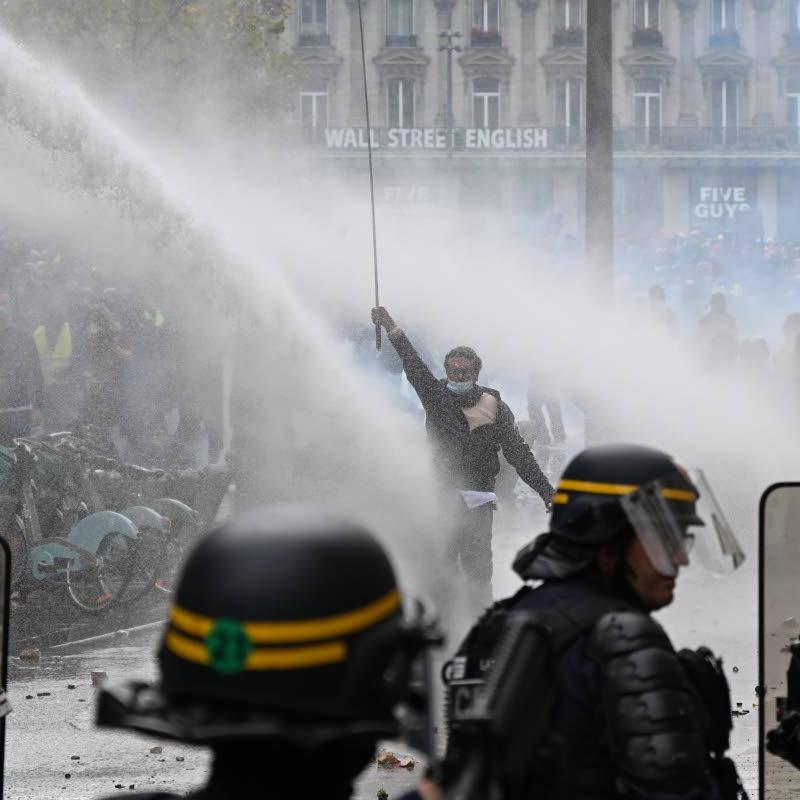
Scuffles and fires break out as protesters rally across France, joining students
20 minutes ago
 World
World
Child sex abuse charges against actor Timothy Busfield dismissed by judge
21 minutes ago
 World
World
Nicolás Maduro tells New York court new torture allegations are ‘false’
2 hours ago
 World
World
Cardinal Bernardin: An example for the Church and the world
2 hours ago
 World
World
Top News Headlines In Indonesia, Myanmar, Philippines, Singapore, Thailand & Vietnam: Oct 17, 2026
3 hours ago
 World
World
A fire guts a Bangladeshi beach resort, killing 10 people
3 hours ago
 World
World
G7 pledges $290 mil. to fix Chornobyl shield | NHK WORLD
4 hours ago
 World
World
The ‘World Series earthquake’ that caused highways to collapse
5 hours ago