
Philosophers Are the Latest Hiring Target for AI Companies
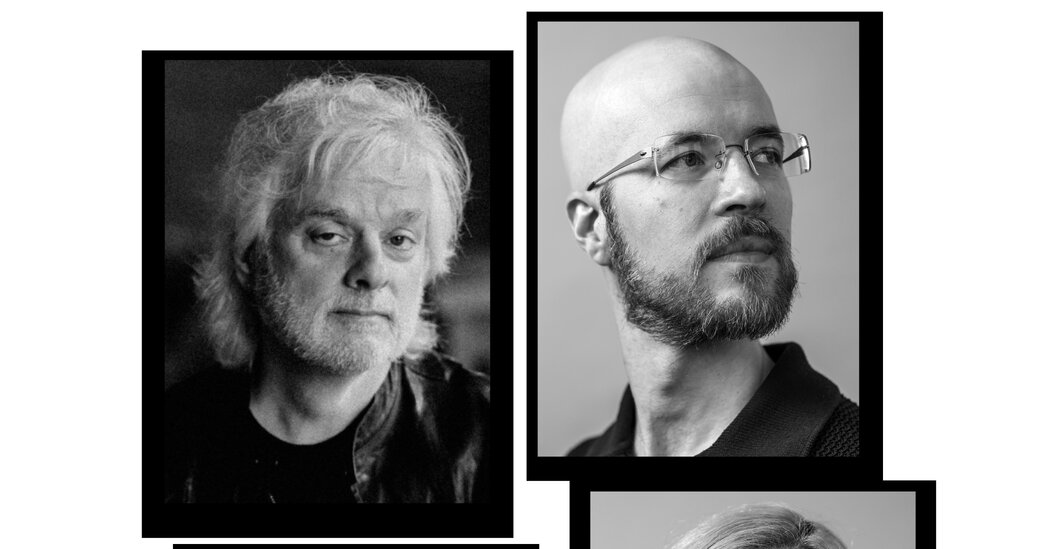
Clockwise from top left: David Chalmers, Dillon Plunkett, Rosie Campbell and Robert Long.Credit...Aaron Wojack for The New York Times (top left); Ian C. Bates for The New York Times
Growing up in Georgia, Robert Long was given to pondering big questions and the meaning of life — before he was 10, he doubted his own free will. But it wasn’t until college, where he majored in social studies, that he learned he could think about consciousness full time. He read a book by Douglas Hofstadter called “I Am a Strange Loop,” which explored mysteries such as What is a self? “I didn’t even realize that those were questions you could ask,” he says, “and then that there were philosophical disciplines about them.”
When Mr. Long entered graduate school at New York University, to study the philosophy of mind, it was with a conventional ambition. “I was very much on the path of publishing in journals, go on the job market, get a job at a university,” he said. When a fellow philosophy Ph.D. candidate told him that she was going to an obscure nonprofit called OpenAI to work on artificial intelligence policy, “I was like, that’s kind of random.”
But Mr. Long, too, found his philosophical interests trending toward A.I. His dissertation was titled “Essays on the Philosophy of Machine Learning.” And he moved to San Francisco to pursue postdoctoral research in early 2023, just when ChatGPT was blowing up. As the new large language models began displaying uncannily humanlike behaviors, he awoke to the dawning significance of potentially conscious A.I. — and to the possibility that something professionally interesting might happen if he stuck around.
Trying to rigorously answer fundamental questions is kind of the whole point of philosophy, and Mr. Long and Jeff Sebo, an N.Y.U. philosopher who specializes in animal welfare, soon collaborated to write “Taking A.I. Welfare Seriously,” a paper arguing that it was important to avoid harming A.I. systems if they “matter morally,” and also important not to care for systems if they don’t. Later, with funding from three foundations aligned with the Effective Altruism movement, Mr. Long and a colleague set up a nonprofit, Eleos AI Research. Of his drift from academic philosophy into the A.I. start-up ecosystem, Mr. Long says, “I sort of got, like, frog-boiled.”
“So, I think I’m going to major in philosophy” is the kind of undergraduate statement that for decades has terrorized tuition-burdened parents, inspiring dark visions of basement-dwelling offspring who fail to launch. Diogenes the Cynic lived in a clay jar. Baruch Spinoza ground lenses to pay the bills. Friedrich Nietzsche survived on the kindness of family and friends. The idea that a philosophy degree is a ticket to a lifetime of underemployment persists. When Google DeepMind announced in April that it was hiring someone whose actual business-card title would be “Philosopher,” the memes flowed. “It’s so the A.I. can learn what it feels like to have a college degree and still be unemployed,” someone posted on X. Of philosophy majors’ job precarity, a Redditor contributed: “Half are pulling espresso shots while silently debating whether the customer who ordered oat milk truly exists.”
But Mr. Long’s trajectory and Google’s new hire were in keeping with a quietly building trend: A.I. labs, and the related nonprofits around them, have been recruiting workers as versed in Consequentialism and John Stuart Mill as in neural networks and reinforcement learning. While a plain-vanilla philosophy degree remains as hard to monetize as ever, David Chalmers, a prominent philosopher of consciousness at N.Y.U., observes: “I think the demand for philosophers with A.I. training is, if anything, outstripping the supply right now. It’s an area I encourage students to go into. I think these issues with A.I. will be front and center for a good while.”
Thank you for your patience while we verify access. If you are in Reader mode please exit and log into your Times account, or subscribe for all of The Times.
Want all of The Times? Subscribe.
Related Stories
 AI News
Mozambique Launches AI Association to Drive National Technology Ecosystem
45 minutes ago
 AI News
God, Artificial Intelligence and the New Problem of Evil
45 minutes ago
 AI News
Why AI doesn’t make companies more productive
45 minutes ago
 AI News
Why Kazakhstan’s AI challenge might not be adoption, but capability
1 hour ago
 AI News
Paul Claude Gigot: Why I Am Right About AI
1 hour ago
 AI News
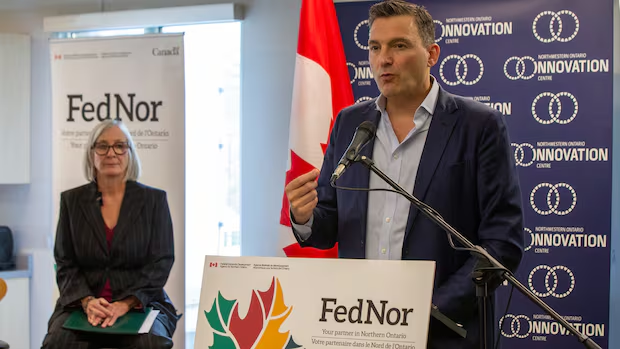
Feds spend more than $600K on artificial intelligence projects in northern Ontario
1 hour ago
 AI News
On
4 hours ago
 AI News
As AI booms, Canadian musicians face ‘existential struggle’
5 hours ago