
Ottawa’s nuclear energy strategy seeks more new reactors, global exports
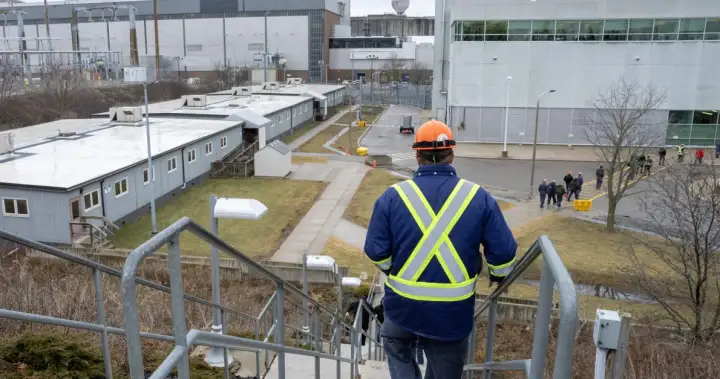
The federal government on Monday launched a new nuclear energy strategy that seeks to build at least 10 new large-scale reactors in Canada and expand global exports over the next 15 years.
The strategy builds on Ottawa’s overall aim to double electricity capacity by 2050, something the government argues requires zero-emission power sources like nuclear to avoid wide-scale environmental impacts.
“If our goal is to double our grid and build a low-carbon economy in less than 25 years, there is no credible plan to do that without nuclear energy and the clean, reliable baseload power is provides,” Energy Minister Tim Hodgson said at the strategy’s unveiling in Newmarket, Ont.
“We are writing the next chapter in one of Canada’s great industrial success stories.”
At the heart of the strategy is the Canada Deuterium Uranium (CANDU) reactor, which the federal government owns the intellectual property rights and licensing for. These reactors rely on natural uranium fuel and therefore do not require uranium enrichment, lowering costs and the potential for nuclear weaponization.
Seventeen CANDU reactors across Canada supply 13 per cent of the country’s electricity, while nine others are in service abroad in countries including South Korea, Romania, India and China.
The strategy aims to have two new large-scale reactors under construction by 2035, with five more planned or under development by 2040. It also calls for the commercial rollout of at least one new nuclear reactor outside Ontario, and the creation of a Canadian-made microreactor, by 2035.
Microreactors would then be deployed to remote communities “in the late 2030s” under the strategy’s timetable.
The plan also looks to expand CANDU reactor sales to new countries by securing at least four new international markets by 2040, while engaging six to 10 other countries seeking to enter the nuclear energy space over the next 15 years.
It also seeks to make Canada a key player in enriched uranium supplies by doubling exports over the next decade.
“Our nuclear energy strategy is ambitious. It has to be, because the scale of the opportunity is immense,” Hodgson said.
The international export goals are being framed as an effort to position Canada as a “partner of choice” for both nuclear technology and raw materials as European and Asian countries seek to turn away from Russia and China. Russia is a key supplier of enriched uranium while China is rapidly expanding nuclear energy production.
“Reactor exports are not transactional. They establish multi-decade partnerships, creating durable geopolitical and commercial relationships that advance Canada’s broader foreign policy interests,” the strategy says.
“As Canada works to diversify its trading relationships and strengthen ties with middle powers, CANDU can be a central instrument of that strategy.”
The strategy is set to be a boon to Saskatchewan’s uranium mining industry, which produces roughly one-quarter of the world’s uranium output which is mostly exported to other countries for nuclear fuel.
Nuclear power projects have been championed by the current Liberal government, which referred the Darlington New Nuclear Project in Ontario to the Major Projects Office for expedited reviews and approval in September.
Last October, the federal and Ontario governments announced a total of $3 billion would go toward a project to build four small nuclear reactors in the Greater Toronto Area.
“Ontario has long called for federal investment to build out the next generation of Made-In-Canada nuclear energy” that will drive jobs and “long-term competitiveness,” Ontario Energy and Mines Minister Stephen Lecce said in a statement.
At a technical briefing for media earlier Monday, officials from Natural Resources Canada said construction of the new reactors could cost more than $100 billion.
New projects will be built with private financing and capital along with Indigenous equity participation, according to the government, which did not announce any new public funding toward the strategy.
It says a new federal financing policy for new nuclear power projects will be released by April 2027, which will outline preconditions to access available loan streams and Canada Infrastructure Bank investments.
The plan also seeks to increase private research and development funding for new nuclear technologies like fission and fusion to between $500 million and $700 million by 2032, more than double the current level.
Project proponents at home and abroad will need to develop long-term nuclear waste management and disposal solutions under the strategy.
A modernized, cost-competitive CANDU design will be made available by 2030 for proponents.
Asked about the strategy ahead of the announcement at an unrelated press conference in British Columbia on Monday, Conservative Leader Pierre Poilievre said he wasn’t sold on the plan.
“An announcement will not build anything,” he said.
“And this is the problem we’ve had with the Carney Liberals is their promises are being reported on as results and so far there have been no results.”
In a statement, industry group Electricity Canada called the strategy “an important development” that recognizes the need for additional electrical grid capacity through multiple clean power sources.
“With demand set to surge from electrification, AI, and economic growth, nuclear power, alongside hydropower, renewables, storage, and emerging technologies, forms a critical part of an ‘all-of-the-above’ solution that keeps the lights on affordably while driving down emissions,” president and CEO Francis Bradley said.
“Canada’s electricity sector is uniquely positioned to lead, with a world-class workforce, proven technology, and a strong domestic supply chain. This strategy helps unlock that potential even further, and helps build the Canadian economy through greater export capacity and more job opportunities.”
The strategy document says Prime Minister Mark Carney was not shown the strategy and had no role in developing it due to the ethics screen he has in place.
Brookfield co-owns a reactor CANDU competes with and Carney had options and deferred shares in both the Brookfield Corporation and Brookfield Asset Management that were put into a blind trust after he became prime minister.
—With files from the Canadian Press
Related Stories
 AI News
‘Rather be us’: Bizarre claim from coach after elimination
9 minutes ago
 AI News
What Australia can learn from the rise of populists around the world to avoid following Hanson down her rabbit hole
10 minutes ago
 AI News
Citizens or Voters? What the Supreme Court's SIR Verdict Reveals About India's Fractured Idea of Citizenship
11 minutes ago
 AI News
Hopes Burnham's rise could boost Liverpool jobs
11 minutes ago
 AI News
City centre revamp to bring year
11 minutes ago
 AI News
AP reporter describes severe weather disrupting DC's America 250th celebration
11 minutes ago
 AI News
Tynwald Day 2026: All you need to know
11 minutes ago
 AI News
Patients struggle to get vital medicines amid shortages
11 minutes ago