
OpenAI's next-generation artificial intelligence (AI) model 'GPT
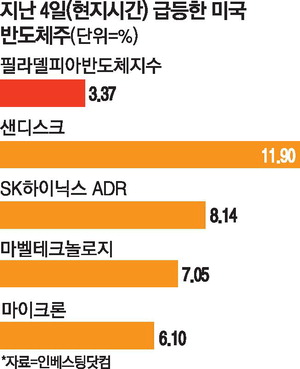
OpenAI's next-generation artificial intelligence (AI) model 'GPT-6 Astra' has rekindled its semiconductor stock price. Despite the U.S. stock market's weakness due to the impact of employment indicators, memory and AI semiconductor stocks surged, creating a distinct market of differentiation. Attention is focusing on whether semiconductor-related stocks, including Samsung Electronics, will continue to warm up in the domestic stock market.
The Philadelphia Semiconductor Index surged 3.37% on the 4th (local time). In contrast, the Dow Jones Industrial Average, New York's three major indexes, fell 0.51%, the S&P 500 fell 0.38%, and the Nasdaq Composite fell 0.29%. SK Hynix's U.S. stock deposit certificate (ADR) jumped 8.14 percent, while memory chip stocks such as Micron (6.10 percent) also surged.
The spark for the solo was the GPT-6 Astra, which OpenAI unveiled on the 3rd. By combining search and program utilization, Astra has significantly strengthened its "AI agent" function to perform complex tasks on its own. As AI evolves, the amount of computation and data throughput increase, and expectations have increased that demand for high-bandwidth memory (HBM), DRAM, and NAND as well as graphics processing units (GPU).
As the 'AI overinvestment theory' eased, equipment such as Ram Research (5.12%) and ASML (4.17%) and optical communication stocks also jumped. There were many questions about whether Hyperscaler's astronomical data center investment could lead to actual profits, but AI performance has taken a leap forward, strengthening the justification for large-scale facility investment.
On the other hand, the burden of interest rates remained. Concerns have resurfaced that the U.S. Federal Reserve (Fed) will raise interest rates in September as non-agricultural employment in the U.S. far exceeded market expectations in August.
Market attention is shifting to the Consumer Price Index (CPI) in August, which will be announced on the 11th. The CPI in August is expected to be a key indicator that will determine the direction of the Federal Open Market Committee (FOMC) in September, as Fed Director Christopher Waller and others made remarks to the effect that price trends should be checked further to determine whether to raise interest rates further.
Recently, the stock market has been sensitive to changes in long-term interest rates. Long-term interest rates in Japan and Europe have risen, increasing the burden of discount rates on global growth stocks. If interest rates rise further due to the U.S. Treasury Department's long-term bond buyback and the bidding for the 10-30-year Treasury bond on the 9th, the semiconductor rally could also increase volatility.
Related Stories
 AI News
Manitoba educators grapple with AI in schools
22 minutes ago
 AI News
Manitoba consultations on AI chatbot, social media ban in class to begin in 'coming months'
26 minutes ago
 AI News
Why federal guidelines for AI data centres are facing pushback
1 hour ago
 AI News
HP grows Saudi presence through AI, manufacturing and skills investment
2 hours ago
 AI News
Anthropic IPO timetable shifts towards mid
2 hours ago
 AI News
Why AI-first development matters
2 hours ago
 AI News
Scientific literacy must keep pace with artificial intelligence
2 hours ago
 AI News
Is AI eliminating the first rung of the employment ladder?
3 hours ago