
Is AI eliminating the first rung of the employment ladder?
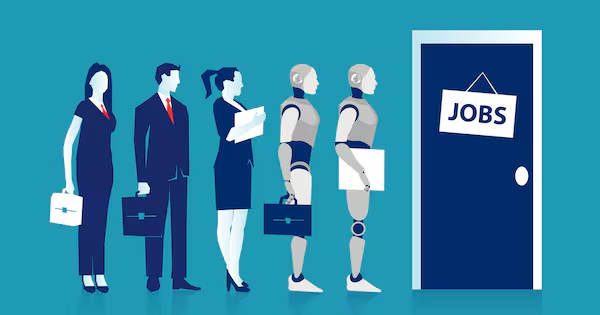
University students preparing to graduate worry about the prospect of employers deciding to use artificial intelligence to fill graduate roles – and the Reserve Bank shares some of their concern.
In its monetary policy statement, the Reserve Bank said members of the monetary policy committee agreed that growth in activity in the economy might not lead to the increase in employment that would normally be expected, "if businesses are relatively more focused on efficiency and technology investment in the short run".
When she appeared at the finance and expenditure select committee, governor Anna Breman said businesses could use technology to create productivity gains, which would normally create more jobs.
She said there was discussion in New Zealand and overseas about whether some employers might be reluctant to employ younger people, and might instead deploy AI tools.
While she did not think it would be a problem in the medium term, she said it could be an issue in the short term, particularly for young people.
Young people have had some of the sharpest increases in unemployment in recent times. Youth unemployment is nearly three times that of the wider working-age population.
Reserve Bank Governor Anna Breman. (Source: Getty)
University of Otago student Ella Lord said that concerned her.
"I feel extremely lucky to have a grad role for next year, but I know many people who do not and there don't seem to be many available," she said. "I think it's important for young people to be able to get a job out of uni, somewhat in the field of their study, so they are able to build the skills they need for their future careers.
"Otherwise, how are people ever going to be able to get their foot in the door? I feel like it is much harder than it used to be.
"I know people are considering doing more study, if they are unable to get a job, but are concerned about whether this would even help them and about putting more money on to their student loan.
"Young people should be taught how to use AI, rather than AI taking their jobs."
She said some entry-level roles said they required a year or two experience, when it was hard for people to gain that experience.
Associate professor Paula O'Kane said she was very worried.
"There are a lot of long-term implications for developing future leaders, as they often cut their teeth on the entry-level jobs that AI can target.
"That, combined with the economic pressure at the moment, mean we are seeing fewer graduate opportunities and this can also lead to students taking on more study to shine, which can also add to their graduate debt.
"It's a big issue and employers need to be thinking into the future now, rather than meeting this issue in 5-10 years, when they haven't got the talent. We are already always short on top talent, even in a downturn - we are certainly very worried for our students."
Artificial intelligence is increasingly reshaping how New Zealanders get hired — with one company alone conducting more than 2500 AI-led interviews last month. (Source: BNZ Business Breakfast)
Fortitude Group Recruiter Hayley Pickard agreed losing the first rung of the employment ladder would create a succession issue.
"Entry-level positions allow young people to learn how a workplace operates, develop practical knowledge and build the experience needed to become tomorrow's senior employees.
"If businesses remove those opportunities now, where will their experienced workforce come from in five, 10 or 15 years?
"That is particularly important in engineering and manufacturing, where we already have an ageing skilled workforce, and not enough apprentices and junior employees being developed.
"AI and automation may assist with programming, documentation, planning and process improvement, but they cannot replace the years of hands-on learning required to become a capable machinist, toolmaker, engineer or tradesperson.
"AI is a wonderful tool, when it is used in the right way. It can support employees, improve systems, and allow people to spend more time on work that genuinely requires their knowledge, judgement and personality.
"However, it cannot replace human empathy, practical experience, natural conversation or the ability to build meaningful relationships.
"My concern is that, if employers focus only on the immediate cost saving, they may create a much larger long-term problem. Businesses should use AI to help their people become more effective, and help junior employees develop and contribute sooner, not as a reason to stop giving them their first opportunity."
Auckland University professor Rod McNaughton said entry-level hiring was weak at the moment for several reasons.
"We should be careful about jumping from high youth unemployment to saying AI is causing it," he said. "The evidence does not yet support that conclusion.
"The more immediate issue is that AI is changing the kinds of tasks organisations need people to do and many of those are the tasks through which young people have traditionally entered professional work."
"The risk is not simply that AI eliminates jobs. It may remove some of the first rungs of the career ladder.
"Junior employees have traditionally learned by doing relatively routine research, analysis, drafting and administrative work. If AI does much of that work, we need to ask how inexperienced people are going to acquire the experience employers want.
"That creates a problem for employers, as well as young people. Entry-level jobs are part of how organisations develop their future experienced workers and managers.
"If firms become much more efficient at the bottom of the organisation, but stop bringing people through, they may eventually discover that they have weakened their own talent pipeline.
"I think the policy question is broader than how we protect entry-level jobs from AI. It is how we redesign the transition from education into work, when some of the tasks that historically made it economical to employ and train a novice can now be done by technology."
Related Stories
 AI News
HP grows Saudi presence through AI, manufacturing and skills investment
39 minutes ago
 AI News
Anthropic IPO timetable shifts towards mid
39 minutes ago
 AI News
Why AI-first development matters
39 minutes ago
 AI News
Scientific literacy must keep pace with artificial intelligence
39 minutes ago
 AI News
People
1 hour ago
 AI News
Tough choices ahead as the US pushes a global artificial
1 hour ago
 AI News
Milan-based Cato raises €6 million to help companies find and win public tenders with AI
2 hours ago
 AI News
Top Tech News Today: AMEC Chips, Claret Capital Funding, Graduate Hiring, Crypto Hack & AI Applications
2 hours ago