
New York City Put Limits on AI in Schools. Are They Enough?
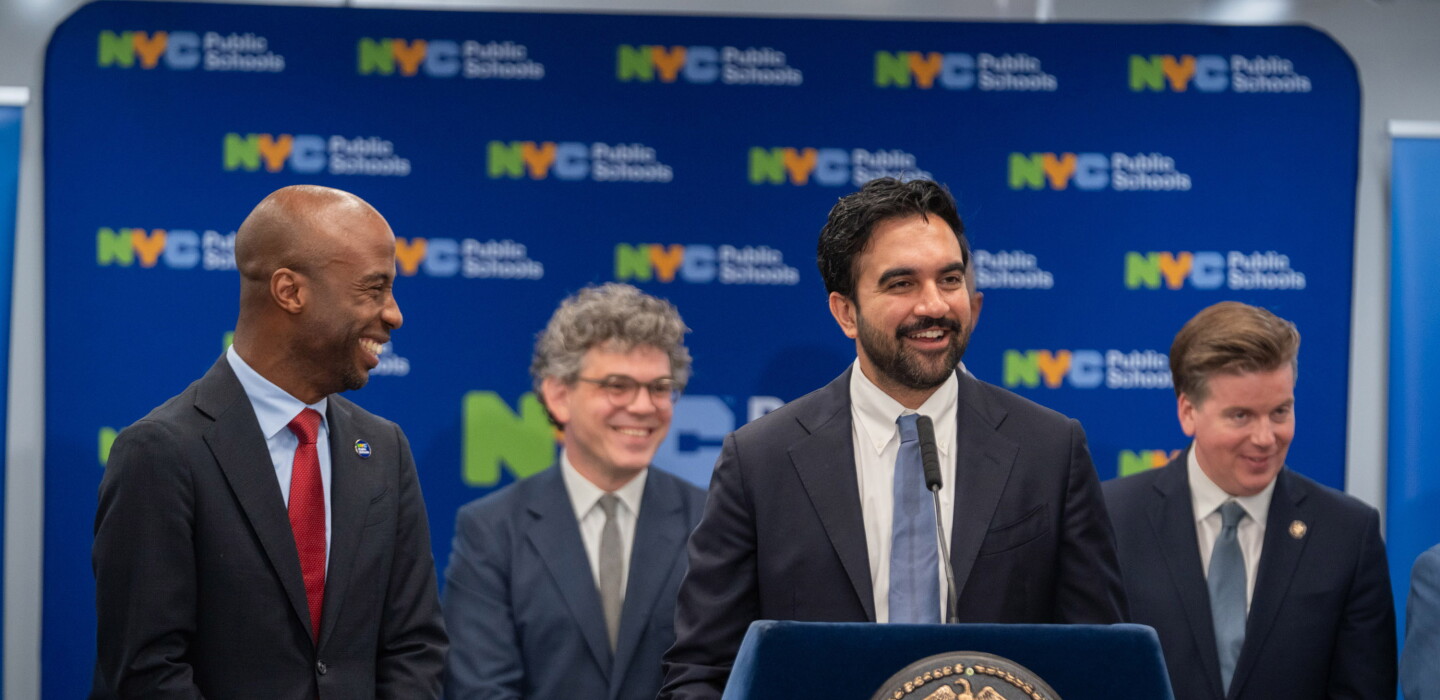
As he officially announced the New York City public education system’s artificial intelligence policy this week, Mayor Zohran Mamdani touted the new rules as the most sweeping pause on AI in schools across the nation.“It is the most comprehensive of its kind anywhere in the country,” Mamdani said during a news conference Wednesday at the Brooklyn STEAM Center, alongside Chancellor Kamar Samuels. “And it begins with a simple principle: Children need their teachers and human connection in order to learn and in order to grow.”But a coalition of mostly parents that’s been pushing for a two-year moratorium on AI in schools told reporters that the guidelines, while a step in the right direction, include exemptions that could endanger students, particularly high school. And they’re not alone in taking issue with the regulations: The United Federation of Teachers, the city’s teachers union, which offers AI training to its members, issued at a statement that the policy leaves many questions unanswered and expects too much of teachers.
“There are a lot of holes in the policy,” said Liat Olenick, the parent of a pre-K student and a member of the AI Moratorium (AIM) Coalition, which held a press call after the event. “If we’re honest, there’s a lot of unanswered questions. Too many exceptions. But kindergartners will not be talking to AI chatbots this fall — and that is huge progress.”The policy for at least the upcoming school year bans generative AI for students in 2-K through eighth grade, while launching AI literacy modules and pilot programs in high school, the Daily News was first to report on Tuesday. The rules also include restrictions on screen time, prohibiting students in 2-K through second grade from using individual devices, such as Chromebooks, in the classroom and recommending time limits for older grades. Cell phones were already banned in public schools under state law last school year.“I know there will be some who think, well, we didn’t go far enough, or we didn’t move faster with AI in schools,” Samuels said in Brooklyn. “There are others who will think there’s no place for AI in a classroom. I understand both instincts. But I don’t believe either serves our students.”
The policy may be extended or amended after next school year, Mamdani said. But the mayor offered few details about how he plans to enforce the guidelines, only saying he has “trust” in teachers, principals and district superintendents. Speaking with education reporters after the news conference, school officials added the policy isn’t intended to be punitive for students.Michael Mulgrew, the UFT president, said in a statement that the screen-time policy “makes sense,” but the AI policy “leaves many questions unanswered” because the school system hasn’t explained how it will ensure products it purchases follow the new rules.“If we are going to be serious, let’s start at the source,” Mulgrew said, “rather than expect school communities or individual educators to figure out after the fact if what their school uses fits the new policy.”Beyond the general AI ban in the younger grades, the mayor said at the news conference the school system will also prohibit AI “companion” chatbots across all grade levels, and “fully discontinue or disable the AI components” of 38 previously approved programs that no longer meet the standards. The Daily News has requested a list of the programs, but did not hear back in time for publication.While the school policy sets a number of restrictions on AI, it also leaves the door open to more AI in the classroom to prepare older students for the workforce, including career and pilot programs in high school, The News previously reported.Up to 50,000 high school students will participate in five pilot programs using AI, with a maximum of five classes per school, according to a news release Wednesday that shed more light on the policy. Principals can apply for the pilots, which use several types of pre-approved AI software that are already in use: Quill for reading support, Edia for math coaching, Brisk Teaching and Playlab for teachers to design activities, and Intel AI-Ready Schools for semester-long projects. The AI programs’ use will be limited to a maximum of 45 minutes per week under direct teacher supervision, Mamdani said.Older students will also take 45-minute AI literacy trainings twice per year on “what AI is and is not, as well as AI-related bias, risks, ethical considerations and impacts on careers and future skills,” according to the release. Teens in the pilot programs will be required to take a longer course of about 12 to 15 hours, officials said.Yelani Joseph, a rising junior at Urban Assembly Institute of Math and Science for Young Women in Brooklyn who’s involved in the New York Civil Liberties Union’s Teen Activist Project, was upset the AI ban in the younger grades did not extend to high school, too.“We can’t just stop at middle school,” Joseph said. “High school students deserve more than to simply be the subjects of these experiments.”Meanwhile, Richard Buery, Jr., the chief executive of Robin Hood, an anti-poverty organization, said he appreciated that the city will allow limited use of the technology in high school since employers increasingly demand AI skills in the workforce and young graduates struggle in the job market. But he said the AI moratorium for younger grades is “not the right call,” and that it should not extend past the upcoming school year.“In an understandable effort to protect students, I fear we’re rejecting uses that could help them,” Buery said in a statement. “I also fear that by not teaching all students about the appropriate use of AI in schools, we increase the likelihood that students will use it inappropriately at home.”The first day of school is Sept. 10.©2026 New York Daily News. Visit nydailynews.com. Distributed by Tribune Content Agency, LLC.
Can AI Replace Teachers? Chicago School Tests the Model
Boston Becomes First Major District to Bring AI Literacy Into Classrooms
TNS delivers daily news service and syndicated premium content to more than 2,000 media and digital information publishers.
Related Stories
 AI News
Several users report issues with ChatGPT, Claude and X's Grok on Downdetector | World News
40 minutes ago
 AI News
Abliteration.ai is making a business out of removing AI guardrails
1 hour ago
 AI News
Government lacks ability to verify AI labs’ claims, experts say
1 hour ago
 AI News
Scranton Faculty and Staff Examine Papal Encyclical on Artificial Intelligence
1 hour ago
 AI News
Nvidia strikes $12.9bn deal to buy AI platform Hugging Face
1 hour ago
 AI News
MAGA begins to crack as 2026 GOP roster backs away from Trump's tech vision
2 hours ago
 AI News
Agentic AI UW brings next step in artificial intelligence to UW
2 hours ago
 AI News
Artificial Intelligence (AI) In Warehousing Market Report Highlights Key Segments, Regional Trends And Major Competitors
2 hours ago