
New $267M research lab in Winnipeg will work to counter future pandemics
New $267M research lab in Winnipeg will work to counter future pandemics
$10M design contract awarded for medical countermeasures facility
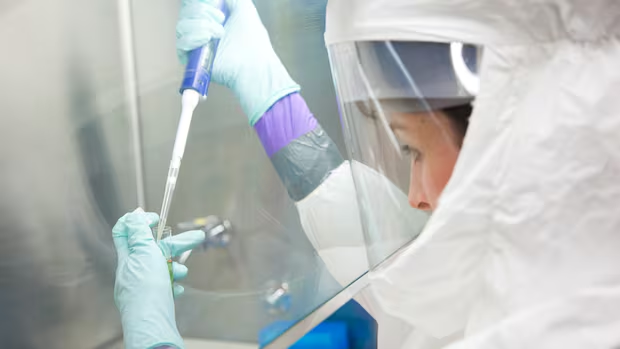
A new medical research facility in Winnipeg will play a critical role in closing gaps in Canadian vaccine research and other areas of public health emergency preparedness, officials said Wednesday.
The new $267-million medical countermeasures lab, to be built at the rear of the federal National Microbiology Lab on Arlington Street, will produce experimental vaccines and other research to respond to future pandemics.
Federal and provincial politicians, along with medical researchers, announced the awarding of a $10.2-million contract to design firm Architecture49 at a Wednesday news conference at the microbiology lab.
The expected completion date is sometime in 2033, Winnipeg South member of Parliament Terry Duguid said.
"This is a big deal," said Duguid. "This is a big deal for our city, our province, a big deal for life sciences in Canada to help protect the nation and the world," he said.
In addition to its medical research, the facility will spur employment through construction and technical support work, enable scientists' careers and also possibly lure private industry to move to the city to be in proximity to the lab's services, media were told at the morning news conference.
It will be owned and operated by the federal government.
The practical gap that the lab will ultimately fill is developing high-quality test vaccines and therapeutics that will advance for further testing, said Keith Fowke, medical director of the Institute of Infection and Immunity.
It will not be a large-scale manufacturing facility, said Fowke.
"It will produce the test lots that are required … and then you narrow down which of your products are most effective" before mass manufacturing takes place, Fowke said.
The new lab's proximity to the high-security Winnipeg microbiology lab — currently the only lab in Canada that can study the world's most dangerous pathogens, which have no known vaccines or treatments — makes sense, as it will build on existing know-how, Fowke suggested.
"The expertise the NML has is going to be instrumental in being able to run and operate those facilities," said Fowke.
Steve Guercio, chief operating officer of the Winnipeg microbiology lab, says the expansion will allow scientists to do more research.
The new facility will use some of the work that world-renowned scientists have developed at the microbiology lab and put it into different types of testing mechanisms, he said.
"We are going to have an opportunity to test multiple candidates for potential vaccines, therapeutics or diagnostics, and we will be expanding our capacity, like the amount of lab space that we have to do it," he told CBC News.
There are not many other facilities like the new medical countermeasures lab around the world, he said.
"It's something that really brings an opportunity to collaborate with academia, as well as potential collaborations within industry — under the appropriate agreements, of course."
National Microbiology Lab seeks new leader again
Dr. Isaac Bogoch, an infectious diseases specialist at Toronto General Hospital, says anything that can be done to better prevent, detect and respond to rising pathogens in a world of "emerging and re-emerging" infectious diseases is a smart move.
The talent to do that work already exists in Canada, he told CBC News.
"There's no reason we shouldn't be a global leader on this front, so when you start to see senior leadership paying attention and prioritizing this and funding this, it's clearly a right move forward."
The new lab will include Level 2 and Level 3-rated facilities, while the microbiology lab is rated Level 4 — the highest level of containment.
Architecture49 won the contract through an open bid process that unfolded after the government issued a request for proposals, officials said. The company, which maintains an office on Buffalo Place in Winnipeg, has a history of being tapped for similar work.
On its website, it lists numerous past projects such as the Life Sciences Research Institute in Halifax and the Rocky Mountain Integrated Research Facility in Montana.
The Winnipeg microbiology lab also has a new leader, as Celia Lourenco was recently appointed its vice-president, the Public Health Agency of Canada said in a statement.
Lourenco, who officially began in the role on July 20, is the first woman to serve in the position and brings "an exceptional depth of expertise in regulatory science, public health policy and international collaboration," the statement said.
Lourenco holds a PhD in pharmacology from the University of Toronto and has served in several management and executive-level positions at Health Canada since 2001.
Lourenco is replacing Jason Kindrachuk, who stepped down in June to return full time to his research lab at the University of Manitoba.
"We're very excited that she's here, and we're looking forward to working for her and looking forward to her leading this facility into the next stage," said Guercio, who served as interim vice-president after Kindrachuk's departure.
Winnipeg microbiology lab expanding to produce test vaccines
With files from Karen Pauls and The Canadian Press
Related Stories
 Canada
2 belugas, 4 dolphins from Marineland heading to aquarium in Spain
1 minute ago
 Canada
Most U.S. aluminum comes from Canada as industry says ‘good luck’ to tariff threats
2 minutes ago
 Canada
Buy Canadian: Purchasing patriotism sees renewed push amid rising tariffs
2 minutes ago
 Canada
Trump: time to teach Canada you can’t do this anymore
2 minutes ago
 Canada
Trump says it’s time to ‘teach Canada you can’t do this anymore.’ Live updates here.
1 hour ago
 Canada
2 Air Canada employees arrested in RCMP drug probe at Montreal airport
1 hour ago
 Canada
U.S. military says it killed four in strike on alleged drug
1 hour ago
 Canada
2 Air Canada employees arrested by RCMP in connection with alleged drug trafficking
1 hour ago