
Nehru Archive: Inside Nehru’s Letters, Ideas, Politics, and Private World
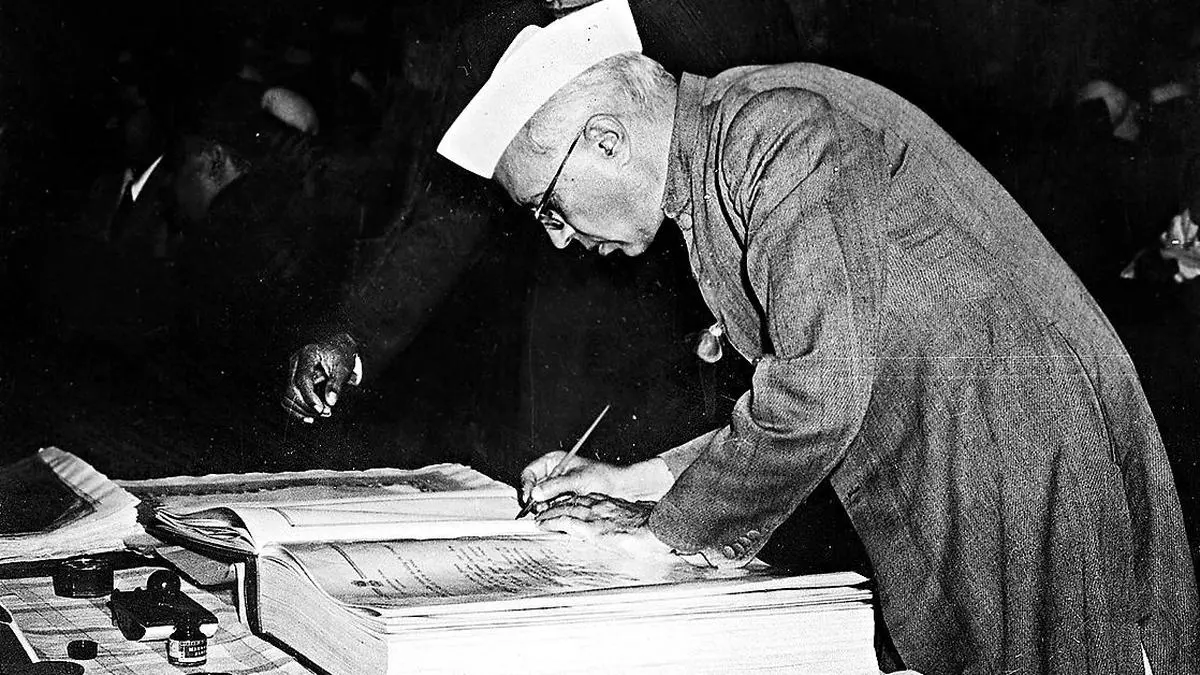
Nearly a year before he founded the National Herald in Lucknow, Jawaharlal Nehru turned his critical gaze on himself. In October 1937, he wrote “The Rashtrapati”, a sharply self-deprecating essay about his own growing stature as president of the Indian National Congress, and sent it for publication under the pseudonym Chanakya. It appeared anonymously in the Kolkata-based monthly The Modern Review in November that year. Today, the essay is among the most-read documents on The Nehru Archive, which went live in November 2025.
The growing interest in the essay is part of a larger pattern emerging from the digital archive. Between February 10 and August 17 this year, the archive recorded 1,51,900 visitors and 4,21,000 page views, with users spending an average of 3 minutes and 17 seconds on the site, according to Professor Madhavan Palat, secretary of the Jawaharlal Nehru Memorial Fund (JNMF) and editor of nehruarchive.in.
The website’s usage data shows visitors searching for both major historic moments and Nehru’s lesser-known personal writings. Of the total, 1,03,000 visitors were from India, more than 25,000 from the US, and nearly 5,000 from the UK, with Canada and Pakistan also figuring in the traffic.
“The Rashtrapati” received 1,300 page visitors and 1,900 views. Nehru’s historic August 14-15, 1947, “Tryst with Destiny” speech and the first volume of the Selected Works of Jawaharlal Nehru both drew high engagement, each attracting about 1,800 visitors and 2,200 views. Viewers are also increasingly drawn to his personal letters, such as those written to his mother, Swarup Rani Nehru.
The most-visited pages reflect a broader public interest in Nehru’s inner circle and the political challenges he faced. These range from his documentation of Partition-era financial disputes to his correspondence with figures such as Subhas Chandra Bose, Edwina Mountbatten, John Matthai, and Shyama Prasad Mookerjee.
As part of the project’s first phase, all 100 volumes of the Selected Works of Jawaharlal Nehru have been made available online, Palat said. They can be accessed, read, and downloaded free of cost. “It has been well received by both scholars and the general public. It is our ambition to include Nehru material, authenticated and edited, so that both scholars and the wider public may get access to all Nehru material in one place,” he said, adding: “The site’s usage patterns also suggest that visitors are consulting it as a research tool, as the ‘search’, ‘documents’, and ‘Selected Works’ sections are among its most visited areas.”
Mobile phone users slightly outnumbered desktop users, suggesting that a collection once accessible primarily through physical volumes is now being accessed on phones. The analytics showed 79,600 visitors using phones, compared with 71,100 on desktops and about 1,200 on tablets. For the JNMF, which runs The Nehru Archive, Palat said the numbers offer both validation of the project and a reason to expand it.
The archive’s second phase has a clear editorial direction, but the task ahead is more complicated than simply scanning and uploading documents. “A large quantity of material remains scattered across institutional and personal archives, including the National Archives of India. This content needs to be located, copied, cleared for permission, and eventually uploaded,” Palat said.
Jawaharlal Nehru’s digital archive is drawing growing public interest, with more than 151,000 visitors recorded between February and August 2026. | Photo Credit: www.nehruarchive.in
The archive plans to add new and unpublished documents from national and international archives. “Our aim is to include not only what Nehru wrote but also letters he received or responded to, file notings, and records of discussions in which he participated,” he added.
The expansion also intends to provide a fuller picture of Nehru’s intellectual interests. Palat said Nehru regularly shared articles and pamphlets with colleagues and officials. “During my research on Nehru, I found several remarkable aspects about his dedication to nation-building. He had this habit of sharing articles and pamphlets that carried information about economic progress and scientific development. He would always recommend that his colleagues and officials read them,” he said. “We are planning to upload the related material on our website so that his stated position is better understood.”
The documents will be published in their original languages, accompanied by English translations. “The archive intends to add works by Nehru that appeared in different languages during his lifetime,” he said, adding that the next phase would also include books about Nehru that appeared during his lifetime and to which he contributed.
Among the prominent works are The Discovery of India (represented through the Calcutta Press, John Day Company, and Second Edition releases), Toward Freedom: An Autobiography, and both volumes of Glimpses of World History. The update also encompasses his reflective correspondence and shorter essays, such as Letters from a Father to His Daughter, A Bunch of Old Letters, A Window in Prison and Prison Land, and Recent Essays and Writings.
Users will also gain access to his political commentaries through titles such as Soviet Russia, China, Spainand the War, The Unity of India, Whither India, Eighteen Months in India, India and the World, One Nation, One Heart, and Independence and After.
The collection additionally features reference materials alongside key Hindi texts, such as the Jawaharlal Nehru Bibliography, Ladkhadati Duniya (Uncertain World), and Rajniti Se Dur (Far from Politics).
The audio and video material poses a different challenge, with the JNMF dependent on public broadcaster Prasar Bharati for access to the archival recordings. “At present, the costs are exorbitant, and we can’t afford to acquire them,” Palat said. “We can’t source them from the publicly available sites, as there is no certainty about their authenticity or completeness.”
So far, the JNMF has spent about Rs.2.67 crore from its own resources to develop the digital archive. It now seeks contributions to build a corpus that will support the archive’s expansion and maintenance. “Since the Selected Works of Jawaharlal Nehru series was published in book form, there were severe constraints of space and finance. With digitisation and a website, space is no longer a constraint, but finance remains one,” Palat said, adding: “After the start-up phase, now to implement Phase II, we propose to create a corpus, the annual income from which will be devoted to updating and maintaining nehruarchive.in at global standards. As a non-profit organisation, we rely on your generosity to expand our collection and keep our shared history freely accessible to all.”
Also Read | Nehru and the Partition of Bengal
Also Read | Nehru, Guru Dutt, and the demise of a tender India
Related Stories
 World
World
Ultimate preview: women's 100m
36 minutes ago
 World
World
U.A.E. warned Netanyahu of major Hamas operation days before Oct. 7 attack: Israeli newspaper
36 minutes ago
 World
World
‘Wheel of Fortune’ announcer Jim Thornton fired following investigation
36 minutes ago
 World
World
The Exploration Company secures €387 million to accelerate development of reusable high-thrust rocket engine
40 minutes ago
 World
World
Ultimate preview: women's 800m
1 hour ago
 World
World
9/11: 'A Day to Give Back'
1 hour ago
 World
World
Ultimate preview: men's 400m
2 hours ago
 World
World
Adjusting to a world without Limited Term Appointments
2 hours ago