
Manitoba plans to ban AI chatbots for those under 16. This school uses them as an educational tool
Manitoba plans to ban AI chatbots for those under 16. This school uses them as an educational tool
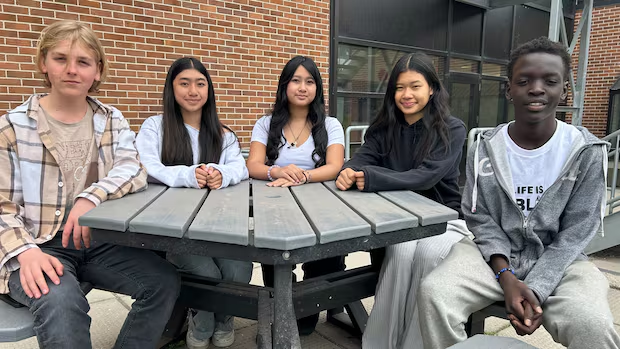
General Wolfe students, educators talk about how they're mindfully incorporating AI into learning
Whether scrolling, watching videos or connecting with friends, young people are online — and they have opinions about a ban on apps they already use.
"No matter what, we're still going to find out, like, the negative side of social media sooner or later," said Mary Wah, who's in Grade 9. "I just think that they shouldn't ban it."
Shamira Salazar, also in Grade 9, favours age appropriate restrictions rather than an all-out ban.
"There are, like, negative stuff on social media," she said. "But also, like, young kids today, like, they use social media to connect with others and express themselves, as well as getting informed."
Wah and Salazar are students at General Wolfe School, where CBC recently went to learn about how they’re introducing artificial intelligence in the classroom.
CBC went back to talk with with the middle school students and educators about Manitoba's move toward a ban on social media and artificial intelligence chatbots for those under 16.
Denys Kotochihov, who's in Grade 8, is OK with using chatbots for ideas and even helping him learn English after moving to Manitoba from Ukraine.
He thinks it comes down to how they're being put to use.
"Some chatbots can be like … you think you're talking to a real person, but you're talking to a chatbot, and the situation is pretty bad, 'cause maybe in the future you will have some problems to talk to the real people," he said.
Qyra Francisco, who's in Grade 8, said AI chatbots can help answer questions about schoolwork when parents can't.
"For immigrant families like some of us … our parents didn't have the privilege of such, like, good education, and some of our parents didn't even finish university," Francisco said.
"A lot of things that were heard growing up was, ‘Do your best and finish school so that you can provide for your family,' and I think that AI chatbots really helped with coming up with ideas for helping with education."
The way students are thinking about the technology shows Grade 7 STEM teacher Donovan Ponce that they're becoming independent learners.
"From an equity standpoint, again, they acknowledge that sometimes their families may not be able to help them with their homework, with their assignments, and knowing that there is a tool for them to use, I think that was kind of a big moment too," said Ponce, who is also a project-based learning support teacher at the school.
Ponce said his approach to introducing AI into learning is always human led.
He teaches students how to incorporate chatbots used by the division responsibly. He's seen them help generate project ideas and simplify text.
News of a ban on chatbots came as "a bit of a shock," he said.
"I think we do need to distinguish between educational tools, which can be very powerful at bridging some gaps, and AI for relationships, which I don't think should exist," he said.
Ponce drives home the importance of reminding students chatbots aren't human.
"AI is a tool. It's not something you should have a relationship or a connection with," he said.
He thinks education around them is key.
"I think that's going to be one of the biggest things that we have to educate students on, just because AI is found in so many different apps now and different devices."
General Wolfe principal Susan Darazsi said they know kids are spending a lot of time on screens, and they have concerns about how that impacts mental health and well-being.
Educating students about how to use technology and online platforms appropriately is critical, she said.
When it comes to chatbots, she said they can be used to support learning — not replace thinking.
"We are learning alongside students. In fact, I would say the students are ahead of us at some points, and so we need to start doing some catching up and learning what we can do to support this new journey," Darazsi said.
Students are already talking about ways to get around a ban, she said.
Ponce would like to see guidelines from the province about how and when they should start educating students around AI.
Manitoba Premier Wab Kinew said Thursday that the province wants to ban social media and AI chatbots because "these are highly addictive tools that are monetizing the attention of our children and causing mental health harms in the process."
The province is investing in the Manitoba Education Research and Learning Information Networks, or MERLIN, which is described in part online as supporting "the use of technology in improving educational services."
Kinew said even with a ban, he's open to the province using AI tools in schools if there's a way for them to be developed "in a walled garden that's safe for kids."
That includes the possibility of chatbots.
"If there is a tool that is legitimately educational that's opening new vistas for learning for young people, and we're running it locally on computers that we control, using technology that we know the data's not being sent out of Manitoba," he said.
Manitoba plans an AI chatbot youth ban. This school already uses them
Alana Cole is a reporter at CBC Manitoba. Email: alana.cole@cbc.ca
Related Stories
 AI News
Mastercard Lighthouse UAE Picks Six AI Startups
7 minutes ago
 AI News
OpenAI Files a $400M Second Startup Fund
7 minutes ago
 AI News
Shopping with AI: Consumers ask artificial intelligence for advice but less than half trust it
8 minutes ago
 AI News
Tech news: EY to bring tailored AI solutions via Integrated Solutions portfolio
2 hours ago
 AI News
Apple unveils M5 Ultra and M6 chips with focus on artificial intelligence
2 hours ago
 AI News
Immersed in artificial intelligence: "We have 10 Manhattan projects"
2 hours ago
 AI News
Residents prepare to fight AI data centre approval
3 hours ago
 AI News
Quote of the day by tech pioneer Claude Shannon: 'I visualize a time when we will be to robots what dogs are to humans'
4 hours ago