
Managing rainfall through technology, bricks could reduce flooding in Gulf region
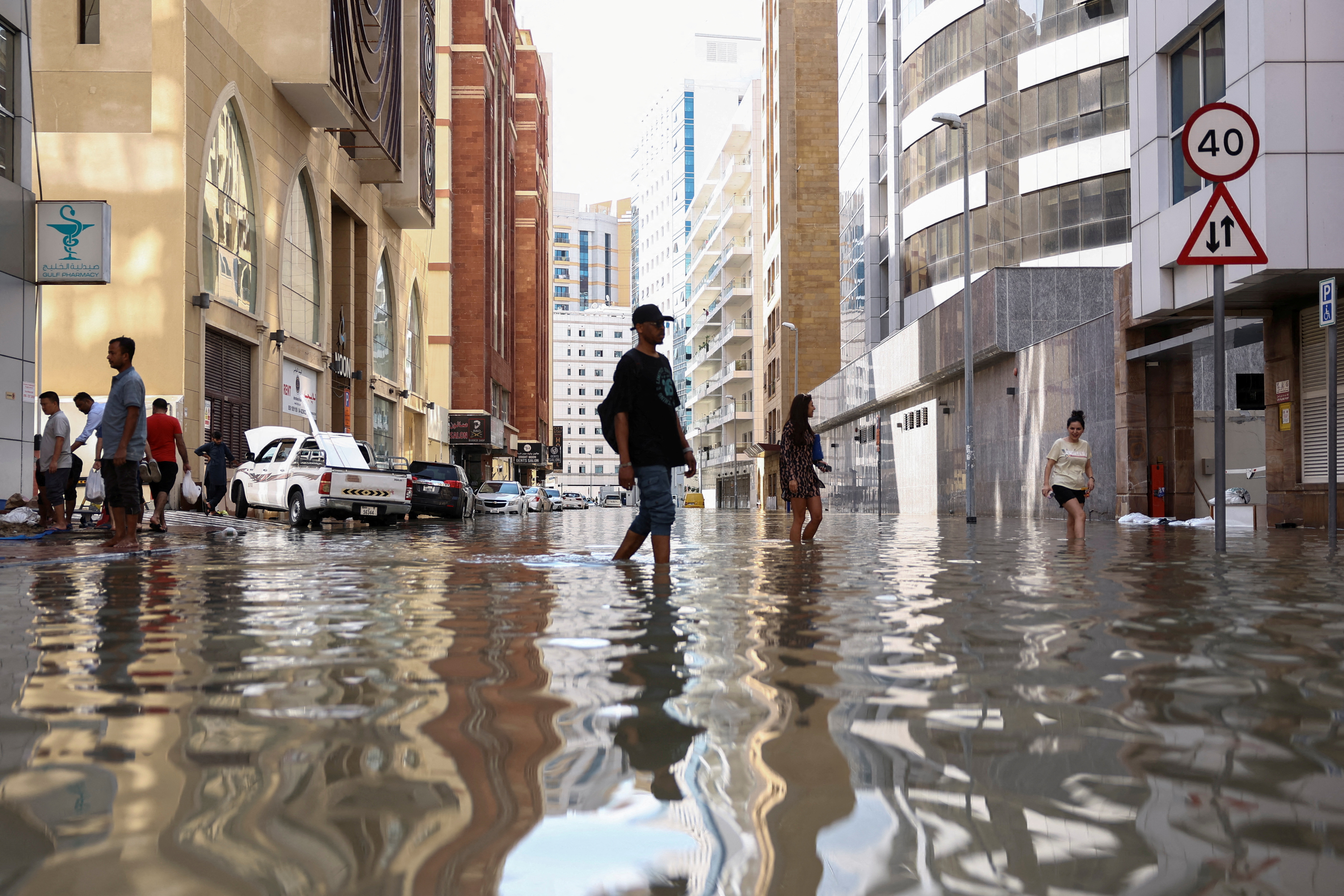
LAS VEGAS: As climate patterns shift and extreme weather events increasingly threaten urban centers across the Middle East, city planners are turning to innovative software to simulate disasters before they strike.New technology, known as advanced catchment modelling, is being used to map the flow of stormwater to help manage potential flooding in urban areas. Speaking to Arab News from the sidelines of Autodesk University 2026 in Las Vegas, stormwater expert Samer Muhandes, a senior product manager for Autodesk InfoWorks ICM, explained the battle against urban flooding was no longer just about reacting to the rain; it is also about accurately forecasting its behavior across vast urban landscapes.“We model the behavior of infrastructure in a city, or even a country, and then we predict what’s going to happen when an extreme event lands on this city,” Muhandes explained.In 2024 a deluge of water fell during storms from April 14–16, bringing record-breaking torrential rainfall and severe flash flooding in the UAE, Oman, and neighboring countries.The UAE recorded its heaviest rainfall in the past 75 years of modern record-keeping, with up to 259.5 mm (over 10 inches) falling in fewer than 24 hours in some areas.Dubai received approximately 1.5 to 2 years’ worth of average rainfall in a single day, causing widespread disruption — not least at Dubai International Airport.And there were human losses, too, with 19 fatalities in Oman due to flash floods before the storm system moved across the Strait of Hormuz into the broader Gulf.
Urban areas across the Gulf face risks of flooding amid heavy rainRainstorms also caused disruption across the region earlier this year.Muhandes said cities and other urban areas in the Gulf now faced a dual threat when intense storms approached: the sheer mass of water and the constraints posed by existing infrastructure.Traditional storm drainage networks struggle under intense, sudden downpours, Muhandes added, pointing out that while the weather remained unpredictable, urban infrastructure was a variable engineers could actively control.“Obviously, the sheer volume of rain that falls in any given moment plays a major factor in the Gulf region,” he said. “Especially because it tends to be hit suddenly by really heavy rainfall (which) then stops. But a lack of adequate draining means the problem doesn’t suddenly go away, causing ongoing disruption.”However, this is something that could be worked on to improve how urban areas cope in the future, by collecting data on where stormwater has built up, how it got there and along which routes.“You can figure out what’s going to happen to a degree, but with all that knowledge, what’s being done?” said Muhandes, adding that engineers were using technology known as time-step forecasting to model real-time scenarios.The software gives municipalities a view on the exact timeline of a storm’s impact, allowing them to pinpoint vulnerability windows, he explained: “So, I can tell you at 6 a.m. what’s going to happen, and 8 p.m. what’s going to happen.”But why is the Gulf suffering from increased risk of flooding? Muhandes says this is due to a combination of factors — not least climate change, which brings higher rainfall, but also the ongoing development of cities, described as “concreting the jungle.”The root cause of accelerating flood risks in rapidly developing regions like Dubai and Saudi Arabia lies in the alteration of the natural landscape. Rapid development replaces arid, absorbent ground with concrete, glass and asphalt which seriously disrupt the natural hydrological cycle.
“If you’re building the desert and you’re adding a lot of residential properties, commercial properties, towers and the rest, you’re urbanizing the area. So, you’re basically converting the sponge into a funnel,” Muhandes warned.This is in stark contrast to how undisturbed nature, where the ecosystem regulates itself, copes with these situations.Muhandes said: “If you go to a national park or to go to the desert ... do you find gullies and pipes looking after the water in some water runoff? No. It’s a sponge, and basically, that is a natural cycle.”The flooding is a result of the “funnel effect,” where water runs as long as the flow remains constant, but overflows when it increases — in the same way that drainage systems become overwhelmedTo combat the funnel effect, engineers are relying on software to calculate the precise lifecycle impact of development. This research is known as detriment and betterment analysis.Before a single foundation is laid, the process of detriment analysis maps the negative hydraulic impact of new construction.Negative hydraulic impact — often referred to as a destructive hydraulic shock or water hammer — causes severe pressure spikes, violent vibrations and mechanical damage in fluid transport and machinery systems.So what is being done to counter this problem?Muhandes says that when developers add residential neighborhoods, commercial towers, and paved roads to the desert, this analysis calculates exactly how much natural water absorption will be lost, where the resulting runoff will accumulate, and how it will strain existing municipal systems.
What the engineers are doing to minimise the flooding impact in ares of Saudi Arabia and UAEIn response, he explains, the betterment analysis is then deployed to design the cure.“It virtually tests proposed infrastructure interventions, such as sustainable drainage systems, diversion tunnels, or massive storage tanks, to verify their effectiveness before capital is deployed,” Muhandes said, adding that this in turn allowed engineers to compare the options available to them to see which configuration yields the best flood reduction.“We can, using our solutions, predict the behavior after the intervention,” he said. “So, we can tell you, if you put a tank downstream and you throw some concrete at the problem, this is gonna happen, but if you approach the problem in a different way, this is what’s going to happen.The behavior of stormwater before and after could then be predicted.Muhandes planning now not only looked at the creation of structures and roads, but also how to prevent — or at least reduce the risk — of serious disruption experienced in previous storms.Examples of some flood prevention work includes introducing factors such as the use of bricks to create a surface on central reservations by roads. The small but multiple gaps between the bricks allow water to drain, but at a more controlled rate.Landscaping projects are also being used for rain runoff and coarse gravel is being used to control the flow of water into the ground, preventing the funnel effect.A lot of technology is being used upfront to combat the issue, but something as simple as planted areas, gravel and bricks could help reduce the risk of flooding in the long run — something especially important in the Gulf, where water is such a valuable resource.Small projects such as capturing rain from the roof of commercial buildings provides enough water to flush toilets, rather than using expensive treated water which goes straight back into the system.
Related Stories
 Technology
Cyprus deep-tech scene tops 150 start
39 minutes ago
 Technology
The Top 7 Debt Recovery Startups To Keep An Eye On
1 hour ago
 Technology
A Niagara construction dynasty just wrote a $1
2 hours ago
 Technology
Jeypore police turn to technology for smarter night patrolling
2 hours ago
 Technology
Exclusive: Ex
3 hours ago
 Technology
Robotics startups are courting university researchers. Microagi just hired eight.
3 hours ago
 Technology
5 CleanTech opportunities European startups should watch in the Republic of Korea (Sponsored)
4 hours ago
 Technology
Two
4 hours ago