
‘Main Vaapas Aaunga’ movie review: Imtiaz Ali’s love story for the ages
A sweeping, bittersweet examination of displacement, Main Vaapas Aaunga is a timely, intimate, poetic character study about how geopolitical lines permanently alter the trajectory of human hearts. Imtiaz Ali’s filmography is built around characters who travel in search of their souls. Here, he evolves from his road movies and, together with co-writer Nayanika Mehtani, grounds this obsession in the tragedy of Partition, turning his lens toward the refugee crisis, where transit is no longer a choice of self-exploration, but a desperate battle for survival.
As always, Imtiaz steers clear of the macro-level politics. He treats Partition not as a grand battlefield, but as a spiritual wound, an abrupt emotional rupture between two specific individuals. Unlike movies that use 1947 to fuel aggressive nationalist sentiments, the film reminds one of the sensitive, humanistic storytelling of Deepa Mehta’s Earth and Chandraprakash Dwivedi’s Pinjar, where the antagonist is not a specific community; it is the chaotic, unfeeling mechanics of history itself. By stripping the rioters of their specific religious identities and comparing them to an alien entity, the script shifts the focus from a familiar, polarising ‘us vs. them’ battle to a broader, existential commentary on the madness of violence and mocks the mechanics of hate.
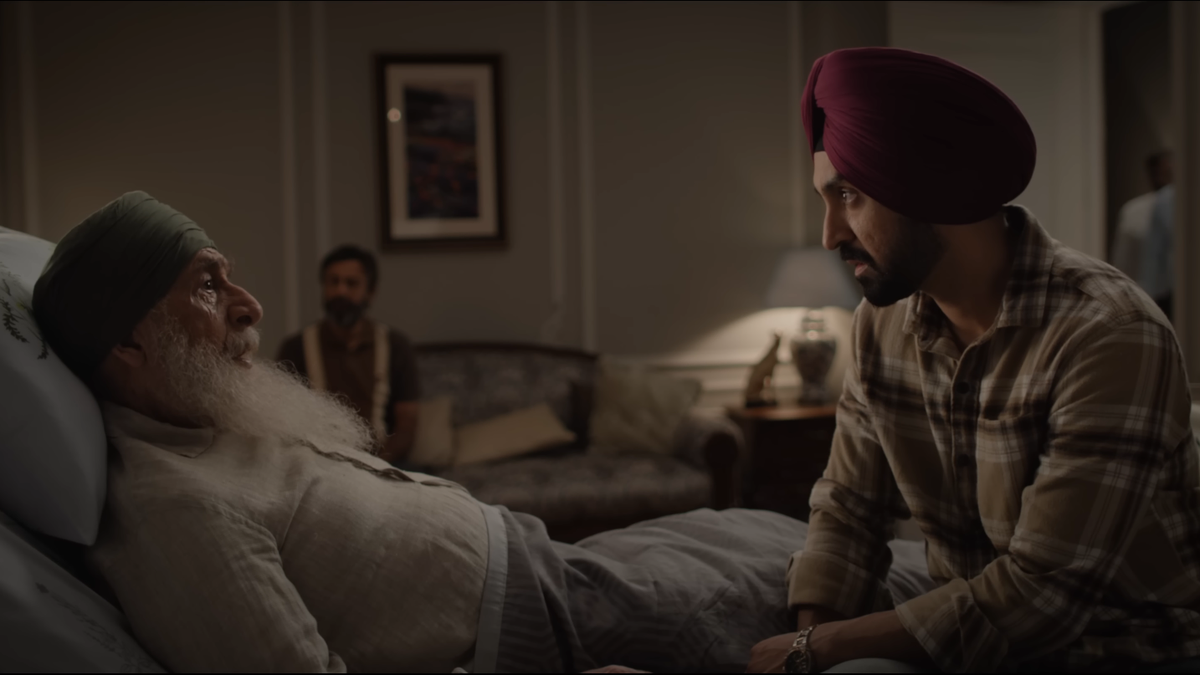
A still from ‘Main Vaapas Aaunga’ | Photo Credit: Special Arrangement
The story revolves around an elderly man named Keenu (Naseeruddin Shah) who is severely ill and on his deathbed after suffering a debilitating stroke. Despite his physical paralysis and failing health, Keenu refuses to let go of life. He remains psychologically trapped in the past, constantly repeating that he must return to his ancestral home in Sargodha, now in Pakistan. In the lexicon of Partition poetry, Sargodha isn’t just a geographical city on a map. Earlier this year, Dharmendra also returned to the city with the memories of Husna in Sriram Raghavan’s Ikkis.
Keenu’s grandson, Nirvair, portrayed by Diljit Dosanjh, who is struggling with his own migrant status in London, steps in as his caregiver. Through the elderly man’s slurred speech, sudden emotional outbursts, and fractured recollections, which also inject a surreal, light-hearted charm that keeps the overarching tragedy from becoming utterly suffocating, the grandson pieces together a 78-year-old secret that the family had buried for generations.
Imtiaz acknowledges the work of The Partition Museum in Amritsar as the film flashes back to undivided Punjab, where a younger, more vibrant Keenu (Vedang Raina) falls passionately in love with Jia (Sharvari Wagh). Their beautiful, old-world courtship — defined by stolen glances, playful conversations, and a promise to always stay together — is violently interrupted by the Radcliffe Line. Keenu is forced to cross into India, carrying nothing but a lifelong promise that he would eventually return to her, a vow that consumes his entire life.
Jia and Keenu live up to Kabir’s credo, “Haman hai ishq mastana, haman ko hoshiyari kya” (We are intoxicated by love, what use do we have for worldly cleverness?), beautifully composed by AR Rahman. Imtiaz invokes Premchand’s moving fable, Duniya Ka Sabse Anmol Ratan, on what constitutes the ultimate sacrifice for freedom and love, and weaves it into his Partition narrative, turning a physical border crisis into a spiritual and philosophical quest. While Premchand’s story focused on nationalistic martyrdom, Ali subverts it to suggest that the most precious thing in the world is the teardrop of a refugee forced to leave their home, or the unwavering memory of an early youth romance that outlives decades of political separation.
Along the way, it questions the older generation’s decision to suppress their historical trauma and drink the poison of Partition in silence. It was meant to be an act of generational protection, but the film shows that trauma cannot be safely buried; it simply mutates. By leaving the history unaddressed, the silence itself becomes a toxic inheritance that leaves the younger generation completely unequipped to face modern-day prejudice.
The creative synergy between Shah and Imtiaz lends the thought a powerful emotional heartbeat. It marks an intersection where the veteran actor’s charming restraint meets the filmmaker’s signature poetic obsession with longing and memories. The film works as a brilliant reclamation of Shah’s dramatic range as his performance transforms what could have been a standard framing device into a profound meditation on old age and lingering grief that tears you up. He reaches out from the deathbed, as if he will literally pull us into the screen with the sheer, unbridled force of his gaze.
At the same time, with stroke diagnoses becoming common and at times a burden for family members, Shah’s soul-stirring turn provides a bridge of empathy, allowing the audience to truly comprehend the silent, frustrating physical and emotional battles our own loved ones endure. As a commitment-phobic tech professional, Diljit serves as a literal surrogate for the modern audience.
Vedang Raina’s performance as the young Keenu suffers from a disconnect in character continuity. The young actor is sincere, a little too earnest, but he struggles to project the inherent gravitas or enigmatic charm needed to make the audience believe this boy will eventually evolve into Naseeruddin Shah’s weathered protagonist. Weeks before turning into Alpha, Sharvari channels the sassy eloquence and playful energy of the classic Imtiaz Ali heroine in a cinematic world guided by Rahman’s melodies and Irshad Kamil’s poetry.
Rahman is shifting his musical axis, fusing his global, synth-heavy soundscape with the raw, untamed heartbeat of Punjab. It is not an easy marriage and at times gives a sense of desperation to fit in, but the friction between Rahman’s clinical precision and Punjab’s bleeding heart is precisely where the magic happens.
Like Dilijit’s performance, the film too occasionally trades subtext for overt messaging; however, though this transparency or flatness irks a bit, after a point, it feels less like a narrative flaw and more like a deliberate, urgent response to our fractured times. In an era dominated by calculated outrage, the film functions as a vital cinematic antidote to rage-baiting, swapping polarising narratives for an empathetic, unifying, and healing prayer.
Main Vaapas Aaunga is currently running in theatres
Related Stories
 World
World
Manchester United weigh up stunning move for Real Betis and ex-Tottenham forward Troy Parrott
1 day ago
 World
World
Israeli police arrest 10 following weekend attacks by settlers on journalist and diplomats
1 day ago
 World
World
Trump says suspension of Russia sanctions is to keep peace negotiations going
1 day ago
 World
World
Ukrainian drones strike St. Petersburg oil facilities | NHK WORLD
1 day ago
 World
World
Victoria Falls stadium in Zimbabwe nears completion for CWC27
1 day ago
 World
World
‘The world will be amazed:’ Iran’s commanders prepare for further war
1 day ago
 World
World
Festival opens with musket salute in Sakai, Osaka
1 day ago
 World
World
Trump's new pitch for Republican candidates — they're really good
1 day ago