
Large Language Models in equity markets: applications, techniques, and insights
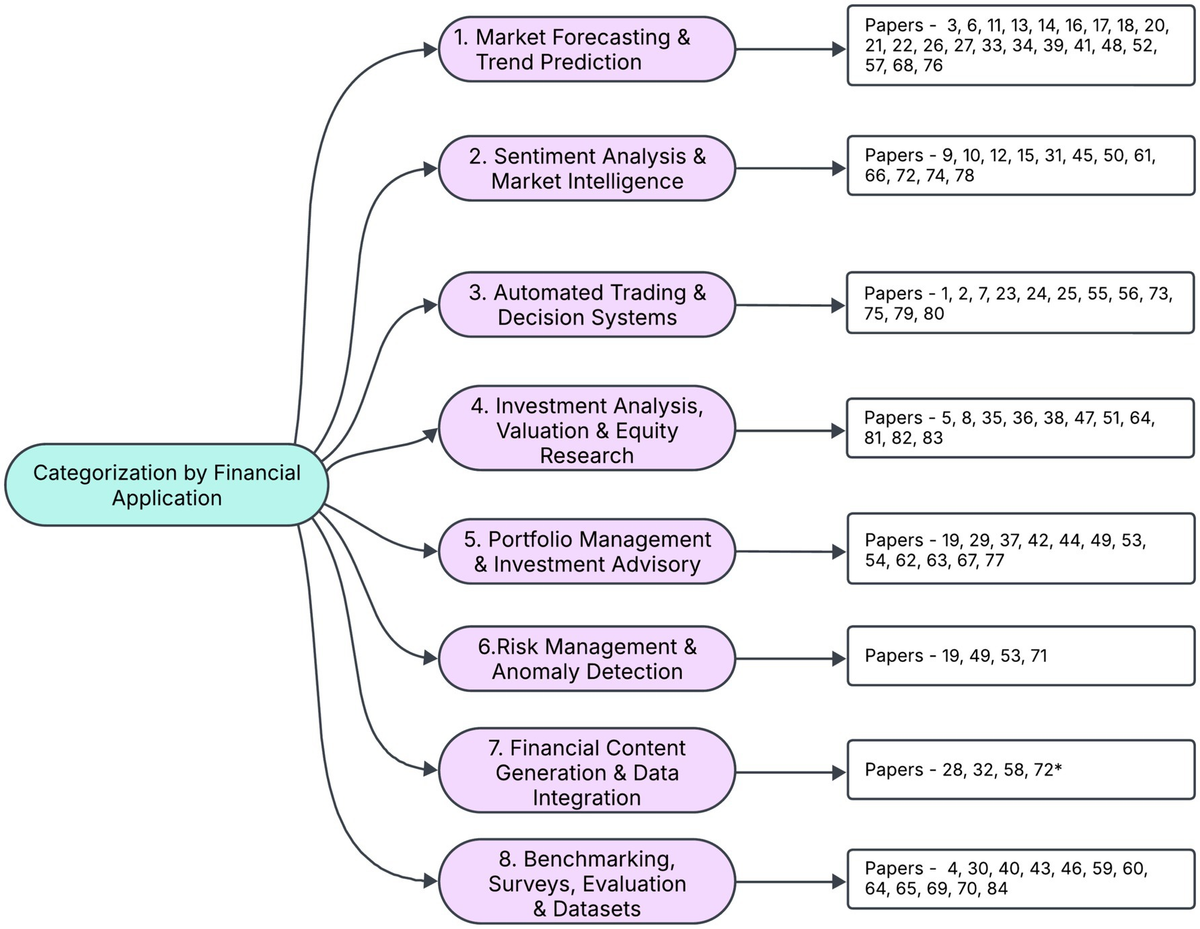
This section presents the key technical innovations underpinning recent research in the application of Large Language Models (LLMs) to Financial Stock Investing. We offer a comprehensive overview of the methodologies employed across these studies, highlighting the diverse techniques and nuanced approaches that drive progress in this field. Figure 2 provides a summary of the categorization of recent research by different approaches for LLMs.
Categorization of research by LLM technique/methodology.
This category includes research that systematically evaluates the performance of LLM-based financial applications through benchmarks, surveys, and evaluation frameworks, providing critical insights into both the capabilities and limitations of current approaches.
Zhao et al. (2024) and Kong et al. (2024) provides a comprehensive overview of how LLMs are being applied in finance.
Bi et al. (2024) surveys how AI—especially ChatGPT—can transform financial forecasting, addressing key challenges such as privacy and ethics.
Kong et al. (2024) reviews the transformation of finance by LLMs, categorizing applications and presenting datasets, benchmarks, and methodologies for future research.
While all three papers provide broad overviews, Zhao et al. (2024) and Kong et al. (2024) offer a general view, Bi et al. (2024) focuses on the potential of a specific LLM, and Kong et al. (2024) provides a structured categorization of the field.
Note that the categorization is not completely mutually exclusive, some papers that fit in two categories are represented in the one category and by an asterisk in the next most relevant category.
Sentiment analysis: Liu et al. (2024) provides a deep dive into the application of LLMs for financial sentiment analysis, using detailed datasets and case studies.
Trading agents: Ding et al. (2024) reviews the landscape of LLM-based trading agents.
The application-specific overviews provide a foundation for more detailed technical evaluation.
Nie et al. (2024) offers an in-depth review of various approaches, detailing progress, prospects, and challenges while classifying applications into linguistic, sentiment, financial, and agent-based tasks.
Li et al. (2024) introduces InvestorBench, a standardized benchmark for evaluating LLM-based agents in financial decision-making across equities, cryptocurrencies, and ETFs, assessing their reasoning and decision-making capabilities using 13 different LLM backbones.
Glasserman and Lin (2023) evaluates both “Look Ahead Bias” and the “distraction effect” by comparing sentiment-driven trading strategies based on original versus anonymized news headlines, using in-sample and out-of-sample tests to isolate and measure these biases.
Yu (2023) presents a case study on US equity market news sentiment analysis revealing significant variability in LLM sentiment classification, highlighting inherent output volatility. This could act as a benchmark reference for future research.
Li et al. (2024) provides a broad benchmark for financial agents, while (Glasserman and Lin, 2023; Yu, 2023) focus on specific aspects of LLM performance, such as bias and output volatility. Glasserman and Lin (2023) and Yu (2023) both use real world data to evaluate LLMs, whereas (Li et al., 2024) builds a benchmark.
The findings from these benchmarking and bias evaluations inform the broader overviews and technical analyses.
Prompting techniques are pivotal in harnessing the capabilities of LLMs for financial applications, enabling precise control over model outputs and facilitating complex reasoning. This section explores various prompting methodologies, demonstrating their impact across diverse financial equity investing tasks, from forecasting to portfolio management.
Paper 5: Uses GPT-4-32k with a diverse set of financial datasets (covering fundamental, market, and news data) and a Retrieval Augmented Generation (RAG)-like strategy to generate multi-horizon equity stock ratings. It employs both zero-shot and few-shot prompting for effective data integration.
Nishida and Utsuro (2025) generates explanatory financial news articles about stock price movements by implementing few-shot learning and contrasting its performance with zero-shot methods.
Pop et al. (2024) enhances stock trend prediction by applying a “denoising-then-voting” technique that combines few-shot learning with in-context prompt engineering.
Mateega et al. (2025) automates the extraction of key elements from equity research reports by combining zero-shot/few-shot prompting with information retrieval.
Chen et al. (2024) investigates ChatGPT’s forecasting tendencies by analyzing its extrapolation behavior, calibration, and inherent biases in predicting historical stock returns using a prompt-based approach.
Lee et al. (n.d.) converts qualitative textual insights into quantitative market prediction scores by leveraging crafted prompts with dynamic few-shot examples.
Swamy et al. (n.d.) extracts quantitative signals from qualitative data—such as moving averages and options volume—using innovative prompting strategies and integrates these signals with traditional quantitative features.
Lefort et al. (2024) classifies financial news sentiment and de-noises aggregated outputs through zero-shot and few-shot prompting, supporting trading decisions on the NASDAQ.
Chen et al. (2024) applies zero-shot classification to analyze over 77 million investor social-media posts, categorizing them into technical versus fundamental analysis and bullish versus bearish sentiment.
Romanko et al. (2023) implements a two-step process where prompting (via zero-shot/few-shot methods) gathers stock suggestions, which are then refined using traditional portfolio optimization techniques (e.g., Markowitz mean–variance optimization).
These papers showcase the versatility of zero-shot and few-shot prompting, varying in their complexity and application. Papasotiriou et al. (2024) and Romanko et al. (2023) utilize RAG and optimization techniques, respectively, to enhance the prompting process, while other papers focus on direct application to sentiment analysis, forecasting, and data extraction.
The effectiveness of these prompting techniques extends to portfolio management, where tailored prompts can guide LLMs in generating and evaluating investment strategies.
Li et al. (2024) leverages zero-shot prompting to generate portfolios and assess asset diversification, comparing the performance of these portfolios against randomly selected ones.
Ko and Lee (2024) uses ChatGPT in a zero-shot setting to produce asset class selections, which are quantitatively evaluated for diversity and performance.
Fieberg et al. (2024) employs structured prompts across 32 different LLMs, each reflecting diverse investor profiles, to generate financial advice that is then evaluated for suitability, performance, and potential bias.
Lu (2025) integrates a ChatGPT-based system—utilizing both zero-shot and few-shot prompting—into a robo-advisor framework to enhance investor understanding of alpha and beta, leading to improved portfolio choices.
Bond et al. (2023) utilizes ChatGPT’s zero-shot NLP capabilities to analyze daily U.S. news summaries and generate a market sentiment indicator for short-term stock return forecasting.
Wang et al. (2023) also covers the development of Alpha-GPT, an interactive system that uses prompt engineering and LLMs to generate creative trading signals, validated through alpha mining experiments.
These papers demonstrate the application of prompting for portfolio management, with variations in the use of zero-shot versus few-shot prompting, as well as the use of LLMs to generate investment advice, and trading signals. Fieberg et al. (2024) and Lu (2025) incorporate the analysis of investor profiles, and educational aspects, whereas the rest of the papers focus on pure portfolio creation and analysis.
Fatouros et al. (2024) uses GPT-4 as both a predictor and signal evaluator for stock selection by analyzing diverse financial data. It employs chain-of-thought and in-context learning techniques to enhance signal accuracy.
Deng et al. (2022) adopts a semi-supervised approach by prompting an LLM with chain-of-thought techniques to generate weak sentiment labels from Reddit posts, which are then distilled into a smaller model using regression loss—achieving performance comparable to supervised methods.
These papers show how chain of thought prompting allows LLMs to create better outputs, by improving the reasoning process. Fatouros et al. (2024) uses it to improve signal accuracy, whereas (Deng et al., 2022) uses it to create better sentiment labels.
Perlin et al. (n.d.) evaluates Google’s Gemini 1.5 Flash LLM for investment decision-making using anonymized U.S. market data. It queries the LLM with prompts that specify investment horizons and relevant financial inputs.
Huang et al. (2024) implements scenario-based iterative prompt engineering to generate stock suggestions. These suggestions are subsequently screened using additional financial algorithms (NBESOA) for optimized portfolio construction.
Lu et al. (2023) uses a prompt-based approach with data feeds from the Wall Street Journal and China State policy datasets to assess the efficacy of ChatGPT in providing financial stock investing recommendations.
Dolphin et al. (2024) by combining LLM generative capabilities with advanced prompting and a validation framework using string similarity, the system extracts granular, per-company insights from news articles, demonstrating high accuracy and providing a live API and dataset for further research.
These papers showcase the use of instruction and context prompting across various applications, from evaluating LLM performance to generating stock suggestions and extracting market insights. Perlin et al. (n.d.) and Lu et al. (2023) focus on evaluation, whereas (Huang et al., 2024; Dolphin et al., 2024) focus on the creation of outputs.
Cheng and Tang (2023) leverages GPT-4 to autonomously generate equity investment factors through knowledge inference without direct data input. It employs prompting strategies that guide GPT-4 in reasoning and generating these factors.
Comparative analysis of LLMs is crucial for understanding their relative strengths and weaknesses in financial equity applications. This section explores studies that benchmark different models across various tasks, highlighting the nuances in their performance and capabilities.
Krause (2023) compares the performance of ChatGPT, Bard, and Bing on various financial tasks—including report/text generation, decision support, summarization, and general NLP—to assess their suitability for financial analysis.
Wu (2024) evaluates and contrasts multiple LLMs (e.g., ChatGPT, Tongyi Qianwen, and Baichuan Intelligence) in generating news-based stock scores and predicting stock market returns.
Shi and Hollifield (2024) assesses the predictive capabilities of GPT against traditional transformer models like BERT using economic data from the Federal Reserve Beige Book, to determine their effectiveness in financial market prediction.
Tandon (2024) systematically reviews and compares various LLM techniques (including BERT and FinBERT) for stock market prediction by analyzing financial news headlines using historical datasets from Kaggle and Yahoo Finance.
Voigt et al. (2024) adapts NLP-centric, Transformer-based architectures for stock price forecasting by leveraging the structural parallels between text sequences and time-series data, with the expectation that models excelling in language processing can capture temporal dependencies in financial markets.
Abdelsamie and Wang (2024) Compares the performance of Quantum, an advanced LLM specialized for financial forecasting, with other general purpose LLMs—GPT-3, GPT-4, FinGPT, and FinBERT and human analysts. Employing a dataset of historical financial data, news headlines, and social media sentiment, the research systematically assesses predictive accuracy, response efficiency, and interpretability across models.
Lopez-Lira and Tang (2023) compares the performance of various GPT models, BERT and Finbert to confirm accuracy and reliability in predicting stock prices based on new headlines while also suggesting an interpretability framework
Kirtac and Germano (2024) covers a comparative analysis of LLMs, including GPT-3-based OPT model, BERT, and FinBERT, alongside traditional methods for financial news sentiment analysis, demonstrating that OPT significantly outperforms others in predicting stock market returns and generating substantial trading profits.
These papers vary in their scope and focus, from comparing general-purpose LLMs across diverse tasks (Krause, 2023; Wu, 2024) to evaluating specialized financial LLMs against human analysts and traditional models (Abdelsamie and Wang, 2024; Kirtac and Germano, 2024). Shi and Hollifield (2024), Tandon (2024) and Voigt et al. (2024) focus on comparing LLMs against traditional transformer models. Lopez-Lira and Tang (2023) adds the dimension of interpretability. The evaluations vary in the data used, and the metrics used.
The findings from these comparative studies inform the development of more effective prompting techniques and the selection of appropriate models for specific financial investing tasks.
Finetuning plays a critical role in adapting Large Language Models (LLMs) to the specific demands of financial stock investing tasks, enabling them to capture nuanced patterns and generate accurate predictions. This section reviews various finetuning methods used to adapt Large Language Models to financial tasks, ranging from instruction tuning to parameter-efficient finetuning and knowledge distillation.
Guo and Hauptmann (2024) fine-tunes LLMs for stock return forecasting, integrating and comparing token-level embeddings from different LLM architectures.
Valeyre and Aboura (2024) evaluates the Chronos model for time series prediction in financial markets by testing both its pre-trained and fine-tuned configurations using supervised forecasting.
Aparicio et al. (2024) adapts BioBERT to the financial domain by fine-tuning it on curated financial textual databases, enabling sentiment analysis of press releases and financial texts around key biotech stock inflection points.
Wang et al. (2024) this research developed InvestAlign, a method that constructs supervised fine-tuning training datasets for LLMs using theoretical solutions from simplified investment problems, rather than costly and privacy-sensitive real-user data, to better align LLM investment decisions with human investor behavior.
These papers demonstrate various approaches to domain adaptation, ranging from fine-tuning for specific prediction tasks (Guo and Hauptmann, 2024; Valeyre and Aboura, 2024) to adapting models from other domains (Aparicio et al., 2024) and creating synthetic datasets for finetuning (Wang et al., 2024). The data used, and the model architectures adapted vary significantly.
Instruction finetuning builds upon domain adaptation by incorporating specific instructions to guide the model’s learning.
Liang et al. (2024) constructs an instruction tuning dataset using a multi-step process—clustering company-related news to capture dissemination influence, enriching prompts with context and explicit instructions, and then fine-tuning the LLM—to enhance sentiment-based stock movement prediction.
PEFT aims to reduce the computational and memory costs associated with finetuning large models
Konstantinidis et al. (2024) implements LoRA fine-tuning on Llama 2 7B within a generator-classifier architecture for efficient financial sentiment analysis. [Custom Architecture]
Liu et al. (2023) introduces FinGPT, an open-sourced framework that automates real-time financial data collection and adapts general-purpose LLMs for applications like robo-advising and sentiment analysis using LoRA/QLoRA fine-tuning, coupled with reinforcement learning (RLSP). [Reinforcement Learning]
Konstantinidis et al. (2024) and Liu et al. (2023) both utilize LoRA finetuning, but they differ in their architectures and applications. Konstantinidis et al. (2024) uses LoRA within a custom architecture, whereas (Liu et al., 2023) uses LoRA within its open-source framework, and also in conjunction with reinforcement learning.
Combining instruction finetuning with parameter-efficient techniques allows for both task-specific adaptation and computational efficiency.
Ni et al. (2024) employs a QLoRA-enhanced instruction fine-tuning strategy that combines base and external factors for improved stock prediction following earnings reports.
Li et al. (2023) leverages both unsupervised and supervised LoRA on Llama2 alongside instruction fine-tuning on GPT3.5 to automate summarization and idea generation from diverse financial texts, thereby enhancing fundamental investment research.
Reinforcement learning can be integrated with instruction finetuning to further refine model performance based on real-world feedback
Zhao and Welsch (2024) includes finetuning of LLaMA 2 model with instruction tuning to incorporate human instructions. Additionally, reinforcement learning (RL) is used to incorporate stock market feedback by dynamically adjusting knowledge source weights within a RAG module, improving financial sentiment analysis and stock price movement prediction.
Finetuning can also be used to enhance embedding generation for predictive modeling.
Chen et al. (2022) utilizes LLMs (e.g., ChatGPT and LLaMA) to extract contextualized representations from news text for predicting expected stock returns. The study demonstrates that LLM-based predictions, which capture broader article context and complex narratives, significantly outperform traditional technical signals across multiple global equity markets.
Das et al. (2024) combines financial textual data (news and sentiment) with price signals by leveraging large pretrained models (e.g., LLaMA-2-13B, Mistral, Gemma). These models are further fine-tuned or prompted in a zero−/few-shot manner to generate automated trading actions, facilitating effective knowledge transfer.
Agent-based systems have the potential to transform financial stock and equity investing by automating complex decision-making processes. This section reviews various agentic applications, from single-agent solutions to sophisticated multi-agent frameworks, highlighting their diverse approaches and impacts. Research on agent-based frameworks in financial stock and equity investing is still emerging, with only 20 of the 84 reviewed papers focusing on agent systems. (Note: Ding et al. (2024) is a survey and is covered in Section 3.1.1.).
Yue and Au (2023) GPTQuant uses prompt templates and LangChain to create a conversational AI agent that generates Python code for investment research, streamlining the analysis process.
Koa et al. (2024) covers the development of a Summarize-Explain-Predict (SEP) framework, which utilizes a self-reflective agent and Proximal Policy Optimization (PPO) to train an LLM to autonomously generate explainable stock predictions, achieving superior performance in both prediction accuracy and portfolio construction.
Multi-agent systems expand on these single-agent capabilities by coordinating multiple agents to perform complex tasks
Zhou et al. (2024) utilizes a multi-agent CoT system to automate equity research and valuation by combining quantitative and qualitative analysis. It dynamically updates its data using three specialized agents (Data CoT, Concept CoT, and Thesis CoT) that emulate human analyst reasoning, resulting in high-quality, timely research.
Wang et al. (2024) to understand LLM’s reasoning approach for trading decision, study introduce FS-ReasoningAgent, a multi-agent framework that separates reasoning into factual and subjective components, demonstrating enhanced LLM trading performance and showing that subjective news drives returns in bull markets, while factual data performs better in bear markets.
Zhou et al. (2024) and Wang et al. (2024) both employ multi-agent CoT systems, but they focus on different aspects of financial investing. Zhou et al. (2024) automates equity research, while (Wang et al., 2024) analyzes the impact of factual versus subjective news on trading decisions.
Coordinated networks further enhance multi-agent systems by enabling complex interactions and adaptive decision-making.
Kou et al. (2024) proposes a multi-step framework where LLMs extract alpha factors from multimodal financial data. These factors are integrated into a multi-agent system with dynamic weight-gating to produce an adaptive composite alpha formula for enhanced portfolio management.
Zhang et al. (2024) introduces a multi-agent system, “StockAgent,” which simulates investor trading behavior in a realistic market environment. Agents make trading decisions based on various external factors.
Park (2024) presents a multi-agent framework for anomaly detection in financial markets. It employs specialized agents for data conversion, expert web analysis, institutional knowledge application, cross-checking, and report consolidation, thereby automating anomaly alert validation in the S&P 500, reducing manual verification.
Xiao et al. (2024) deploys a multi-agent framework (TradingAgents) that simulates a trading firm by assigning roles such as fundamental, sentiment, and technical analysts, along with risk management agents. These agents collaboratively debate and synthesize diverse analyses and historical data to inform trading decisions, outperforming baseline models on key metrics
Fatemi and Hu (2024) develops a multi-agent system (FinVision) that analyzes diverse multimodal financial data (including text and charts) using a “reflection module” that reviews past trading signals—especially visual cues—to improve stock market predictions.
Xing (2024) proposes a heterogeneous LLM agent framework for financial sentiment analysis, where specialized agents collaboratively discuss identified error types to improve accuracy without additional fine-tuning.
Yang et al. (2024) presents an open-source multi-agent platform (FinRobot) for financial tasks that employs a layered architecture. It leverages Financial Chain-of-Thought to decompose complex problems, dynamically selects LLM strategies, and integrates diverse models through LLMOps and DataOps.
Yang et al. (2025) presents TwinMarket (a multi agent framework) that simulates individual behaviors and interactions to demonstrate how they lead to collective dynamics and emergent phenomena, such as financial bubbles and recessions, within a simulated stock market.
Li et al. (2023) TradingGPT (single and multi-agent system) utilizes three memory layers with custom decay mechanisms, inter-agent debate, and individualized trading traits to enable agents to effectively integrate historical data and real-time market signals for enhanced trading decisions. Note the layered memory also fits in custom architecture
These papers showcase diverse approaches to multi-agent systems with coordinated networks, ranging from alpha factor extraction (Kou et al., 2024) to anomaly detection (Park, 2024) and trading simulation (Zhang et al., 2024; Xiao et al., 2024; Fatemi and Hu, 2024; Yang et al., 2025; Li et al., 2023). The complexity of the systems, and the tasks performed vary significantly. Xing (2024) and Yang et al. (2024) focus on frameworks, whereas the rest focus on applications.
Reinforcement learning can further enhance multi-agent systems by enabling agents to learn from experience and adapt to changing market conditions.
Yu et al. (2024) introduces FinCon, a hierarchical multi-agent system modeled after real-world investment firms. It employs a “conceptual verbal reinforcement” mechanism where agents self-critique and update their investment beliefs to guide future actions, thereby improving performance and reducing unnecessary communication.
Yu et al. (2023) presents FinMem a multi-agent architecture that incorporates three core modules: Profiling for agent customization, a layered Memory module that emulates human trader cognition for efficient hierarchical data assimilation, and Decision-making to translate insights into investment actions; this design allows the agent to self-evolve, adapt to market cues, and surpass human perceptual limits, resulting in improved trading performance.
Li et al. (2024) CryptoTrade, incorporates a reflective mechanism to analyze prior trading outcomes and refine daily decisions, demonstrating superior performance compared to traditional strategies and time-series baselines across various cryptocurrencies and market conditions.
These papers demonstrate the use of reinforcement learning in multi-agent systems, with variations in the reinforcement mechanisms and applications. Yu et al. (2024) uses a conceptual verbal reinforcement mechanism, whereas (Yu et al., 2023) focuses on a multi module architecture, and (Li et al., 2024) uses a reflective mechanism.
Custom architectures are pivotal in pushing the boundaries of LLM applications in finance, enabling the development of specialized models that address unique challenges. This section explores a variety of innovative architectural approaches, from knowledge distillation to hybrid and multi-modal frameworks. Please note multi-agent architectures are covered explicitly in the section 3.5—Agentic Applications.
Knowledge distillation includes the transfer knowledge from a large “teacher” model to a smaller “student” model.
Bhat (n.d.) employs a computationally efficient distilled LLM to extract emotional tone and intensity from financial news headlines. The distilled model’s outputs are fed into classification algorithms for predicting stock price direction, demonstrating that emotion analysis alone can rival the performance of traditional financial data methods.
Transfer learning and foundation models extend this concept by leveraging pre-trained knowledge for broader applications. Guo and Shum (2024) demonstrates the power of transfer learning and foundation models in capturing universal market patterns.
Guo and Shum (2024) utilizes a novel LLM structure designed for large-scale investment applications. The model, termed Large Investment Model (LIM), employs a “foundation model” approach by training on vast financial datasets to learn universal market patterns, which are then transferred via transfer learning to develop specialized and efficient investment strategies for various financial tasks.
Retrieval-augmented and agent-based architectures further enhance LLM capabilities by integrating external knowledge and dynamic interactions.
Fatouros et al. (2025) introduces MarketSenseAI 2.0, which combines Retrieval-Augmented Generation (RAG) with LLM agents for comprehensive stock analysis and selection. This framework processes diverse data types—including financial news, historical prices, company fundamentals, and macroeconomic indicators—with RAG handling SEC filings, earnings calls, and institutional reports. Empirical results on S&P 100 stocks (2023–2024) indicate cumulative returns of 125.9% versus an index return of 73.5%.
Kim and Oh (n.d.) presents an integrated system that fuses RAG with LangChain to dynamically retrieve and synthesize external financial data, producing real-time, contextually enriched stock analysis reports.
Fatouros et al. (2025) and Kim and Oh (n.d.) both use RAG, but (Fatouros et al., 2025) uses RAG in combination with LLM agents.
Time series and temporal reasoning architectures complement other forms by focusing on the temporal dynamics of financial data.
Wang et al. (2024) proposes StockTime, a specialized LLM architecture designed explicitly for stock price time series data. By treating stock prices as consecutive tokens, StockTime extracts textual information (e.g., correlations, trends, timestamps) and integrates this with time series data into an embedding space. This multimodal fusion yields more accurate predictions while reducing memory usage and runtime costs.
Koa et al. (2024) introduces Temporal Relational Reasoning (TRR), a framework that combines LLM-based zero-shot text interpretation with cognitively inspired components (memory, attention, reasoning) to track and aggregate news impacts over time. This structured approach improves detection of impending portfolio crashes by modeling temporal relationships among events and stocks.
Wang et al. (2024) and Koa et al. (2024) both address temporal reasoning, but they differ in their approaches. Wang et al. (2024) focuses on treating time series data as tokens, while (Koa et al., 2024) integrates cognitive components.
Hybrid and multi-modal frameworks integrate diverse data types and models to capture complex market relationships.
Di et al. (2024) proposes a custom architecture for securities index prediction that integrates LLM-driven knowledge extraction with a heterogeneous graph and a Graph Neural Network (GNN) to capture complex market relationships.
Tong et al. (2024) presents a novel, integrated two-part framework (Ploutos) that combines specialized experts for multi-modal data analysis with tailored prompting and dynamic token weighting to enhance interpretability in stock movement prediction.
Ding et al. (2023) introduces a novel framework that combines a Local–Global model for integrating stock features with LLM-derived semantic information and employs self-correlated reinforcement learning to align these embeddings within a shared semantic space.
These papers showcase diverse hybrid and multi-modal frameworks, combining various techniques to capture complex market relationships. Di et al. (2024), Tong et al. (2024) and Ding et al. (2023) all use different methods to combine different data types and models.
Retrieval-Augmented Generation (RAG) in stock investing enables LLMs to provide more accurate and contextually relevant financial insights by dynamically retrieving and incorporating up-to-date information from diverse sources like news articles, financial reports, and market data.
We observe that only a few papers out of the 84 research papers incorporate RAG in some form, with just two using it as the primary technique.
Li et al. (2024) introduces AlphaFin, a data set combining traditional research datasets, real-time financial data, and handwritten chain-of-thought (CoT) data to address the limitation of limited financial training dataset availability. Further they introduce a RAG based, two phased framework (StockChain) for financial analysis.
Several papers incorporate RAG with diverse techniques. Papers (Papasotiriou et al., 2024; Romanko et al., 2023) combine RAG with zero-shot and few-shot prompting; Papers (Kim and Oh, n.d.; Fatouros et al., 2025) utilize RAG with agents and (Zhao, 2024) integrates RAG with reinforcement learning while (Zhao and Welsch, 2024) uses RAG in combination with reinforcement learning and instruction tuning.
This section examines the integration of Reinforcement Learning (RL) with Large Language Models (LLMs) to advance financial trading. Recent studies demonstrate RL’s efficacy in enabling LLM-driven adaptive strategies, particularly in achieving regime-adaptive execution, enhancing the explainability of trading decisions, and improving portfolio performance across volatile market conditions.
Saqur and Rudzicz (2024) Leverages Reinforcement Learning from Market Feedback (RLMF), a regime-adaptive market execution method, to dynamically adjust LLM behavior in real-time. This model-agnostic approach, demonstrated with Llama-2 7B, utilizes intrinsic market rewards and a teacher-student dual-phase pipeline (iterative train and execute cycles) to improve predictive accuracy by 15% over models like GPT-4o, effectively circumventing the need for human-labeled data. This highlights a trend in utilizing RL to reduce reliance on extensive human-labeled datasets.
Gu et al. (2024) presents a framework that fuses LLMs with Reinforcement Learning for margin trading. The LLM system analyzes diverse financial data to produce market forecasts with explainable reasoning, which are then integrated with RL to dynamically adjust trading positions, significantly boosting returns and Sharpe ratios while enhancing transparency in portfolio management.
Zhao (2024) introduces the Hierarchical Reinforced Trader (HRT), an adaptive Retrieval-Augmented Generation (RAG) framework for LLMs, employing bi-level Deep Reinforcement Learning (DRL) and an enhanced Univariate Flagging Algorithm (UFA) for model interpretability. This framework demonstrates significant improvements in portfolio performance and risk management across diverse market conditions. Portfolio comparisons to the S&P 500 reveal favorable results in both bull and bear/volatile market scenarios.
Embedding-based methods leverage the semantic understanding capabilities of Large Language Models (LLMs) to transform textual financial data into dense vector representations. This section explores recent applications of LLM embeddings in financial analysis, focusing on their use in stock prediction and communication evaluation.
Chen et al. (2022) utilizes state-of-the-art LLMs (e.g., ChatGPT, LLaMA) to extract contextualized embeddings from news articles. These embeddings capture nuanced language features—such as negation and complex narratives—and are used as input features to predict stock returns, outperforming traditional technical signals and simpler NLP methods across diverse global equity markets.
Chiang et al. (2025) leverages LLM-based vector embeddings derived from 192,000 earnings call transcripts to quantify the semantic alignment and relevance of Q&A segments, providing a novel metric for evaluating investor communication effectiveness. This method allows for a deeper understanding of the relationship between the questions asked, and the answers given, in earnings calls.
Related Stories
 AI News
ITU WTPF
21 minutes ago
 AI News
Chemistry is changing the way researchers develop AI technology
21 minutes ago
 AI News
AI
21 minutes ago
 AI News
World Plunged Into Chaos as ChatGPT, Claude, and Grok Suddenly Go Down Simultaneously: "Finally I Can See the Sun!"
21 minutes ago
 AI News
Exploring AI’s influence on market dynamics
1 hour ago
 AI News
Exclusive: German AI startup Atira raises $17.5 million to unclog the paperwork bottleneck in industrial dealmaking
2 hours ago
 AI News
Artificial Intelligence (AI)
2 hours ago
 AI News
Artificial Intelligence improves MALDI-TOF identification of bacteria and viruses
2 hours ago